
AIPOCH Open-Science
Organize projects, run analyses, and inspect outputs.
Orchestrate end-to-end scientific workflows with agents, tools, and data connectors in one place.
System roleWorkbench · Orchestrator
AIPOCH Open-Science is an open-source, local-first AI research workbench. It combines agent workflows, Python and R execution, scientific data connectors, and traceable artifacts. Share selected research records as a .science package for review, handoff, or archiving.
 GPT
 Claude
 Grok
 DeepSeek
 Qwen
 GLM
 Kimi
 MiniMax
 StepFun
Product tour / Video
Find installation steps, project setup, workspace guides, and troubleshooting. Check the documented version when following instructions.
Ecosystem / signal flow
Open-Science runs and documents the work. Medical Research Skills provide vetted domain methods, and MedSkillAudit checks each skill before release.
Organize projects, run analyses, and inspect outputs.
Orchestrate end-to-end scientific workflows with agents, tools, and data connectors in one place.
System roleWorkbench · Orchestrator

Domain knowledge and execution logic.
Access 550+ vetted medical research skills covering analysis, reporting, data ops, and study operations.
Skill library597 skills
Loading stars
Audited release-ready before deployment.
Validate skills for safety, correctness, and reliability with automated and human-in-the-loop review.
Release gatePass / Reject
Find installation steps, project setup, workspace guides, and troubleshooting. Check the documented version when following instructions.
Open the Wiki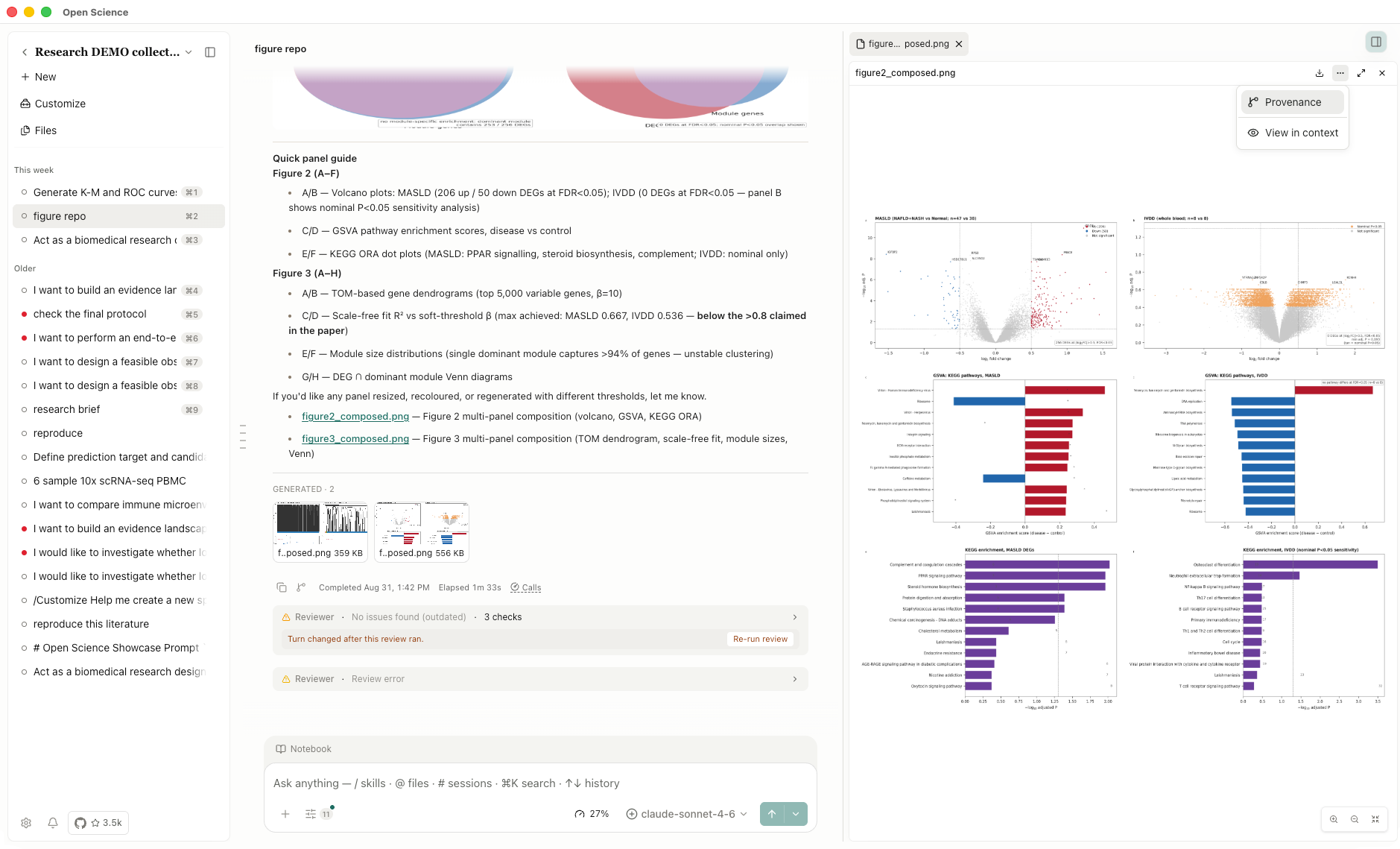
AIPOCH Open-Science v1.2.2 updates
Opt in to a Strict whitelist for Notebook networking — requests must match your rules by protocol, host, and port; unmatched requests are blocked without an authorization prompt.
Interrupted research-film generation continues from validated checkpoints with a five-step progress view; completed scenes and narration are reused.
External PDFs keep native figures, tables, captions, and reading order, and translated documents preserve the original structure and layout.
Folder grants in protected mode are checked before saving, and update, uninstall, and handoff flows recover more reliably with diagnostics preserved.
Qwen4 Max Preview joins Bailian Token Plans in Beijing and Singapore, and default models for official connections are refreshed.
Articles & guides
Product overview
The Workbench / Workflow
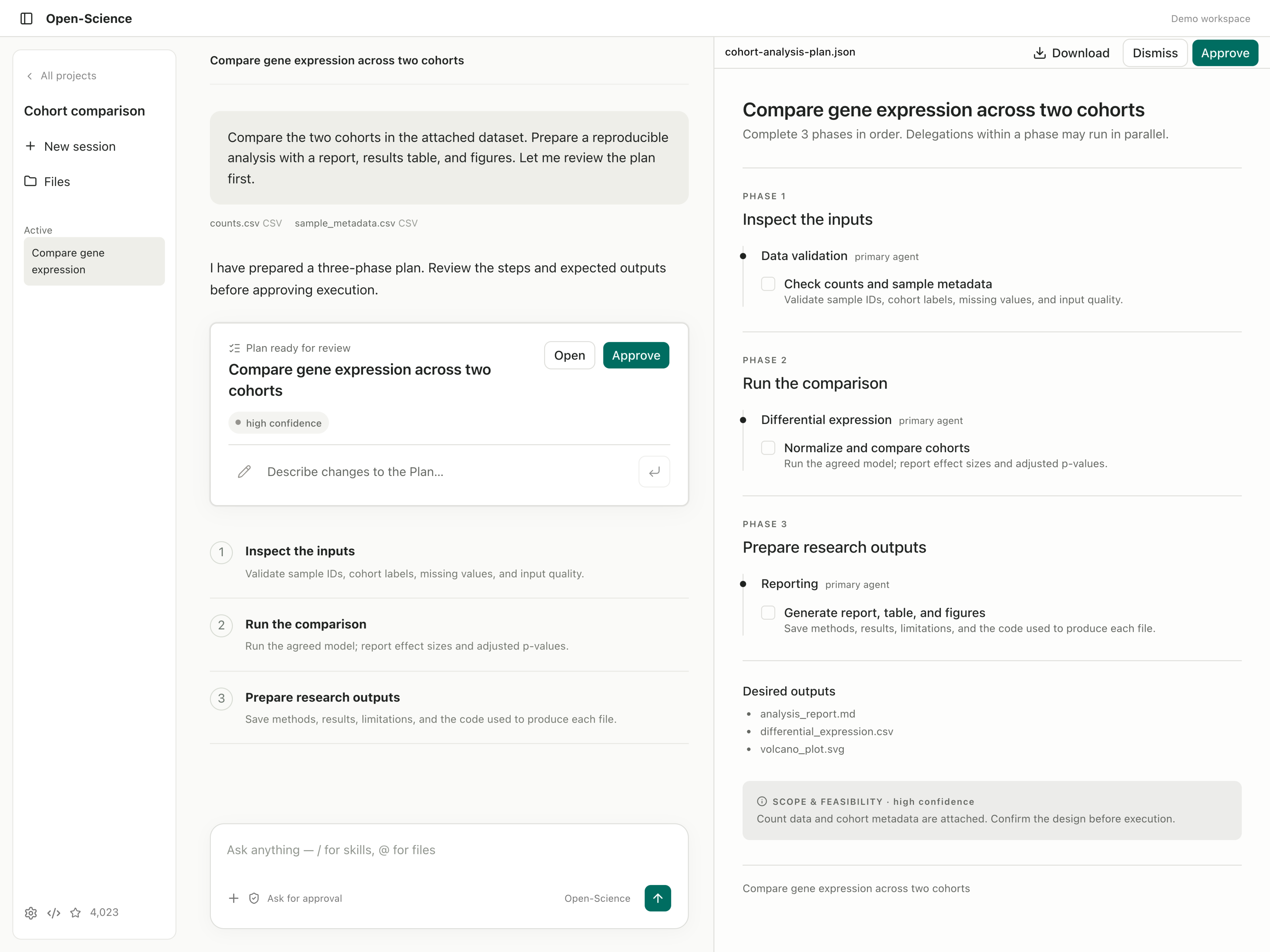
Create a project, add your research files, and describe the task. Use AI agents to run analysis and create reports, tables, and figures, then inspect the outputs alongside available execution records and provenance.
Use Plan first to review the proposed methods, inputs, and outputs before execution. Plan approval and tool permissions are separate controls.
Learn moreRun commands, Python, R, searches, and connectors in one persistent workspace. Operations follow the active approval mode, remembered grants, and resource permissions.
Learn moreTurn the work into reports, tables, figures, and structured outputs while preserving the evidence and steps behind every result.
Learn moreOpen every result in place. Inspect data, documents, images, source, structures, and notebook output before you approve or share it.
Learn more
Agent Skills / The library
597 skills
Browse AIPOCH skills for literature review, study planning, data analysis, and academic writing. Each skill packages instructions and supporting resources for a specific task. Check its requirements and any available evaluation results before use.
01

Search, assess, and synthesize research evidence.
02

Plan study methods, endpoints, and analyses.
03

Prepare data, run analyses, and inspect results.
04

Draft manuscripts, methods, and figure descriptions for researcher review.
Benchmark / Release gate
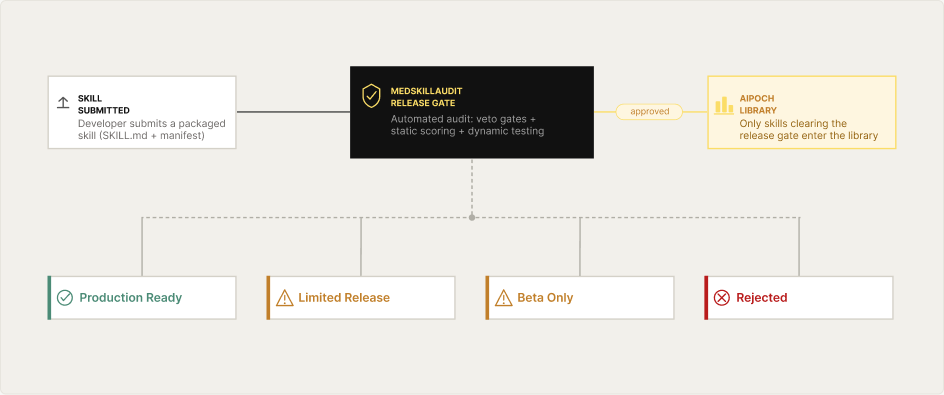
MedSkillAudit is a domain-specific audit framework to evaluate whether a medical research agent skill is ready for release before deployment. It combines two hard veto gates with a two-layer scoring system: static design evaluation and dynamic task-based testing.

No fabricated citations, DOIs, sample sizes, or p-values. Enforced as a hard veto gate — one FAIL means rejection, regardless of the numeric score. Applies to research skills in categories 1–4.

Core results must stay reproducible: no unseeded random-number calls, no unbounded loops, and generated code that runs with its declared dependencies. Each audit runs 3, 5 or 7 test inputs, scaled to assessed complexity.

No logical fallacies such as conflating correlation with causation; statistical methods and study-design choices must be valid and defensible for the stated task. Also a hard veto gate — one FAIL means rejection, regardless of score.
 Claude Code
 Codex
 OpenCode