Open Science v0.13.1 adds local folder access, connector recovery, bounded REPL inference, artifact lineage, and notebook artifact reads, plus hardened database migrations and workspace fixes.
Open Science is an open-source, local-first, model-agnostic, self-hosted AI research workbench from AIPOCH. It pairs a plan-and-execute agent with persistent compute, durable project and session storage, and inspectable research artifacts. This patch follows the v0.13.0 release and focuses on giving the agent safer ways to read local context, recover from connection problems, and answer provenance questions from inside a session.
Watch the release notes video here:
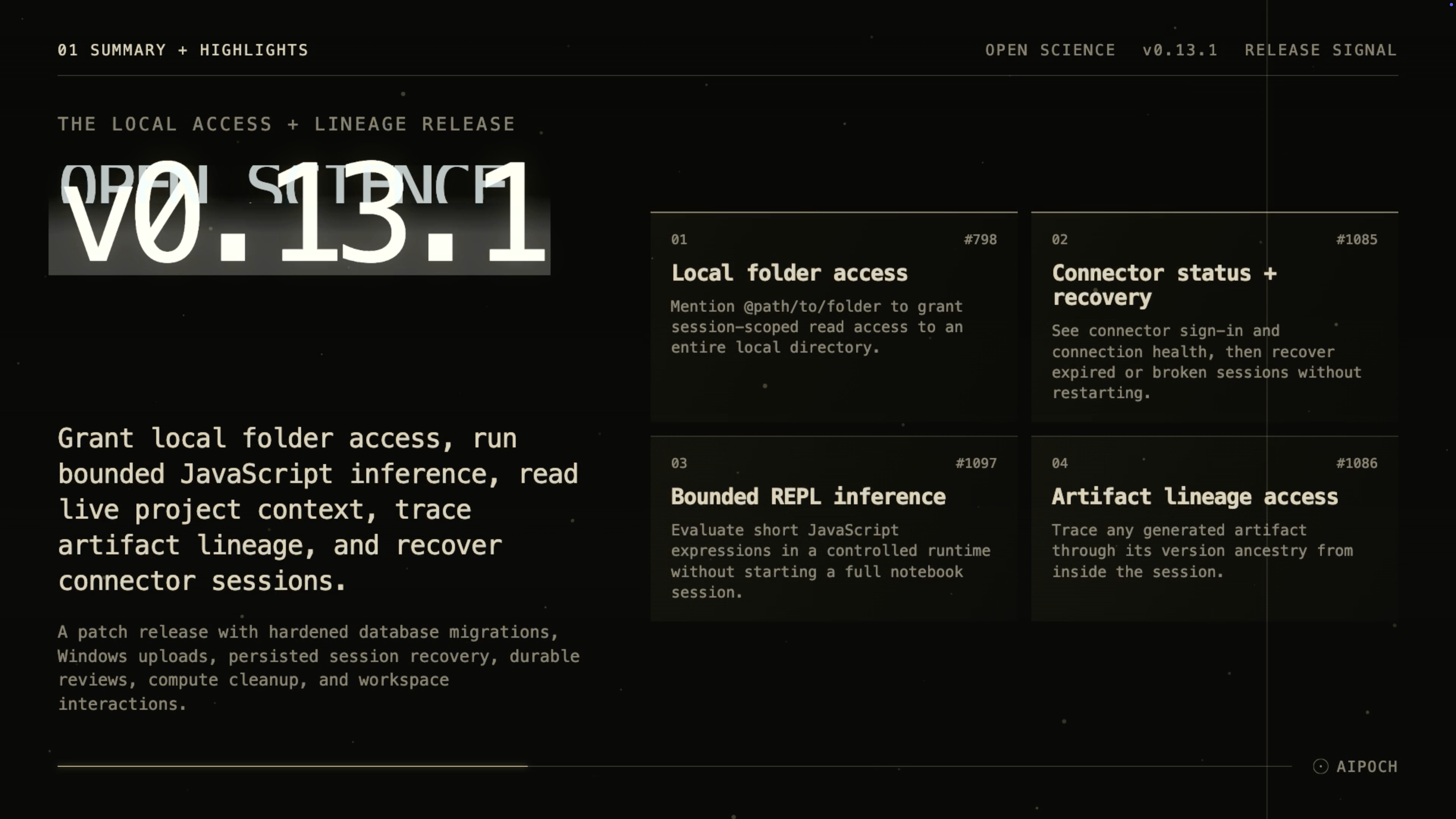
What new capabilities help researchers work with files, connectors, and provenance?
Local folder access with @path mentions
Researchers can now type @path/to/folder in the composer to grant the agent read access to an entire local directory without attaching each file individually. The granted folder is scoped to the session, so the agent can browse its contents for the duration of the task. This reduces friction when a project already lives on disk and you want the agent to discover relevant inputs on its own.
Connector runtime status and recovery
Connector sign-in state, connection health, and recovery flows are now surfaced in the workspace. When a scientific connector session expires or breaks, the failure is visible immediately and can be re-established without restarting the app. This keeps external data sources usable during long research sessions and reduces silent disconnects. (#1085)
Bounded REPL inference
The agent can evaluate short JavaScript expressions in a bounded runtime to test hypotheses, transform small data structures, or verify logic inline — without spinning up a full notebook session. The REPL is restricted to short expressions, so it supports quick checks rather than replacing the persistent Python or R execution environment.
Artifact lineage access
The agent can trace the ancestry of any generated artifact version, walking back through the chain of versions that produced it. This makes it possible to ask how a result was derived and what preceded it without leaving the conversation. Lineage complements the existing artifact version and provenance view by exposing ancestry from within a session.
What else is new in v0.13.1?
Project-scoped frame reads
The agent can now read the live project context — open sessions, active configuration, and current workspace state — during a turn. This gives responses that account for the project you are actually working in rather than treating each message as an isolated prompt.
Refined session sidebar rows
Session sidebar rows have been refined with a cleaner layout and clearer status indicators for active, pending, and completed sessions. The change makes it easier to scan the workspace when several sessions are running or waiting for input. (#1081)
Project actions and agent context
The session sidebar now surfaces project-level actions and agent context information. Common operations are reachable more quickly, and the active agent's configuration is visible at a glance. (#1067)
Notebook artifact read access
The agent can read artifacts generated by the notebook runtime directly, closing the loop between code execution and artifact inspection. A figure or table produced by a Python or R cell is now available to the agent without a separate file-read step. (#1076)
What has improved under the hood?
- Database migrations are versioned in CI. Every schema migration step is now tracked in the continuous integration pipeline, so ad-hoc schema changes are caught before they reach a release.
- Cross-platform CI runner contention has been reduced. PR-gate throughput and stability improved after addressing contention among runners.
Bug fixes that affect daily use
Bug Fixes
- Connector-managed login recovery preserved — connector sessions using connector-managed OAuth could lose their recovery state on restart, leaving the user unable to reconnect without removing and re-adding the connector. The recovery flow now preserves the managed login state correctly.
- Custom skills exposed across agents — custom (personal) skills were not being exposed to all agent frameworks, so a skill created or imported under one backend could be invisible under another. Skills are now consistently available across agents.
- Versioned database migration startup gate — the app now validates that all required database migrations have been applied before startup, blocking launch with a clear message if a migration is missing rather than failing later with an opaque error.
- Legacy check-constraint compatibility — databases created under an earlier schema with equivalent but differently named check constraints were being rejected by migration validation. The validator now accepts equivalent legacy constraints.
- Pre-migration recovery preserved — recovery data captured before a migration could be lost when the migration ran, leaving sessions without their pre-migration state. The migration now preserves recovery records.
- Windows atomic upload publication repaired — the atomic publication path on Windows could fail under certain filesystem locking conditions, leaving an upload in a partially published state. The publication path is now repaired and robust against these conditions.
- Unavailable persisted Codex sessions recovered — Codex sessions persisted in a state that the runtime could not restore were silently dropped on load. These sessions are now recovered with their conversation history intact.
- Review suspension durable across transport loss — a session-plan review suspension could be lost if the transport connection between the agent and the app dropped, causing the plan to resume without the intended review pause. The suspension is now persisted durably.
- Provenance and pending review state preserved — session-plan provenance and the pending review flag could be reset on certain lifecycle transitions, losing track of which steps had been reviewed. Both are now preserved across transitions.
- Settings fail closed on read errors — a read error in the settings backend could cause the app to start with default settings instead of the user's configured values, silently dropping configuration. The app now fails closed with a visible error instead.
- Compute jobs coordinated with owner deletion — compute jobs owned by a deleted session or project could continue running as orphans, consuming resources. Jobs are now coordinated with their owner's lifecycle and cleaned up on deletion.
- Workspace interaction priority preserved — pending interactions (ask-user, permission requests) could lose their priority ordering when multiple were queued, causing the wrong interaction to surface first. Priority is now preserved.
- Questions require next to advance — structured clarification questions could advance automatically without an explicit next action, skipping questions the user had not yet answered. An explicit next is now required.
- Choices persisted only after next — choices in a multi-question clarification card were being persisted immediately on selection rather than after advancing, so a user who changed their mind and navigated away could leave stale choices. Choices are now persisted only after the next action.
- Branded database loading animation reused — the startup database loading step was using a generic spinner instead of the branded loading animation used elsewhere. The branded animation is now reused for consistency.
- PR gate baseline restored — a CI policy test could produce inconsistent summary output, causing the PR gate to fail spuriously. The summary output is now isolated and deterministic.