What this research found
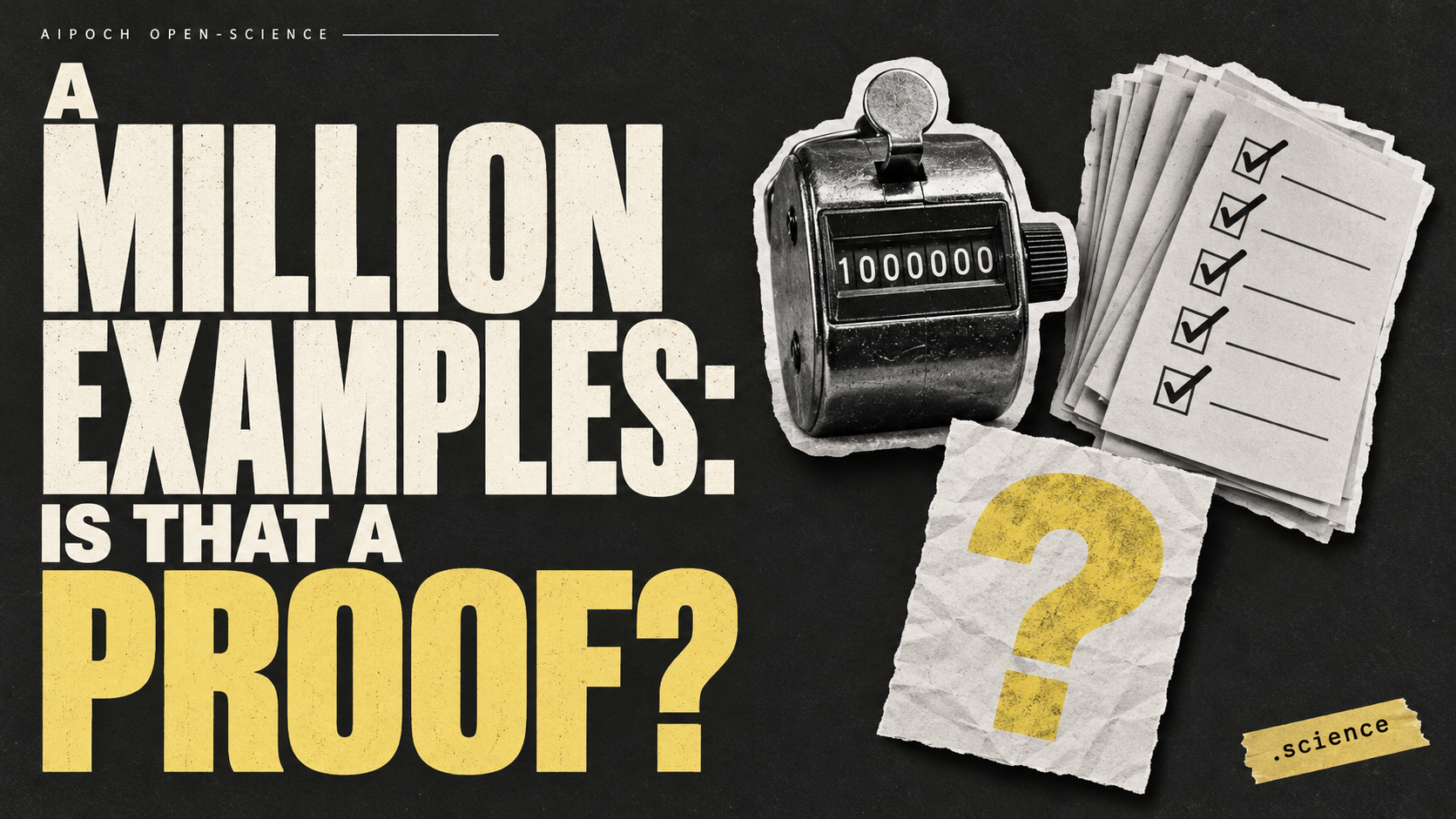
A Million Examples - Is That a Proof?
Research topic and question
If a mathematical claim survives a million tests, why is that still not a proof? This case compares sequential testing, random sampling, and a structured search for an exact counterexample to Euler's conjecture about sums of like powers. It uses the historical fifth-power example attributed to Lander and Parkin as a demonstration, not a new discovery.
Methods and recorded findings
The sequential and random methods test quadruples in 1 <= a <= b <= c <= d <= 144, a finite space of 18,671,940 possibilities. A hit requires a^5 + b^5 + c^5 + d^5 = e^5 with d < e <= 144. Python arbitrary-precision integers and exact fifth-power lookups avoid approximate roots.
| Method | Recorded work | Recorded elapsed time | Result |
|---|---|---|---|
| Sequential | First 1,000,000 distinct quadruples in ascending lexicographic order | 0.149 s | No counterexample |
| Random | 1,000,000 uniform draws from the quadruple space, with replacement; seed 1966 | 2.033 s | No counterexample |
| Structured pair-sum search | 10,296 pair constructions and 497,640 complement lookups; exhaustive within the bounded solution space | 0.082 s | One sorted witness: (27, 84, 110, 133, 144) |
The structured method stores every pair 1 <= a <= b <= 143 by its fifth-power sum, retaining pairs that share a sum. It enumerates e, then c, then d in ascending order with 1 <= c <= d < e <= 144, looks up e^5 - c^5 - d^5, and retains matches with b <= c. Random sampling sorts a uniformly drawn four-element subset of 0..146 and maps coordinate i to t[i] + 1 - i, giving uniform nondecreasing quadruples. Simply sorting four independent integer draws would not give that distribution.
The recorded exact check is 27^5 + 84^5 + 110^5 + 133^5 = 144^5 = 61,917,364,224. The witness quadruple is at lexicographic position 10,418,944, beyond the sequential budget. Given the single sorted solution found by the exhaustive bounded search, the probability of at least one hit in a million independent uniform draws is 1 - (1 - 1/18,671,940)^1,000,000, approximately 5.21%. This is a sampling-model probability; the recorded seeded run is deterministic, and repeated random draws were not counted as distinct coverage.
Assumptions and limits
The bound 144 was chosen because the published answer was already known. The search does not target the four summands, but that informed bound makes the problem tractable; the witness is also used for direct verification and a post-search assertion. Finding it here is not an uninformed discovery.
Times are the archived single-run measurements on Python 3.12.14 and macOS ARM64, not new benchmarks. Random generation and pair-table construction are included; shared power-table setup is excluded. Quadruple tests, pair constructions, and complement lookups are different operations, and the workloads have different coverage. These timings do not establish a universal speedup or quantify timing variability.
A million negative tests leave untested cases. Exhaustive finite computation can establish a bounded claim when coverage and implementation are justified; it cannot establish an unbounded claim without an additional argument. Conversely, one exact counterexample suffices to refute a universal claim.
Research outputs and provenance
The package preserves the conversation, euler_fifth_power_searches.py, euler_search_report.md, euler_search_results.json, euler_search_comparison.png, notebook data, the uploaded source guide, and execution evidence.
The recorded source is L. J. Lander and T. R. Parkin, “Counterexample to Euler's conjecture on sums of like powers,” Bulletin of the American Mathematical Society 72 (1966), p. 1079. The session reports checking citation metadata through Crossref and reading source-guide.md and source-guide.json from the uploaded ZIP. The original AMS PDF was blocked by the session's network destination check. The guide's claimed visual inspection is supplied provenance, not a PDF inspection performed in the recorded session or during this integration.
The original .science package and PNG are imported unchanged from aipoch/open-science-usecases at a1d1bfcb7d1c7a85d3e4a465060fa87fddc6d284. Theresa (@theresayao0614-sudo) contributed the case and poster in 94a33e0. This introduction summarizes the packaged evidence and its stated limitations.
Run this kind of analysis on your own question
Start a session and see how an AI co-scientist accelerates your research. Pay-as-you-go, nosubscription required.