What this research found
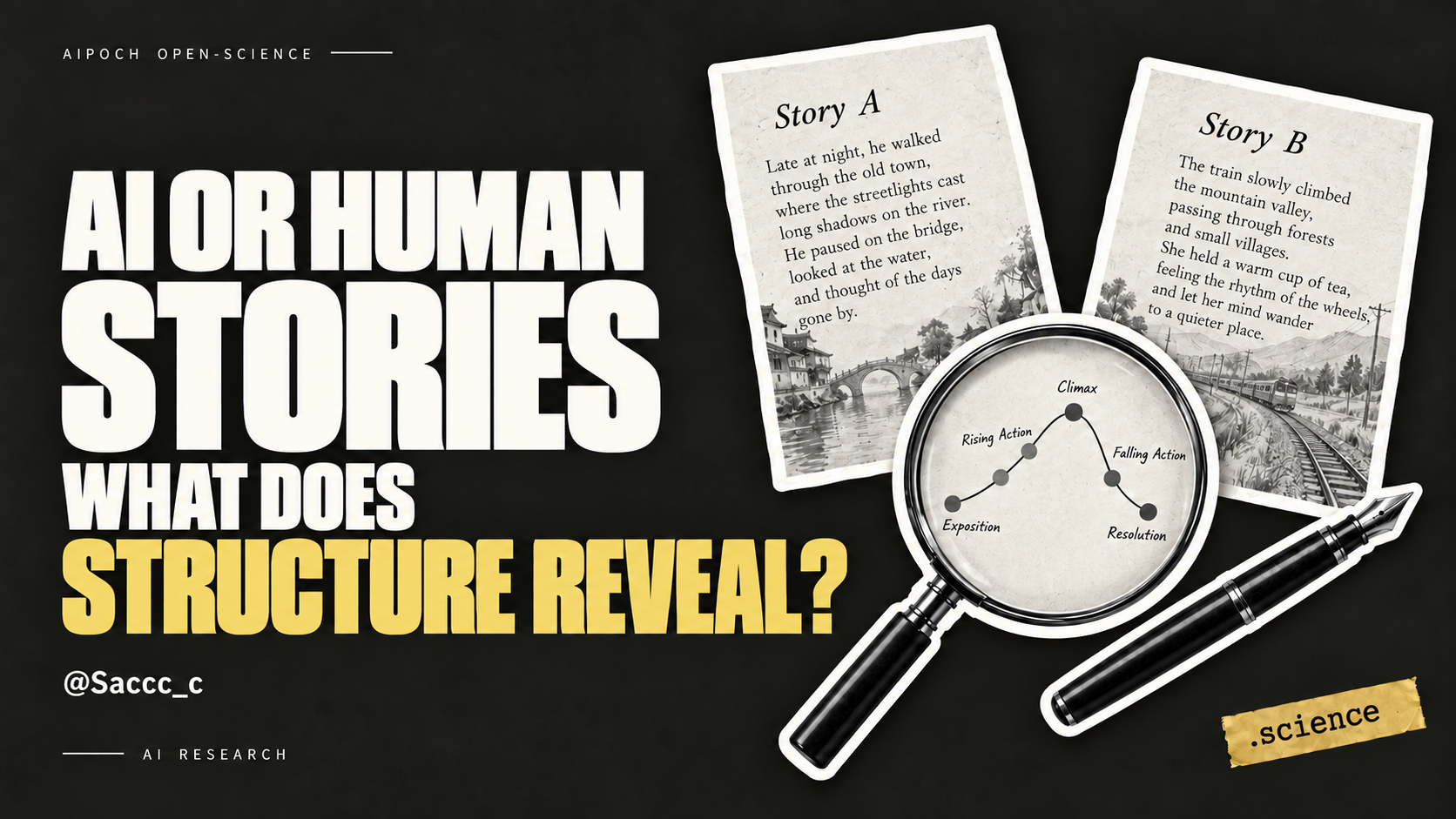
AI or Human - What Story Structure Reveals
Creator: @Saccc_c
Research question
Can narrative structure help a reader distinguish writing patterns without treating style as an authorship detector?
Examines a paper’s approach to distinguishing AI-generated and human-written stories through narrative structure rather than surface style. The archived discussion explains narrative features and applies a qualitative, paper-inspired comparison to two Chinese stories using 30 core narrative questions.
Data and comparison design
The comparison uses chronology, subplots, thematic explicitness, endings, intertextual references, and how emotion is conveyed. Apply the paper-inspired questions consistently to both supplied Chinese stories, while retaining the fact that one text already carries an AI-generated label.
Recorded findings
| Narrative dimension | Comparison question | Why it is useful |
|---|---|---|
| Chronology | Does the story proceed linearly or reorder events? | Makes organization explicit rather than equating fluency with authorship. |
| Subplots and motives | Are secondary threads and conflicting motives developed? | Distinguishes structural complexity from sentence style. |
| Themes and endings | Are lessons stated explicitly and conflicts tightly resolved? | Supports a qualitative reading of closure. |
| Emotion and intertext | Is emotion stated, dramatized or connected to other works? | Examines narrative devices without assigning detector accuracy. |
The archived comparison supplies a qualitative feature-by-feature discussion, rather than a trained-classifier prediction. It illustrates how a linear, tightly resolved story can differ from one with nonlinear chronology and unresolved motives.
The analysis uses the source paper as a set of reading questions, not as a ready-made detector. Both Chinese stories are examined along the same dimensions. The useful unit is an identifiable passage or structural decision: an event told out of order, an unresolved motive, a secondary narrative thread, or an ending that explicitly announces its lesson.
- Establish the texts being compared and preserve their supplied authorship labels.
- Apply the same narrative dimensions to each text, recording an example before giving a qualitative judgment.
- Compare where the structures differ, rather than turning every stylistic difference into a verdict about authorship.
- Keep the paper’s classifier experiment separate from this small illustrative reading exercise.
Because one story is already labeled AI-generated, the exercise is not blinded. Because the source study used a different language and text scale, its detector performance cannot be transferred to these stories. What survives those limits is a concrete demonstration of how narrative structure can be compared beyond vocabulary or sentence fluency.
What the comparison shows
The useful output is an explanation of structural differences. It cannot authenticate an author, transfer the paper’s detection accuracy, or serve as a blinded evaluation.
Sources and research materials
Creator attribution follows the signature on the supplied poster and matches Case Index.csv. The original session export and poster are preserved from AIPOCH-Creator-Use-Cases.zip. This introduction describes the archived research workflow.
Run this kind of analysis on your own question
Start a session and see how an AI co-scientist accelerates your research. Pay-as-you-go, nosubscription required.