What this research found
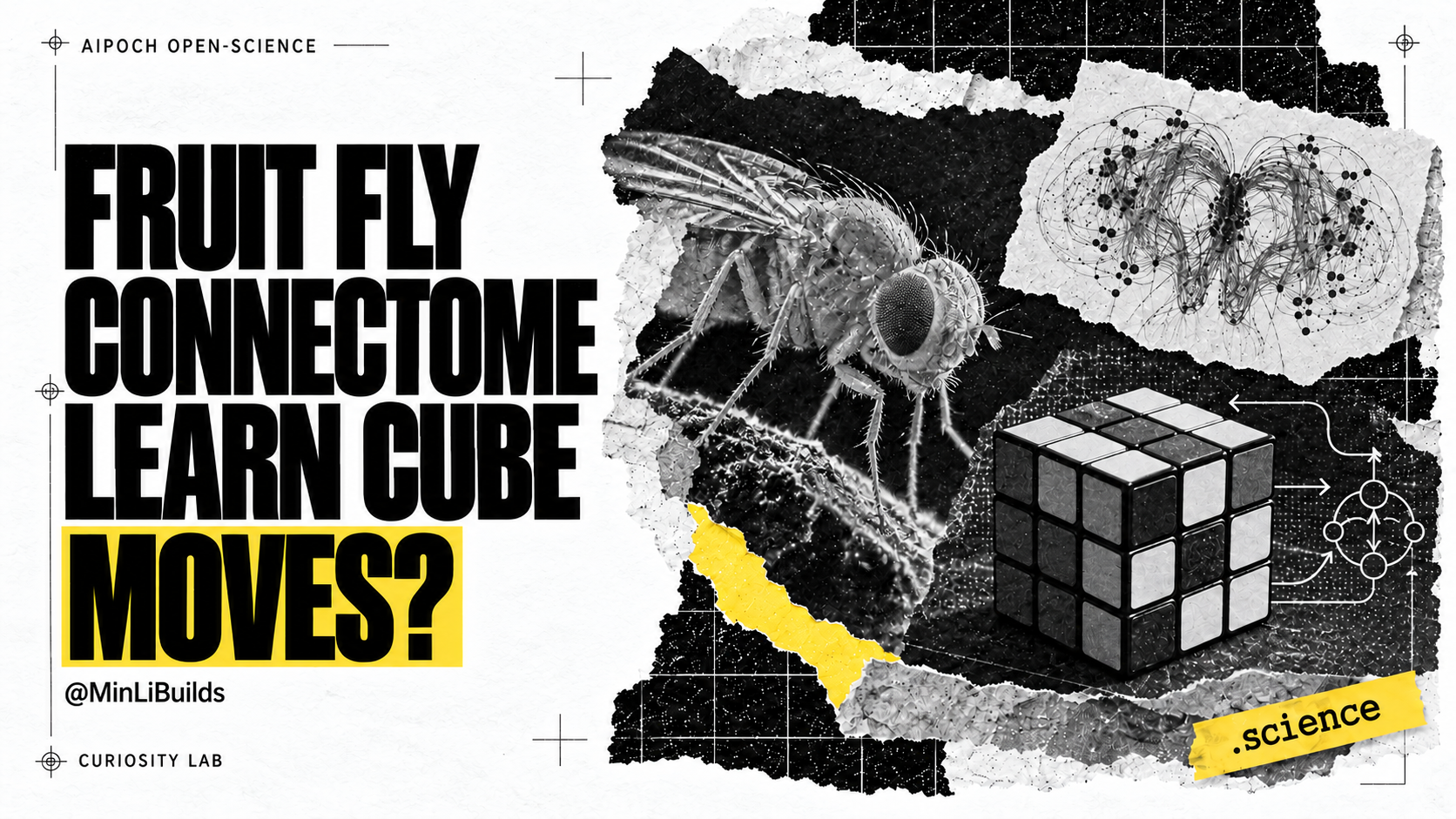
Can a Fruit Fly Connectome Learn Cube Moves
Creator: @MinLiBuilds
Research question
Can a fixed connectivity pattern route learned task information directly to selected motor-neuron outputs?
Investigates whether a fixed fruit-fly connectome topology can be trained by changing its weights so that cube-move decisions are expressed through identified leg motor neurons, rather than decoded first and translated into leg actions afterward. The archived workflow includes frozen-reservoir comparisons, constrained motor-neuron readouts, and an EfficientCube teacher-distillation workflow using rank-8 LoRA and states at scramble depths 1–9.
Data and comparison design
Distinguish three conditions: a frozen reservoir, a restricted motor-neuron readout, and trained weights constrained by the original topology. Keep teacher-action mapping and LoRA training separate from later multistep closed-loop evaluation.
Recorded findings
| Workflow stage | Recorded work | What must be separated |
|---|---|---|
| Graph-inspired model | Connectome-based architecture and cube-state inputs | A design inspired by connectivity, not a biological cube-solving experiment. |
| Supervised training | Learn actions from teacher examples | Teacher labels define the behavior being transferred. |
| Action convention | Teacher action mapping was corrected | A wrong move convention can invalidate apparently trained behavior. |
| Closed-loop evaluation | Apply successive predicted moves to cube states | Distinct from single-step agreement; no removed success rates are restored. |
The archive documents the training and teacher-distillation workflow, including correction of the teacher’s action mapping. The introduction retains that method without adding an unverified cube-solving success rate.
The model conditions answer progressively different questions. A frozen reservoir asks whether fixed graph-constrained dynamics provide a useful representation to a trained readout. Restricting the readout to motor-neuron outputs tests whether that interface retains useful information. Allowing weights to train while retaining the topology tests a broader learned system, rather than the unmodified biological connectome.
- Encode a cube state and the allowed action vocabulary consistently across the learner and teacher.
- Compare fixed internal dynamics with restricted readouts and topology-constrained training.
- Inspect the teacher-to-model move mapping before trusting a distilled checkpoint.
- Evaluate sequences of predicted moves on updated cube states, separately from single-step imitation.
The archive’s action-mapping correction is consequential: a learner can fit labels under the wrong convention while failing when its output is interpreted as a physical cube move. The corrected workflow is therefore an inspectable training study. It is not evidence that a fruit fly’s actual nervous system understands a puzzle.
What the comparison shows
An action-classification target is not a whole-animal behavior claim. Physical movement and closed-loop solving would require separate validation.
Sources and research materials
Creator attribution follows the signature on the supplied poster and matches Case Index.csv. The original session export and poster are preserved from AIPOCH-Creator-Use-Cases.zip. This introduction describes the archived research workflow.

Run this kind of analysis on your own question
Start a session and see how an AI co-scientist accelerates your research. Pay-as-you-go, nosubscription required.