What this research found
Research question
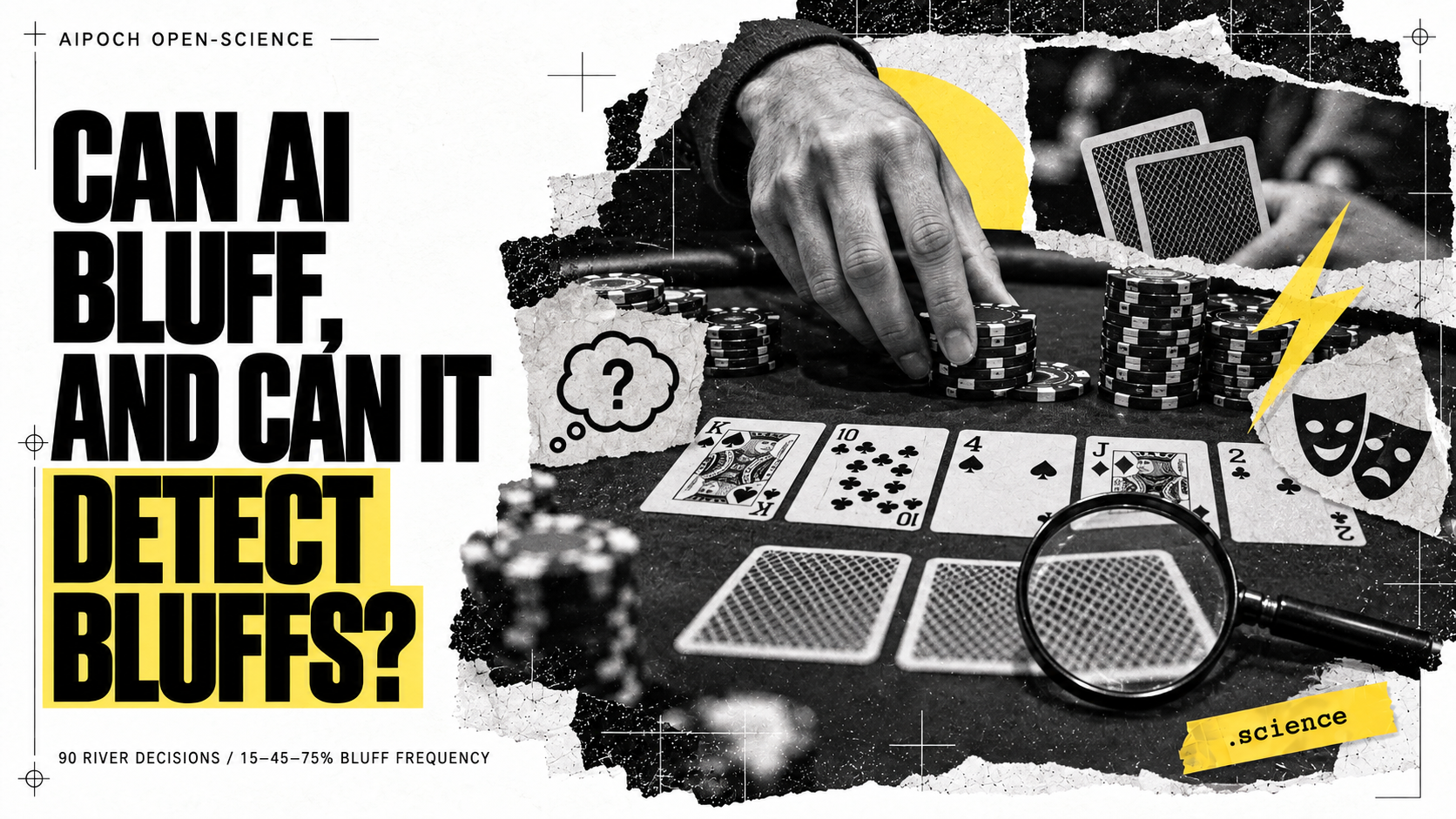
Do calling and raising decisions change when opponents bluff more often?
Records a simplified poker experiment with preset opponent bluff frequencies and saved model actions and confidence scores. The archived report compares calling and raising behavior across the three opponent groups.
Data and comparison design
The analysis uses a simplified scenario generator with three preset bluff frequencies and save actions and stated confidence for 30 hands per level. Compare call rates across conditions and against whether a particular opponent bet was actually designated a bluff.
Recorded findings
Can AI bluff, and can it detect bluffs?
Experiment: I built a simplified heads-up poker scenario, had an LLM (deepseek-v4-pro) decide fold/call/raise on the river against three opponent archetypes with preset bluff frequencies (low 15% / medium 45% / high 75%), and asked it for a confidence score on each of 90 hands (30 per level).
Result
| Bluff level | Bluff freq | Hands | Call rate | Call-or-raise | Mean confidence |
|---|---|---|---|---|---|
| Low | 15% | 30 | 0.367 | 0.433 | 0.777 |
| Medium | 45% | 30 | 0.233 | 0.233 | 0.809 |
| High | 75% | 30 | 0.367 | 0.367 | 0.804 |
Bluffing (producing deception): The model essentially never raised (2/90 = 2.2%) and was heavily passive (59 folds, 29 calls). It did not exhibit aggressive bluffing.
Bluff detection (call rate vs. bluff frequency): The call rate did not rise with opponent bluff frequency — it was 0.367 → 0.233 → 0.367 (no monotonic trend). Reported confidence was also flat (~0.78–0.81), so it carried no discrimination signal either.
One suggestive hint: In the low-bluff group, the model called more when the opponent was actually bluffing (0.75 vs 0.31). But that rests on only 4 actual-bluff hands, so it's too thin to trust.
In this simplified setup the model did not convincingly bluff, and showed weak-to-absent bluff-detection signal — it did not reliably call more against higher bluffing frequencies.
Important caveats
- This measures emergent behavior of a general LLM under prompting, not a trained poker agent; it is not a rigorous test of poker skill.
- 30 hands/level is statistically thin; call-rate differences of this size are within noise.
- The scenario generator used simplified hand/board text rather than full hand evaluation, so correctness wasn't scored — only behavior trends.
Files (versioned artifacts)
What the comparison shows
The scenario measures prompted behavior, not competitive poker skill. Stated confidence is not calibrated evidence of detecting a bluff.
Assumptions and limits
This small artificial river-decision task does not establish general poker strength or reliable bluff detection. Sparse bluff cases and the simplified environment limit the reported comparisons.
Sources and research materials
The original .science export and matching poster are preserved byte-for-byte from the upstream case. The package contains the conversation, session metadata, and the resources inventoried in its internal manifest. This introduction summarizes the archived record; the research, external sources, and model evaluations were not rerun for this import.

Run this kind of analysis on your own question
Start a session and see how an AI co-scientist accelerates your research. Pay-as-you-go, nosubscription required.