What this research found
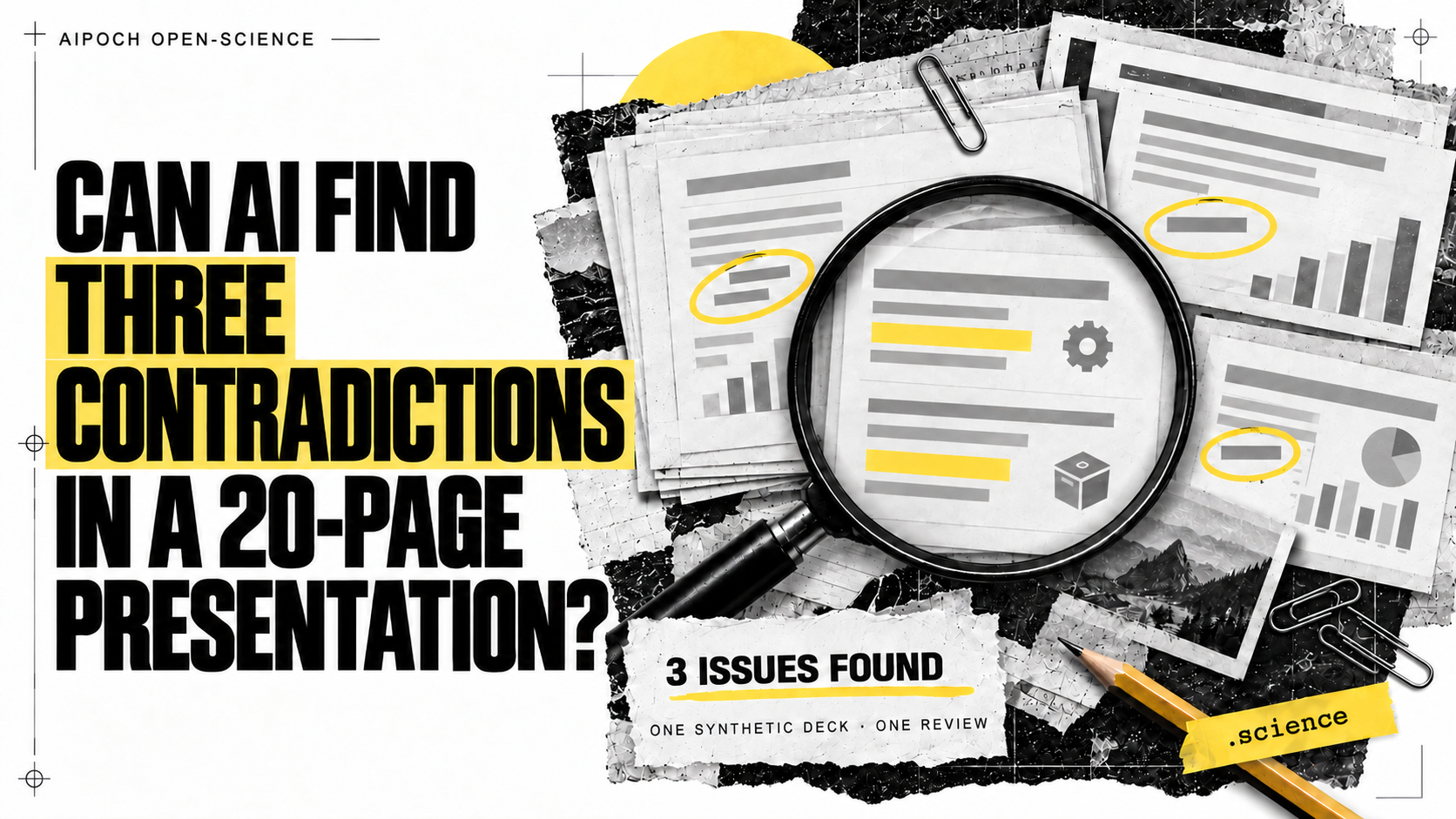
Can AI Find Three Contradictions in a 20-Page Presentation
Research question
Can a reader identify conflicting claims and locate both sides of each discrepancy?
Reviews a supplied presentation for conflicting statements and identifies the slide pairs involved. The archived answer distinguishes discrepancies in active users, pilot conversion, and a planned release date.
Data and comparison design
The comparison uses statements referring to the same quantity, population, or release plan across the supplied deck. Report the slide pair and the two conflicting values, distinguishing an unexplained revision from a proven erroneous value.
Recorded findings
| Contradiction | First statement | Conflicting statement |
|---|---|---|
| Active users | Slide 4: 1.20 million | Slide 11: 1.05 million |
| Conversion rate | Slide 7: 8% | Slide 15: 12% |
| Release timing | Slide 9: June 2026 | Slide 18: September 2026 |
The recorded answer identifies slides 4/11 for 1.20 versus 1.05 million active users, 7/15 for 8% versus 12% conversion, and 9/18 for June versus September 2026 release timing.
The task is to match statements about the same quantity or event across pages. A difference becomes a contradiction only when the period, population, definition and status are compatible. The three saved pairs make the answer inspectable: a reader can return to both cited slides rather than trust a free-form claim that the deck is inconsistent. This is a planted-document task, not a measurement of the rate of contradictions in ordinary presentations.
What the comparison shows
A contradiction identifies a reconciliation task. It does not establish which slide is correct without the underlying source.
Assumptions and limits
The result concerns this supplied deck. Conflicting statements need source reconciliation; identifying them does not determine which number or date is correct.
Sources and research materials
The original .science export and matching poster are preserved byte-for-byte from the upstream case. The package contains the conversation, session metadata, and the resources inventoried in its internal manifest. This introduction summarizes the archived record; the research, external sources, and model evaluations were not rerun for this import.
Run this kind of analysis on your own question
Start a session and see how an AI co-scientist accelerates your research. Pay-as-you-go, nosubscription required.