What this research found
Research question
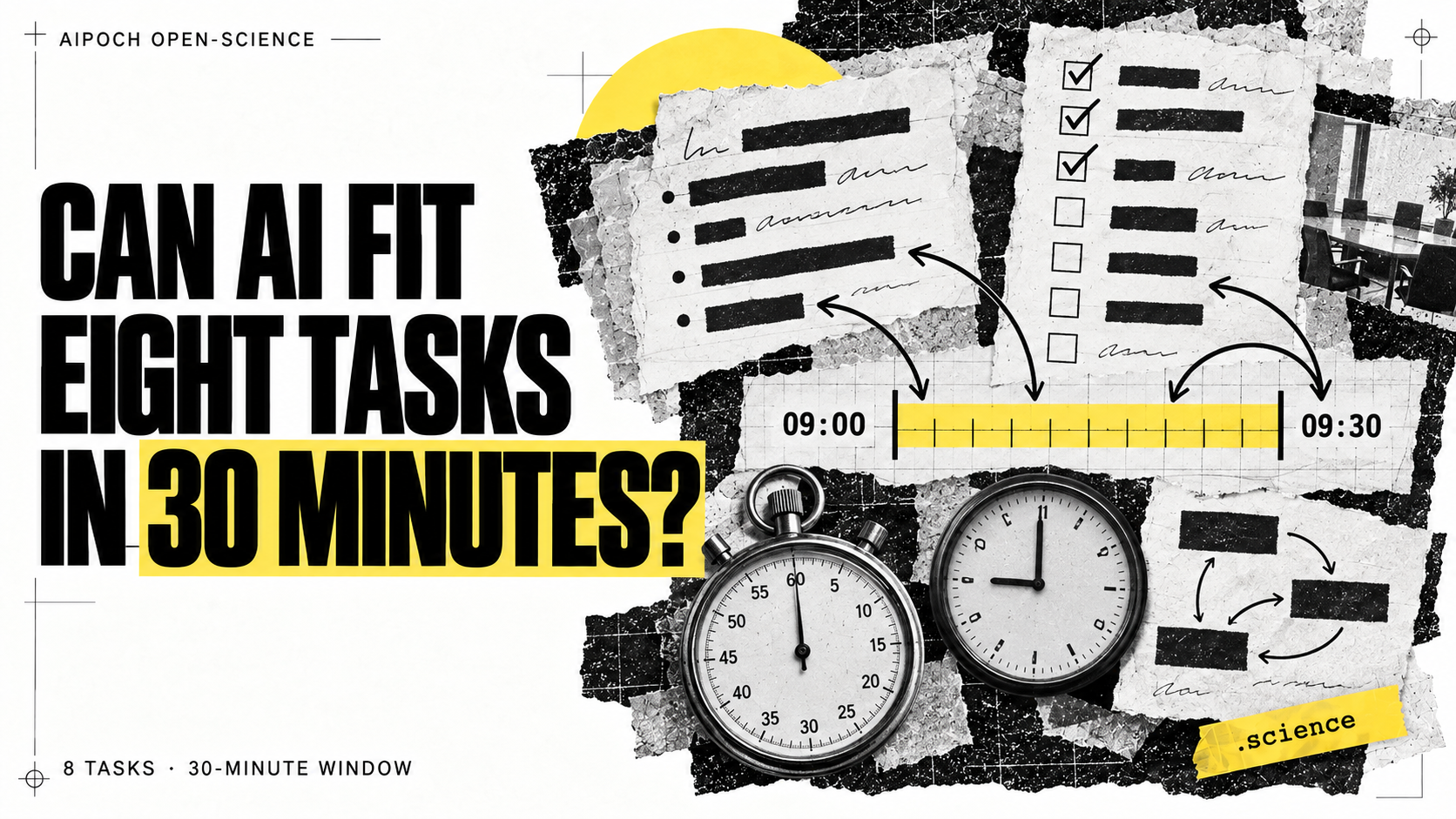
What can one person finish in a fixed half-hour when tasks depend on one another?
Schedules eight dependent tasks for one person in a fixed 30-minute window. The response estimates task durations, respects prerequisites, and distinguishes completed work from work that must wait.
Data and comparison design
Model the prerequisites explicitly: review and planning precede analysis, while slides and the status update precede final submission. Place tasks on a single-person timeline and distinguish fully completed tasks from work merely started near the deadline.
Recorded findings
Assuming the files are accessible, tools are ready, and “preliminary” means a fast first-pass analysis rather than a validated final result, the full workload is about 45 minutes. It cannot all fit into the 30-minute window.
| Task | Estimate | Dependency |
|---|---|---|
| Review experiment brief | 4 min | None |
| Reply to participant emails | 6 min | None |
| Check data quality | 6 min | None |
| Prepare analysis plan | 5 min | Brief review |
| Run preliminary analysis | 10 min | Analysis plan + quality check |
| Create meeting slides | 8 min | Preliminary analysis |
| Send status update | 4 min | Email replies + preliminary analysis |
| Submit final package | 2 min | Slides + status update |
Recommended schedule
| Time | Work | Expected outcome |
|---|---|---|
| 9:00–9:04 | Review experiment brief | Complete |
| 9:04–9:09 | Prepare analysis plan | Complete |
| 9:09–9:15 | Check data quality | Complete |
| 9:15–9:25 | Run preliminary analysis | Complete |
| 9:25–9:30 | Start participant-email replies | Draft most replies; likely not all sent |
By 9:30, you can realistically finish:
- Experiment-brief review
- Analysis plan
- Data-quality check
- Preliminary analysis
- Most of the participant-email work, but not reliably all replies
The following must wait:
- Completion/sending of participant-email replies: about 1 minute
- Meeting slides: 8 minutes
- Status update: 4 minutes, after the emails are sent
- Final-package submission: 2 minutes, after slides and status update
Estimated remaining work after 9:30: about 15 minutes.
This order prioritizes producing substantive findings for the team check-in. Completing the entire dependency chain through final submission by 9:30 is impossible under the stated single-person constraint.
Assumptions:
- The brief is short and needs review, not rewriting.
- There are only a few routine participant emails with no complex issues.
- Data are already available in an analysis-ready location.
- The quality check is a focused screen for missingness, ranges, duplicates, and obvious anomalies.
- The analysis uses an existing environment and standard methods; no troubleshooting is included.
- Slides are a concise update deck built from an existing template.
- “Complete” preliminary analysis means provisional results suitable for discussion, not fully validated or publication-ready output.
What the comparison shows
This is a duration-based plan, not observed work completion. Unknown setup and troubleshooting time can make the feasible subset smaller.
Assumptions and limits
The durations are assumptions supplied by the model, not measured execution times. The package records a planning exercise rather than proof that the tasks were performed.
Sources and research materials
The original .science export and matching poster are preserved byte-for-byte from the upstream case. The package contains the conversation, session metadata, and the resources inventoried in its internal manifest. This introduction summarizes the archived record; the research, external sources, and model evaluations were not rerun for this import.



Run this kind of analysis on your own question
Start a session and see how an AI co-scientist accelerates your research. Pay-as-you-go, nosubscription required.