What this research found
Research question
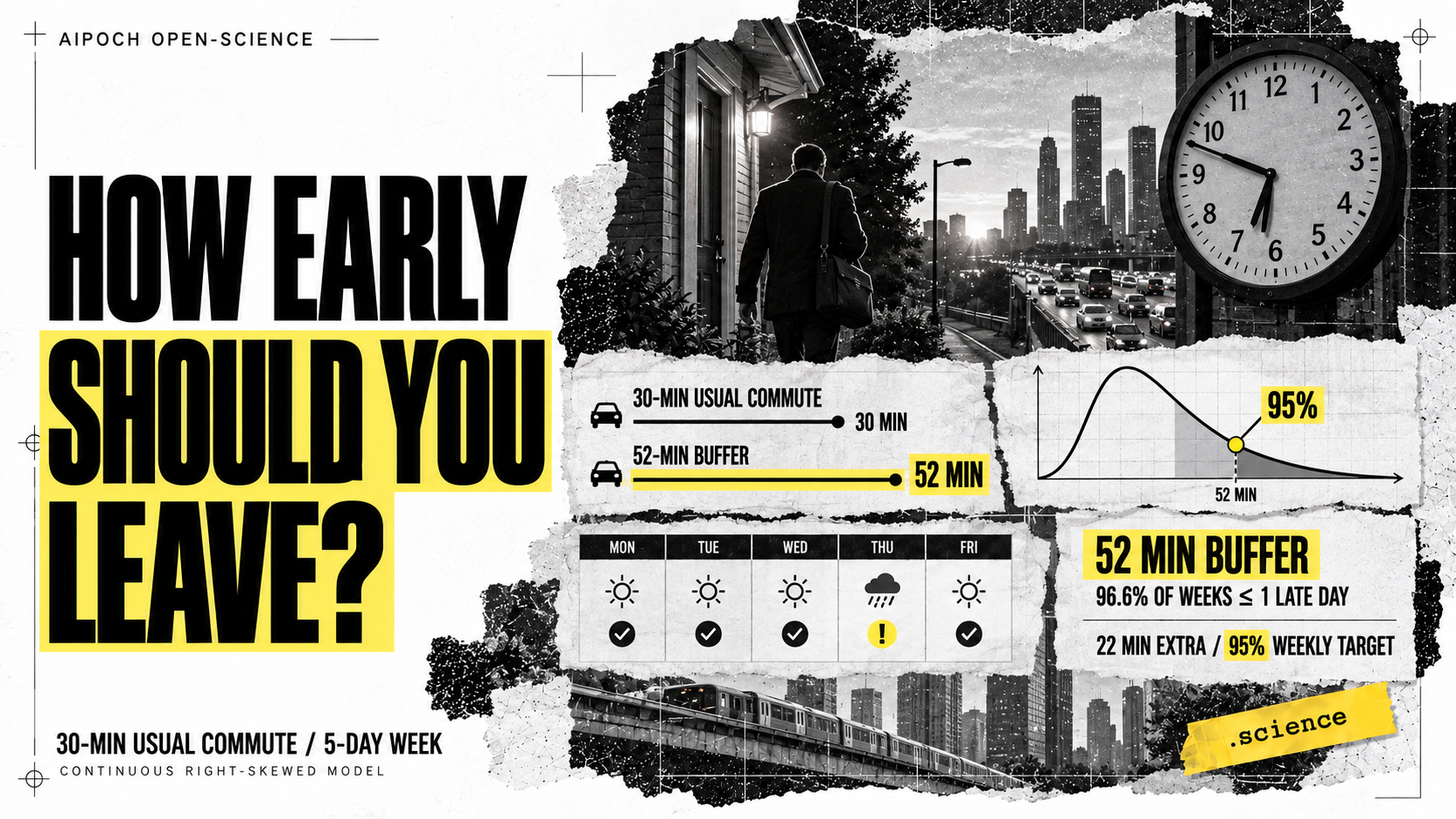
How much departure buffer is needed for a weekly rather than a daily reliability target?
Models commute uncertainty and departure buffers under ordinary-day and accident-day assumptions. The final corrected run compares daily lateness with a weekly reliability requirement and saves a sensitivity table.
Data and comparison design
The comparison uses ordinary-day and accident-day travel assumptions, then distinguish a two-state mixture from a moment-matched continuous lognormal model. Translate the daily late probability into the probability of at most one late arrival across five independent mornings.
Recorded findings
The corrected model executed successfully, and all four artifacts were overwritten from that run.
The executed code used:
- Ordinary-day mean 30 minutes, SD 5 minutes.
- Accident-day mean 60 minutes, SD 15 minutes.
- Accident probability 10% for the defended model.
- A continuous lognormal distribution moment-matched to the resulting mixture mean and variance.
- Five independent mornings.
- A weekly requirement of at most one late morning in 95% of weeks.
The run produced:
- Moment-matched mean: 33.000 minutes.
- Moment-matched SD: 11.224972 minutes.
- Daily late probability at a 52-minute buffer: 0.061811.
- Weekly success probability at 52 minutes: 0.966302, or 96.6%.
- Weekly requirement: 95%.
- Extra buffer beyond the usual 30-minute commute: 22 minutes.
The corrected sensitivity table, using a 15-minute accident-day SD, gives these buffers for 95% of weeks with at most one late morning:
| Accident probability | Two-state mixture | Continuous lognormal |
|---|---|---|
| 2% | 37.8 min | 40.9 min |
| 5% | 39.2 min | 44.9 min |
| 10% | 49.2 min | 50.1 min |
| 20% | 64.5 min | 58.1 min |
Every number in the files below came from the executed Python run notebook-run-1790674265526-2.
What the comparison shows
This is a constructed reliability calculation, not a measured local commute forecast. Independence and the upper tail deserve particular scrutiny.
Assumptions and limits
The distributions and accident probability are hypothetical, inferred from a vague commute description rather than observed trips. The independent-mornings assumption and tail model materially affect the buffer.
Sources and research materials
The original .science export and matching poster are preserved byte-for-byte from the upstream case. The package contains the conversation, session metadata, and the resources inventoried in its internal manifest. This introduction summarizes the archived record; the research, external sources, and model evaluations were not rerun for this import.


Run this kind of analysis on your own question
Start a session and see how an AI co-scientist accelerates your research. Pay-as-you-go, nosubscription required.