What this research found
Research question
Which studies move beyond computational prediction to experiments or human dosing?
Builds an evidence table for AI-related drug-discovery papers, distinguishing computational predictions, cell experiments, animal studies, and human trials. The archived review records what each selected paper was reported to demonstrate.
Data and comparison design
Classify each selected publication by its highest demonstrated stage: computational work, cells, animals, or humans. Keep retrospective prediction of known measurements separate from a new synthesis or experiment, and distinguish trial entry from demonstrated clinical efficacy.
Recorded findings
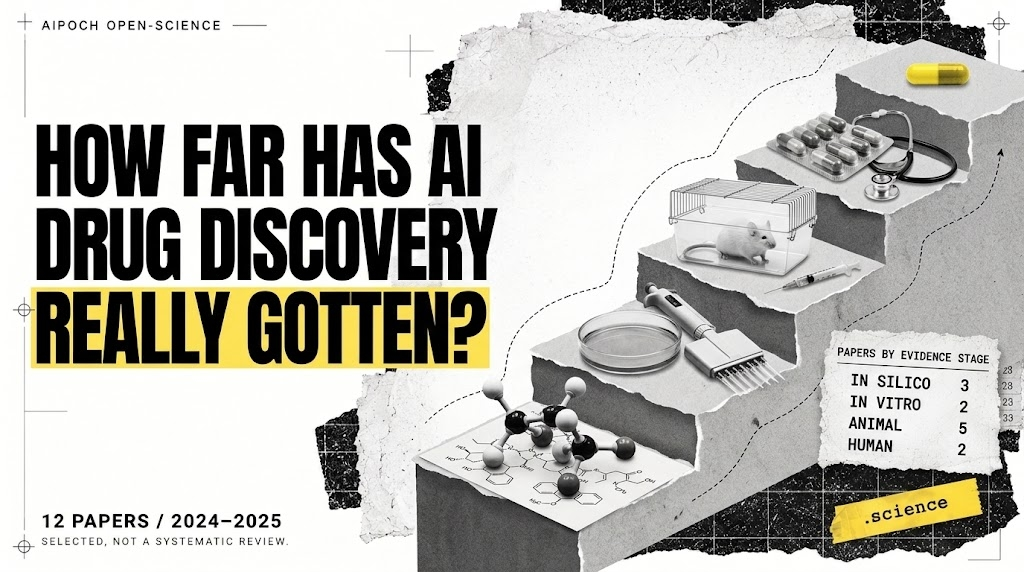
The short answer: AI drug discovery has genuinely reached human trials — but only barely, and the "AI" label covers a very wide range of evidence quality. Of 12 recent papers, 3 are purely computational, 2 stop at cells, 5 reach animals, and only 2 involve human dosing. Exactly one is a randomized, placebo-controlled efficacy trial.
The evidence table
Tier 1 — In silico only
| # | Paper | Year / Venue | What it actually demonstrated |
|---|---|---|---|
| 1 | AlphaFold 3 — 10.1038/s41586-024-07487-w | 2024, Nature | Predicts joint structure of protein–ligand–nucleic acid complexes. Entirely computational; no molecule synthesised. |
| 2 | PCMol — 10.1021/acs.jcim.4c00309 | 2024, J Chem Inf Model | AlphaFold2-conditioned generative model; generated molecules scored favourably by docking only. No wet-lab work. |
| 3 | Boltz-2 — github.com/jwohlwend/boltz | 2025, preprint | Joint structure + affinity prediction, ~1000× faster than FEP. Benchmarked against already-measured assay data. Preprint, not peer-reviewed. |
Tier 2 — In vitro
| # | Paper | Year / Venue | What it actually demonstrated |
|---|---|---|---|
| 4 | NGT — MC2R inhibitors — 10.1021/acs.jmedchem.4c01763 | 2024, J Med Chem | Generated antagonists for a target with zero prior training data; 12 compounds synthesised, cAMP EC50s with full dose–response and LC-MS. No animal work. |
| 5 | RFdiffusion antibodies — 10.1038/s41586-025-09721-5 | 2025, Nature | Cryo-EM at 3.0–3.6 Å confirmed designed binders matched design models, including all six CDR loops. Binding only — no animal efficacy. |
Tier 3 — Animal
| # | Paper | Year / Venue | What it actually demonstrated |
|---|---|---|---|
| 6 | Wong et al. — new antibiotic class — 10.1038/s41586-023-06887-8 | 2024, Nature | Screened 39,312 compounds, predicted on 12M, tested 283. New class active vs MRSA/VRE; reduced bacterial titres 10-fold in mouse infection models. |
| 7 | Krishnan et al. — de novo antibiotics — 10.1016/j.cell.2025.07.033 | 2025, Cell | 36M generated → 24 synthesised → 7 validated (~27% hit rate). Leads NG1/DN1 efficacious in mouse gonorrhoea and MRSA models, novel mechanisms. |
| 8 | SK56 — GSDMD pore blocker — 10.1038/s41590-025-02280-x | 2025, Nat Immunol | AI-designed peptide. In mouse sepsis, survival rose from 5% → 45%, effective even 4–16 h after induction. |
| 9 | ISM5939 — ENPP1 inhibitor — 10.1038/s41467-025-59874-0 | 2025, Nat Commun | Oral inhibitor;synergised with PD-1/PD-L1 blockade across five murine tumour models. |
| 10 | BGM0504 — dual GLP-1/GIP agonist — 10.1038/s41598-024-66998-8 | 2024, Sci Rep | MD-guided redesign, 2–3× more potent than tirzepatide; db/db mice + cynomolgus monkey PK. Physics-based, not ML — included as an AI-adjacent comparator. |
Tier 4 — Human clinical
| # | Paper | Year / Venue | What it actually demonstrated |
|---|---|---|---|
| 11 | INS018_055 / rentosertib preclinical + Phase 1 — 10.1038/s41587-024-02143-0 | 2024, Nat Biotechnol | AI target ID + generative chemistry in ~18 months. Mouse fibrosis efficacy; Phase 1 in 78 healthy volunteers — safety and PK only, no efficacy signal. |
| 12 | Rentosertib Phase 2a (GENESIS-IPF) — 10.1038/s41591-025-03743-2 | 2025, Nat Med | The milestone: 71 IPF patients, randomized, placebo-controlled. FVC +98.4 mL vs −20.3 mL placebo. But see caveat. |
Three things worth flagging
The one human efficacy result is weaker than headlines suggest. The rentosertib FVC improvement was a secondary endpoint — the trial was powered for safety, not efficacy. Arms were n=17–18, duration 12 weeks, and the confidence interval (+10.9 to +185.9) is wide enough to include a modest effect. It's a real signal and a genuine first, but not the definitive proof the press coverage implies.
Attention concentrates at the animal stage. Five of twelve papers stop there. Two reviews identified in the archived search independently quantified the same gap: a PRISMA review of de novo cancer drug design found only 14% of studies reached in vivo testing. The high hit rates you see quoted (54–85%) are almost all in vitro.
Searching is not the same as validating. A caveat on my own method: the literature and PubMed connectors were unavailable in this session (credential and network failures), so I built this from web search plus publisher pages. Every DOI and PMID above was cross-checked against the publisher's own record, but I did not read the full texts — so the "demonstrated" column reflects what abstracts, figures and supplementary descriptions report, not my own reading of every table. Where a number sits in a supplementary table (e.g. NGT's exact EC50s), I've said so rather than quoting it.
One more structural point: only 2 of 12 papers here describe a molecule that ever entered a human. The rest are method papers or preclinical work that may never advance. As of late 2025, ~117 AI-discovered candidates had entered clinical trials, 60 had completed Phase 1, and 8 had completed Phase 2 — and no AI-discovered drug had FDA approval. That's the honest denominator, and it's why the ladder above is so bottom-heavy.
The notebook has the full table with method, target, and a per-paper caveat column, plus the rendered ladder.
What the comparison shows
This curated evidence table is not an exhaustive count of the field. The role of AI and the strength of validation differ across entries.
Assumptions and limits
Evidence stages are not interchangeable and the selected papers are not a systematic census. The import preserves a dated literature review; it does not independently validate clinical efficacy or provide treatment advice.
Sources and research materials
The original .science export and matching poster are preserved byte-for-byte from the upstream case. The package contains the conversation, session metadata, and the resources inventoried in its internal manifest. This introduction summarizes the archived record; the research, external sources, and model evaluations were not rerun for this import.

Run this kind of analysis on your own question
Start a session and see how an AI co-scientist accelerates your research. Pay-as-you-go, nosubscription required.