What this research found
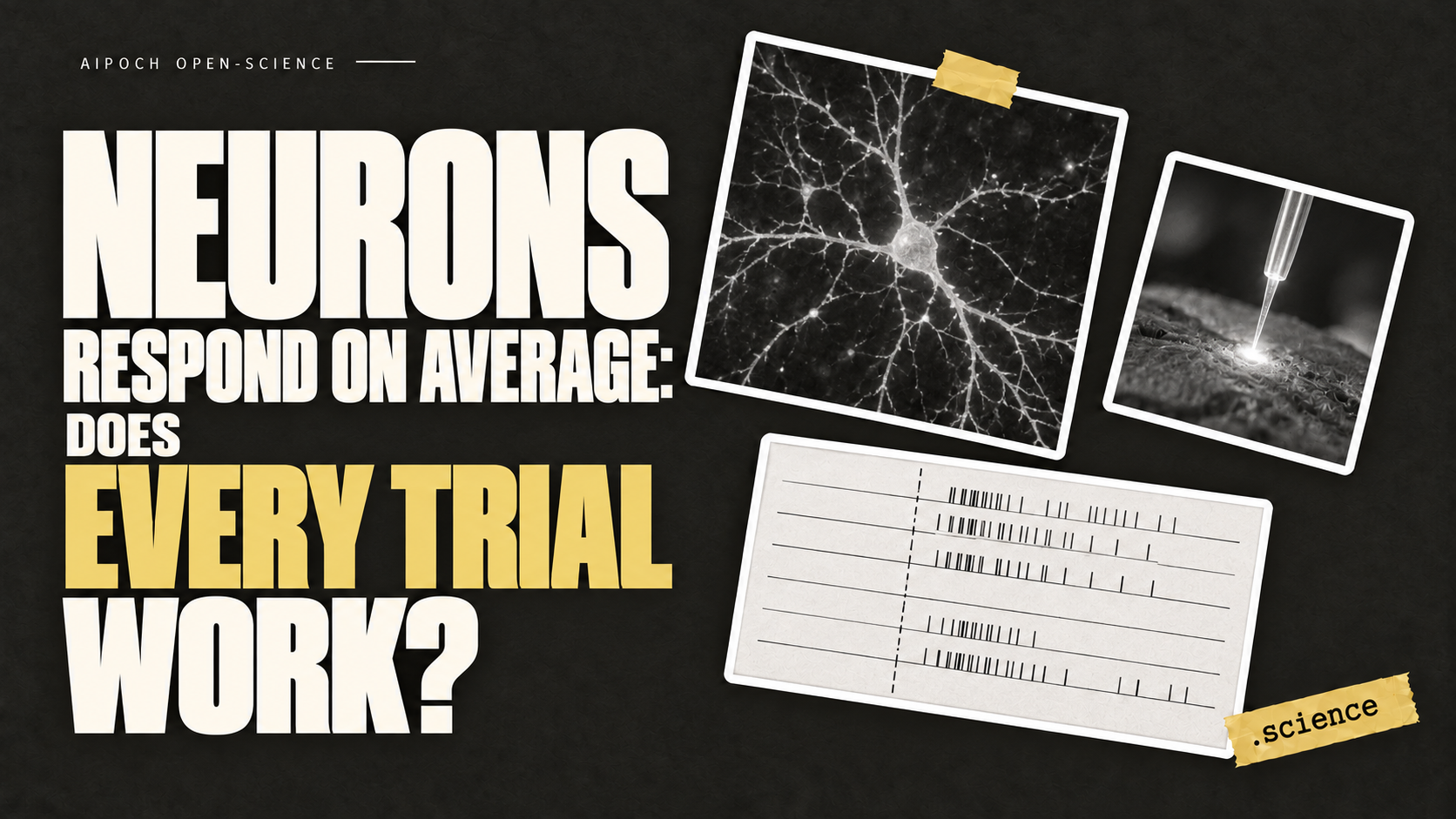
Neurons Respond on Average - Does Every Trial Work
Research question
Can a large average firing-rate response coexist with failures on individual pulses?
Separates average optotagging responses from individual-pulse reliability in the same archived recordings. The analysis compares zero-spike trials, response timing, baseline windows, and light levels.
Data and comparison design
Reuse the reference responder set and compare matched 2–8 ms response and baseline windows pulse by pulse. Count zero-spike observations, conditional first-spike timing, and bursts rather than using only a mean rate.
Recorded findings
No—a clear average response does not mean every pulse produces a spike. At the highest SST light level, 22 of 31 previously identified responders had zero-spike trials, with individual reliability ranging from 40% to 100%.
For those same 31 units, using a 2–8 ms response window and equally long matched baseline:
| Recorded light level | Trials with a response spike | Baseline spike probability |
|---|---|---|
| 1.3 | 21.5% | 6.5% |
| 1.7 | 68.9% | 5.8% |
| 2.0 | 87.0% | 6.3% |
At level 2.0, 101/775 unit–pulse observations contained no spike, despite an average response rate of 229 Hz. Bursts on successful trials help explain that strong average. Among successful trials, the median within-unit timing IQR was 0.91 ms.
The wild-type results remain descriptive. These two recordings cannot establish population-wide reliability, direct activation or artifact-free spiking. Zero-spike counts also assume uninterrupted spike detection and refer only to the chosen window.
What the comparison shows
Trial reliability and average rate are different quantities. The count depends on the chosen window and on uninterrupted spike detection.
Assumptions and limits
Two recordings cannot establish population-wide reliability, direct activation, or artifact-free spiking. Zero-spike counts rely on continuous detection and the selected response window.
Sources and research materials
The original .science export and matching poster are preserved byte-for-byte from the upstream case. The package contains the conversation, session metadata, and the resources inventoried in its internal manifest. This introduction summarizes the archived record; the research, external sources, and model evaluations were not rerun for this import.


Run this kind of analysis on your own question
Start a session and see how an AI co-scientist accelerates your research. Pay-as-you-go, nosubscription required.