What this research found
Research question
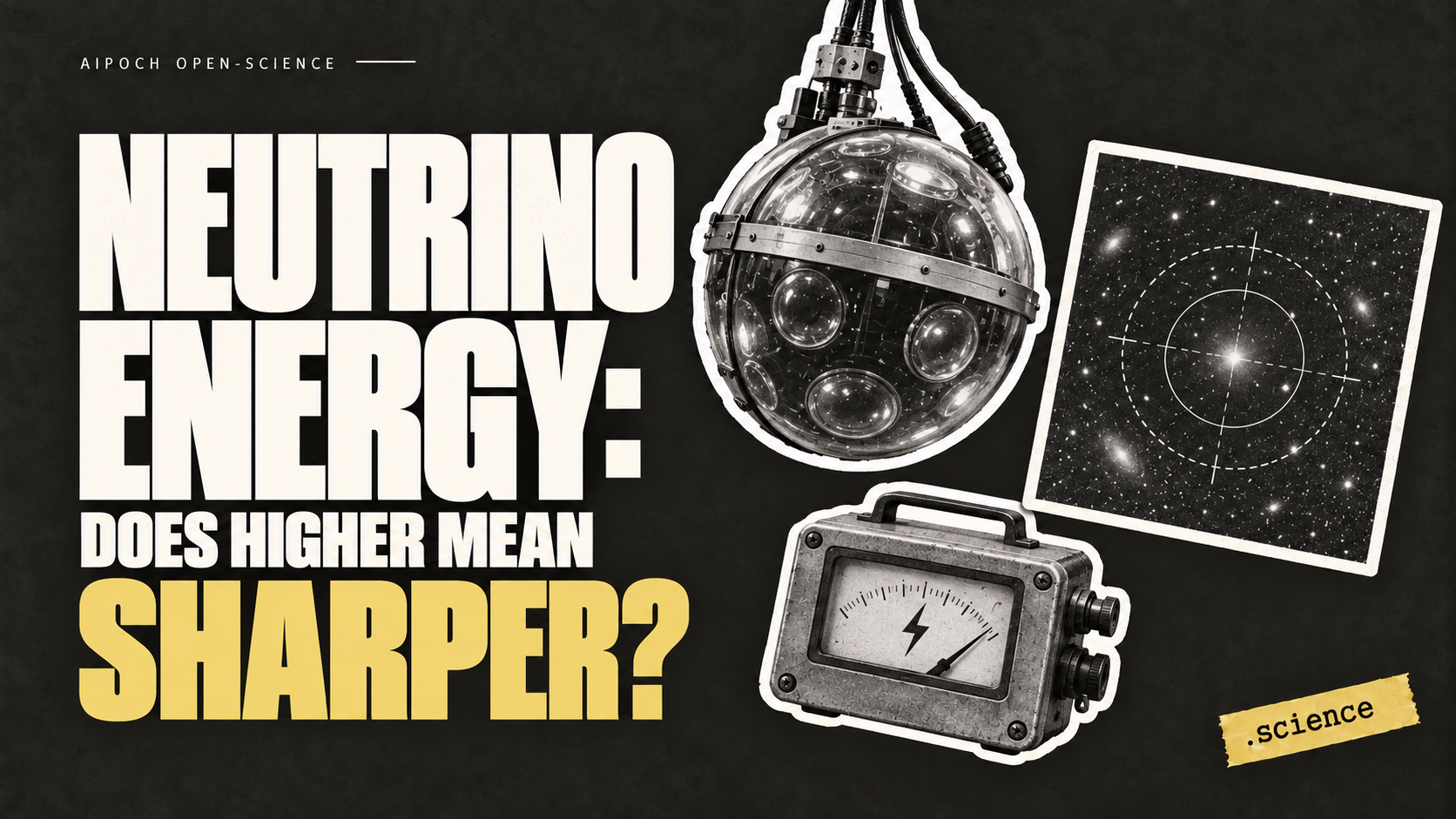
Does the overall energy–uncertainty trend hold across sky directions?
Compares reconstructed muon-energy indicators with estimated angular uncertainty in a supplied IceTracks season. The session examines sky-direction strata, calendar subsets, reporting floors, rounding, and counterexamples.
Data and comparison design
The comparison uses reconstructed muon-energy indicators with estimated angular uncertainty, then stratify by declination and calendar subset. Audit the reporting floor and rounding before treating a strong overall correlation as uniform across the detector’s field of view.
Recorded findings
Overall, yes—but the relationship depends strongly on sky direction. Across 127,695 events from May 2021–May 2022, higher reconstructed muon energy accompanies smaller estimated angular uncertainty: Spearman ρ = −0.530, with 95% bootstrap CI [−0.535, −0.526].
| Population | Spearman ρ | 95% bootstrap CI |
|---|---|---|
| 2021 | −0.535 | [−0.540, −0.529] |
| 2022 | −0.523 | [−0.530, −0.517] |
| Declination −90° to −30° | +0.224 | [+0.211, +0.238] |
| Declination −30° to 0° | −0.368 | [−0.381, −0.356] |
| Declination 0° to 30° | −0.203 | [−0.212, −0.194] |
| Declination 30° to 90° | −0.164 | [−0.174, −0.153] |
All four right-ascension sectors look similar. The southern reversal persists in both years and after excluding floor-valued events. Finer declination bands also reveal reversals hidden by broader grouping.
The quantiles show a substantial overall decrease, followed by an upturn: median uncertainty falls from 1.10° in the lowest energy bin to 0.20° in the ninth, then rises to 0.26° in the highest.
- Reporting floor: 14.74% of events equal the documented 0.20° minimum. Excluding them weakens the overall correlation to −0.377, but does not eliminate it.
- Rounding: perturbing values within their reporting precision barely changes ρ. Unreported values below the floor cannot be recovered.
- Counterexamples: event
136407 / 18743252 / 0has log-energy 5.87 but uncertainty 5.13°; event135352 / 47825884 / 2has log-energy 2.70 and reported uncertainty 0.20°.
These findings concern reconstructed muon energy—not true neutrino energy—and estimated uncertainty—not measured error against a true direction. No independent event-quality flag is supplied.
What the comparison shows
Reconstructed muon energy is not neutrino energy, and an uncertainty estimate is not measured source-location error.
Assumptions and limits
Reconstructed muon energy is not true neutrino energy, and estimated uncertainty is not measured error against a known direction. An overall association need not hold within every sky region.
Sources and research materials
The original .science export and matching poster are preserved byte-for-byte from the upstream case. The package contains the conversation, session metadata, and the resources inventoried in its internal manifest. This introduction summarizes the archived record; the research, external sources, and model evaluations were not rerun for this import.
Related research
View all →
Claude-Assisted CAR Design: Does Higher Expression Mean Better Function?
View use case in AIPOCH Lab →
For the same one-square-meter area, which receives more solar energy over the course of a year London or Seattle
View use case in AIPOCH Lab →
Neutrino Hotspots - Signal or Chance
View use case in AIPOCH Lab →Run this kind of analysis on your own question
Start a session and see how an AI co-scientist accelerates your research. Pay-as-you-go, nosubscription required.