What this research found
Research question
Do phosphate–microbe associations persist after accounting for sampling depth and region?
Explore associations between marine microbial read abundance and phosphate in a bounded Tara Oceans dataset, with depth/region adjustment, station-aware uncertainty and within-station sensitivity.
Data and comparison design
The comparison uses unadjusted and depth-region-adjusted slopes for the selected genomes. Within-station pairing addresses a different source of variation than cross-station regression. Specify the multiple-testing family because it changes the threshold for calling an association.
Recorded findings
| Association check | Recorded result | Interpretation |
|---|---|---|
| Selected data | 20 genomes; 61 samples; 43 stations | Tara Oceans sampled context. |
| Depth-region adjustment | 15/20 slopes weaken | Environmental context explains part of the association. |
| Within-station paired interval | MED_MAG_00101 interval includes zero | Different design from cross-station regression. |
| Multiple-testing family | Discovery counts vary | The correction family must accompany a reported hit count. |
The study tests 20 selected prokaryotic genomes in 61 samples from 43 stations (42 surface, 19 DCM; 18 paired stations). Phosphate sample SD is 0.5410315486 µmol/L. Fifteen of 20 slopes attenuate after depth-region adjustment. Pooled 80-test BH discovery counts across four models are 9/8/2/1, compared with 9/10/2/0 for separate within-model families. MED_MAG_00101 adjusted beta is -1.957974 (95% CI -2.408510 to -1.507437); its paired interval includes zero. MED_MAG_00040 has paired pooled q=0.0499695 but within-model q=0.166549, so support is family-sensitive.
Review finding: No confirmed numerical or interpretive defect was found within the bounded review. Complete historical computational ancestry remains unverified; this is not evidence of a stale result.
What the comparison shows
Attenuation after adjustment indicates that environmental context helps explain the original pattern. The paired interval crossing zero adds uncertainty rather than proving absence of a relationship.
Assumptions and limits
Read shares are not absolute cell abundance, and the phosphate values are author-linked environmental context rather than independently verified aliquot measurements. Associations do not establish nutrient effects. Small paired subsets and multiplicity choices limit support; upstream sequence processing and the full statistical computation were not independently reconstructed.
Sources and research materials
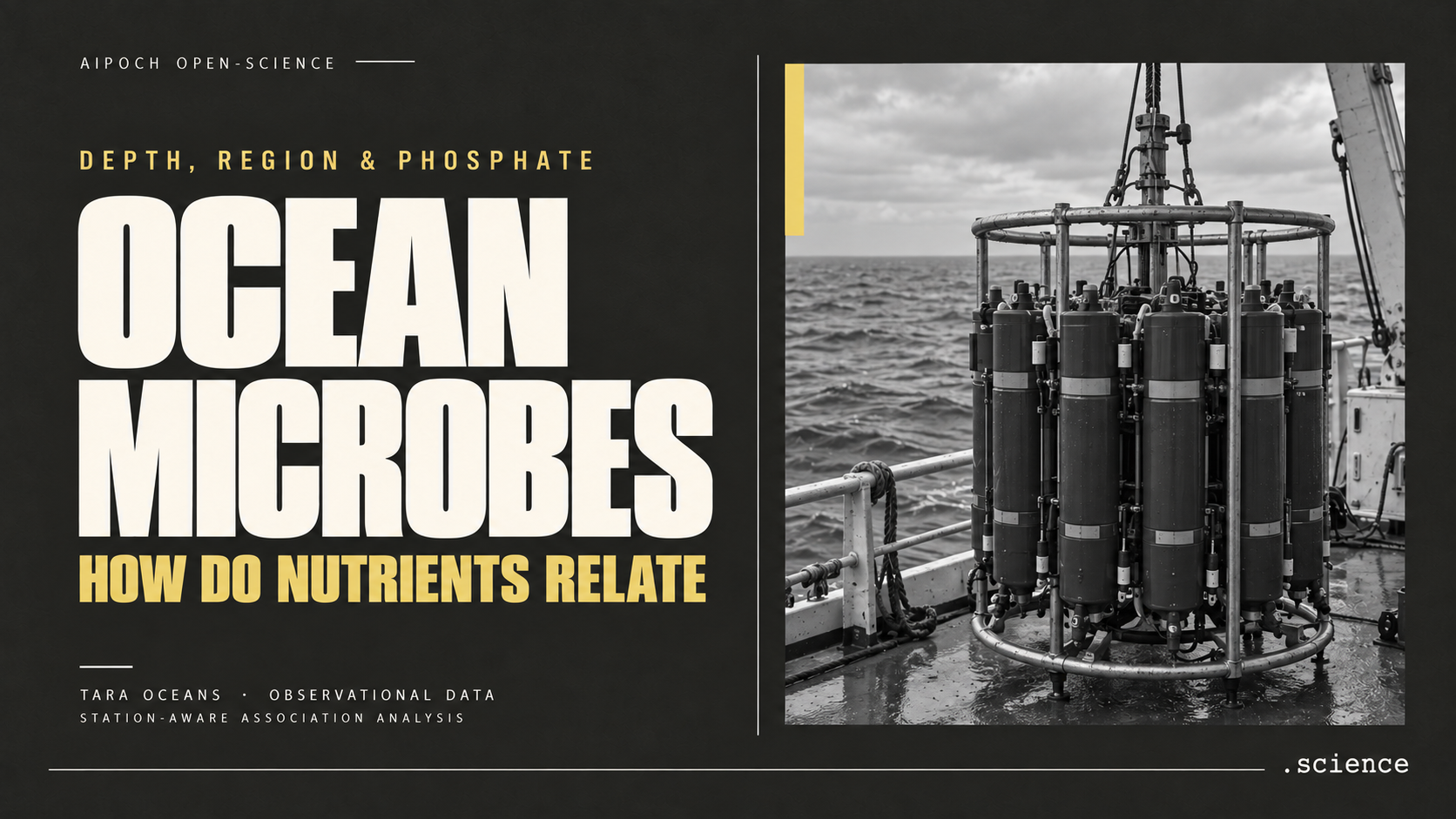
The unchanged research package comes from the upstream archive. It retains the original conversation and included scientific artifacts, including analysis code, results and figures. The poster is an AI-generated thematic illustration, not study evidence. This introduction summarizes archived findings; the analysis was not rerun. Later bounded checks do not certify the entire study or mean the original package was corrected.

Run this kind of analysis on your own question
Start a session and see how an AI co-scientist accelerates your research. Pay-as-you-go, nosubscription required.