What this research found
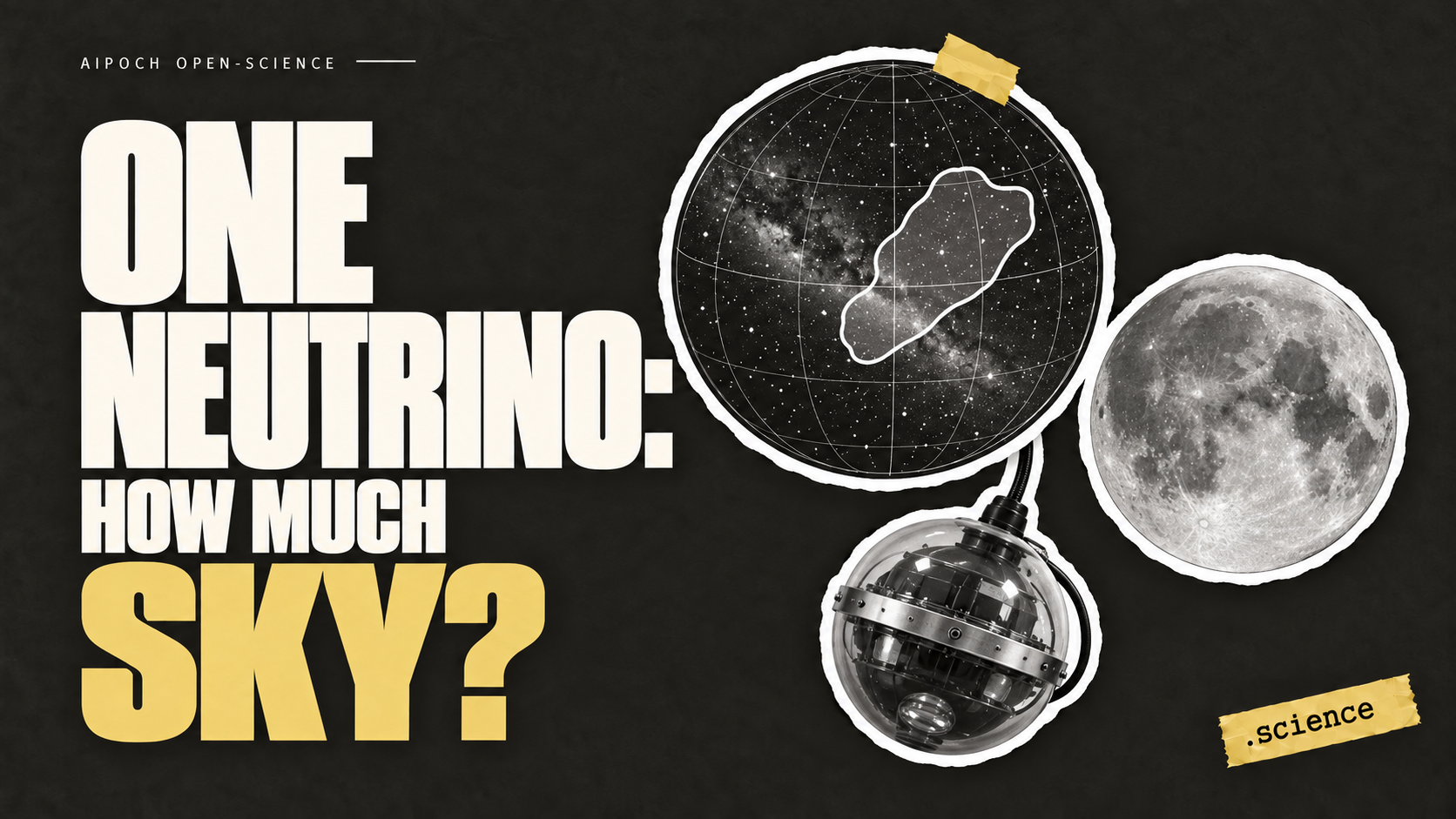
One Neutrino - How Much Sky
Research question
How large is an alert’s localization region compared with a familiar angular scale?
Audits archived IceCube alert notices and compares localization regions with an illustrative full-Moon area. Follow-up work reconciles checksums for HTML and text representations and preserves event classifications.
Data and comparison design
Audit primary circular coordinates and uncertainty bounds, calculate areas with an explicitly described geometry, and compare 50% and 90% regions with a full-Moon reference. Keep event reclassification separate from the map arithmetic.
Recorded findings
| Map summary | Recorded result | What it describes |
|---|---|---|
| Included candidate maps | 19 after excluding an air-shower-muon case | Keeps event interpretation distinct from map geometry. |
| Median 50% area | 1.29 full-Moon areas | Area enclosing half the map probability. |
| Median 90% area | 4.34 full-Moon areas | A larger containment region, not an exact source position. |
| Provenance checks | HTML and text checksums reconciled | Document identity, not independent astrophysical validation. |
After excluding an event identified as an air-shower-muon case, the archive reports median areas of 1.29 Moons at 50% and 4.34 at 90% for 19 candidates. Later checks reconcile HTML and text checksums.
A localization map assigns probability over an area. Its 50% and 90% contours answer different containment questions, and neither contour is the event’s exact source. Expressing area in full-Moon units gives the scale without changing the probability definition. The air-shower-muon exclusion is an event-interpretation correction; it is kept separate from the later agreement between HTML and text checksums.
What the comparison shows
A Moon-equivalent area is an illustration, not a complete probability-map description. Circular approximations and notice revisions remain relevant.
Assumptions and limits
Confidence definitions and notice revisions matter. The final provenance correction does not verify the latest FITS versions or completeness of the full notice history.
Sources and research materials
The original .science export and matching poster are preserved byte-for-byte from the upstream case. The package contains the conversation, session metadata, and the resources inventoried in its internal manifest. This introduction summarizes the archived record; the research, external sources, and model evaluations were not rerun for this import.
Run this kind of analysis on your own question
Start a session and see how an AI co-scientist accelerates your research. Pay-as-you-go, nosubscription required.