What this research found
Research question
What was actually evaluated under the requested poker-agent label?
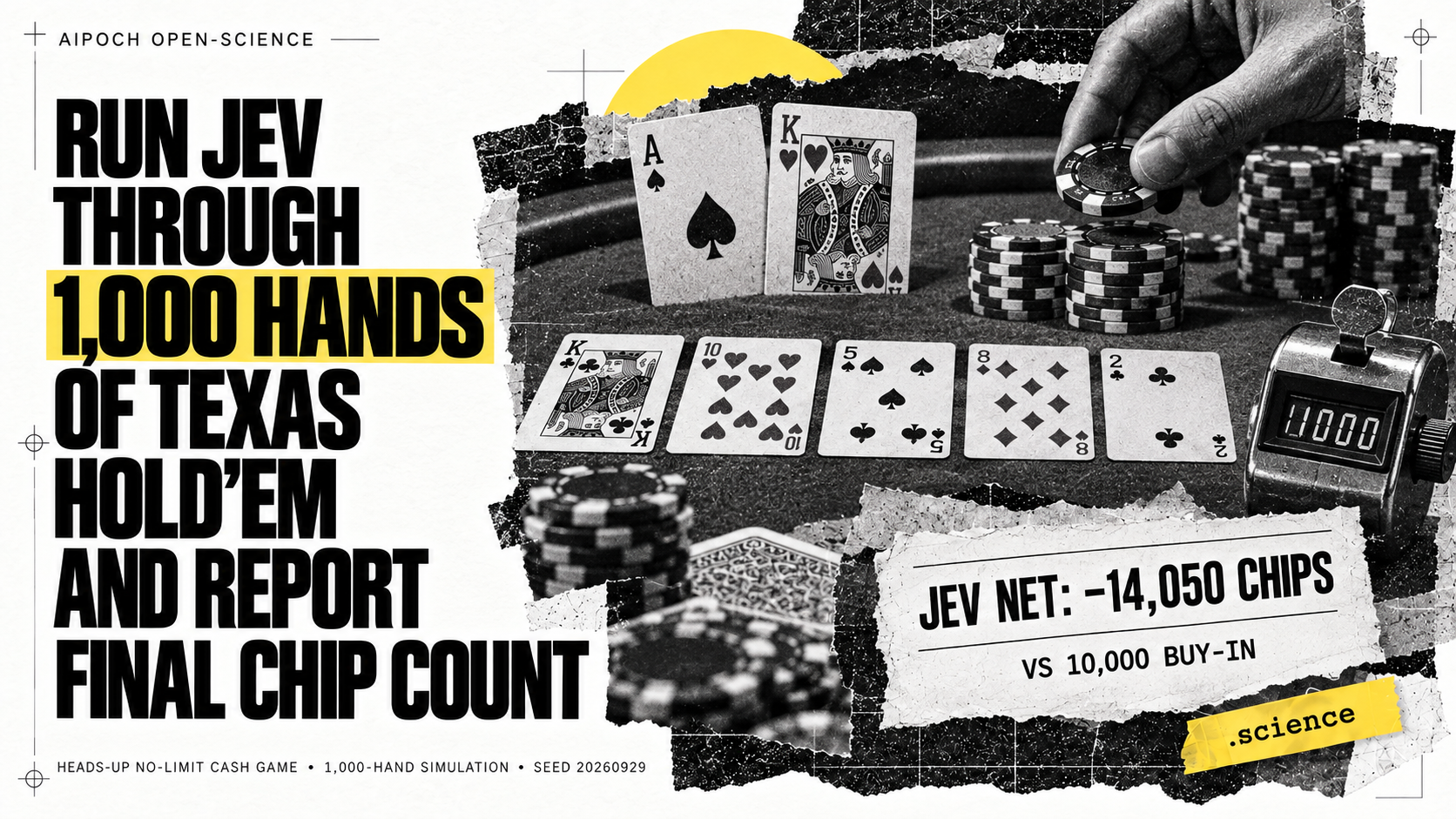
Runs a reproducible heads-up poker simulation with hand logs, seed, chip accounting, and a fixed opponent. The archive reports the outcome under a per-hand rebuy format.
Data and comparison design
The archived experiment uses a deterministic hand-strength/pot-odds bot and a hand-built heads-up engine, with a recorded seed and a rebuy to 10,000 chips each hand. Separate cumulative net chips from a conventional persistent bankroll.
Recorded findings
Result
JEV finished the 1,000 hands at net −14,050 chips (final bankroll −4,050 against the 10,000 per-hand buy-in). Its opponent finished at +14,050.
| Metric | Value |
|---|---|
| Hands played | 1,000 (of 1,000 requested) |
| Format | Heads-up No-Limit Texas Hold'em cash game, rebuy to 10,000 each hand |
| Seed | 20260929 (Mersenne Twister) |
| JEV win rate | 46.7% (467 wins / 528 losses / 5 ties) |
| JEV net chips | −14,050 |
| Opponent net chips | +14,050 |
| Chip conservation check | ✅ 20,000 conserved across all hands |
Important caveats (what "JEV" actually was)
- "JEV" is not a real model and isn't available in this session. I substituted a deterministic rule-based bot (
bot_decision(): hand-strength + pot-odds heuristic) as the poker player, per the recorded "let the agent decide" answer. This is not a neural/reinforcement-learning agent. - No RLCard or RL skill exists in this session, and there was no Skill marketplace search available. I hand-rolled a self-contained Texas Hold'em engine (deck, 7-card best-5 hand evaluator, heads-up betting rounds, pot accounting) in Python instead.
- The engine was verified: 5,000-hand chip-conservation test passed with zero leaks, and the betting-round logic was fixed after correction of an early infinite-loop/scoping bug.
Design decisions worth flagging
- Rebuy format: a continuous-bankroll heads-up match naturally ends when someone busts — the bot busted at hand ~56 with either strategy pairing. To genuinely play exactly 1,000 hands (the literal ask), The archived analysis used a cash-game rebuy design (each hand starts at 10,000), which is standard for this kind of simulation and makes "final chip count" a well-defined cumulative net figure.
- The bot's fixed strategy is slightly too loose (over-raises marginal hands), so it systematically lost to the tighter opponent. That's a real result, not a bug.
Artifacts
- jev_poker_1000_hands.science —
.sciencepackage (zip) containing the seed, environment config, hand logs, and README for forking
To fork it and swap in a real model: replace bot_decision / opponent_decision in the notebook with any model that maps (stage, hole cards, visible board, to-call, pot, stack) → fold/call/raise, then re-run the run cell. The engine and package are fully reproducible from the seed.
What the comparison shows
The label must not become a model-performance claim. Engine correctness, per-hand rebuys, and the fixed opponent constrain interpretation.
Assumptions and limits
The player labeled JEV was a deterministic heuristic bot, not the requested live model, and the engine was custom rather than RLCard. Rebuy accounting should not be read as a continuous real bankroll or a model benchmark.
Sources and research materials
The original .science export and matching poster are preserved byte-for-byte from the upstream case. The package contains the conversation, session metadata, and the resources inventoried in its internal manifest. This introduction summarizes the archived record; the research, external sources, and model evaluations were not rerun for this import.

Run this kind of analysis on your own question
Start a session and see how an AI co-scientist accelerates your research. Pay-as-you-go, nosubscription required.