What this research found
Research question
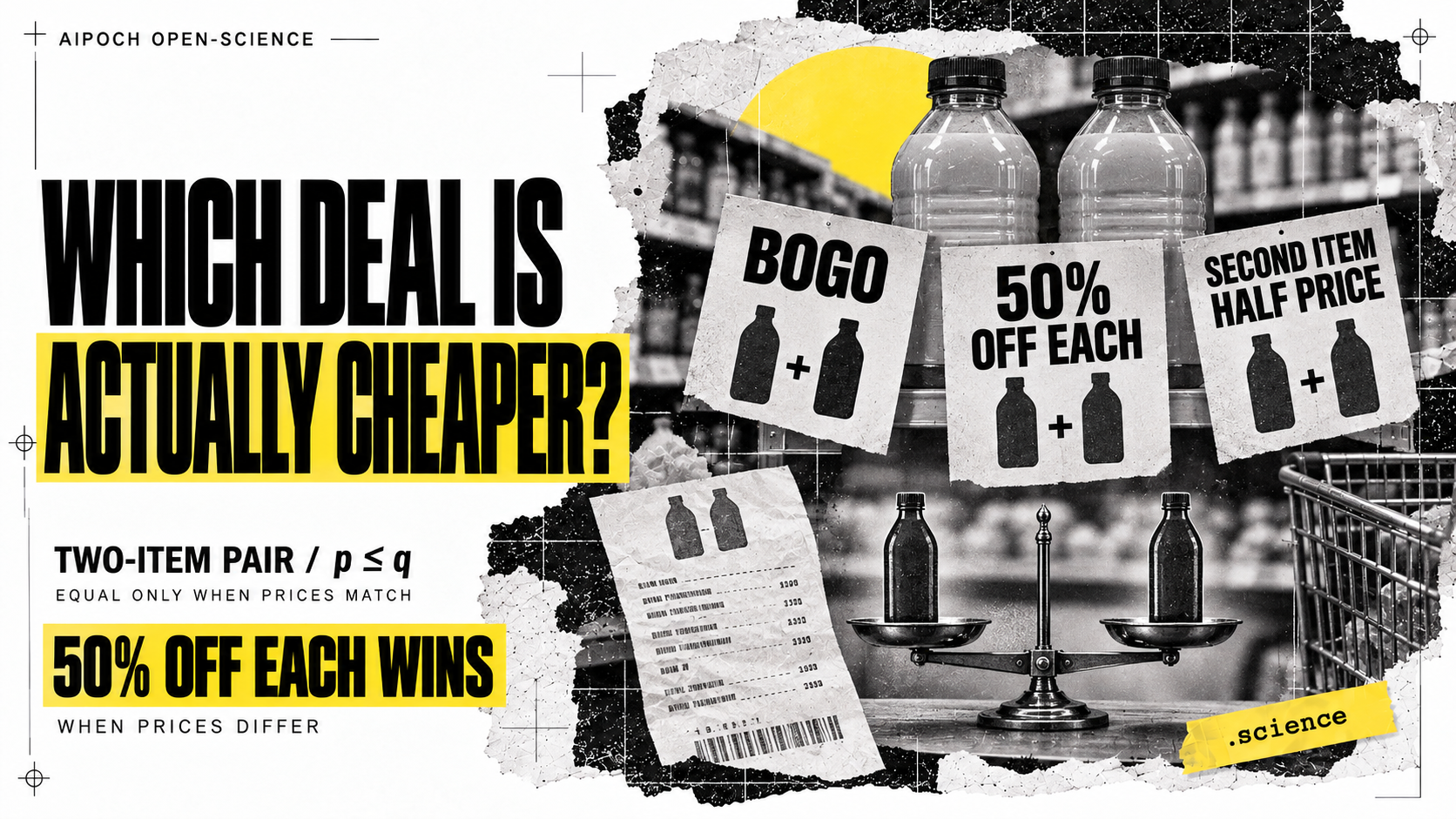
Which promotion minimizes checkout cost when the two products have different prices?
Models buy-one-get-one, half-price, and second-item-half-price promotions for equal and unequal item prices. The archive separates pair cost, per-item cost, and the case where only one item is wanted.
Data and comparison design
Let the lower price be p and the higher q. Under the stated cheaper-item-free rule, compare pair totals q for BOGO, (p+q)/2 for half-price each, and q+p/2 for a half-price second item. Keep pair cost separate from average item cost and the need for only one item.
Recorded findings
The answer depends on what you mean by “cheaper”:
- For a qualifying two-item pair, 50% off each is never worse than BOGO under the stated assumptions.
- They are equal only when the two item prices are equal.
- If the prices differ at all, 50% off each is cheaper.
- BOGO is always cheaper than “second item half price” for positive prices.
- If you only wanted one bottle, the promotions are operationally different: 50% off lets you buy one; BOGO and second-item-half require buying two.
Let the cheaper item cost p, the pricier item cost q, with 0 < p ≤ q.
| Promotion | Two-item trip cost | Average cost per item |
|---|---|---|
| BOGO — cheaper item free | q | q / 2 |
| 50% off each item | (p + q) / 2 | (p + q) / 4 |
| Second item half price | q + p/2 | q/2 + p/4 |
Break-even in plain language:
- BOGO vs. 50% off each:
q = (p + q) / 2 ⇒ q = p
They match only when the two items cost the same. If the pricier item costs even one cent more, 50% off each is cheaper. The trip-cost advantage of 50% off is (q − p) / 2, and the per-item advantage is (q − p) / 4.
- BOGO vs. second item half price:
q = q + p/2 ⇒ p = 0
With any positive-priced item, BOGO is cheaper. “Second item half price” costs exactly p / 2 more per trip, or p / 4 more per item, than BOGO.
For a one-bottle purchase:
- Under 50% off each, one bottle costs
p / 2. - Under BOGO, you must buy two bottles and pay
q. - Under second-item-half-price, you must buy two bottles and pay
q + p/2.
So if you only wanted one bottle, the 50%-off offer is usually the practical winner even in cases where the two-item unit-price comparison looks close.
Assumptions used:
- Promotions apply to one qualifying pair.
pis the cheaper item andqthe pricier item.- No coupons, loyalty points, tax effects, minimum spend, caps, or expiry constraints.
- “BOGO” means the cheaper item is free.
- “50% off” means both items are half price.
- “Second item half price” discounts the cheaper item, since that minimizes the pair cost.
- Per-item cost is the pair total divided by two items.
The table, figure, and assumptions were generated from the same executable model run.
What the comparison shows
The algebra depends on eligibility and which item receives the discount; it does not describe every retailer’s promotion wording.
Assumptions and limits
The arithmetic assumes the stated eligibility and cheaper-item rules. Taxes, exclusions, quantity needs, and store-specific terms can change a real purchase comparison.
Sources and research materials
The original .science export and matching poster are preserved byte-for-byte from the upstream case. The package contains the conversation, session metadata, and the resources inventoried in its internal manifest. This introduction summarizes the archived record; the research, external sources, and model evaluations were not rerun for this import.
Run this kind of analysis on your own question
Start a session and see how an AI co-scientist accelerates your research. Pay-as-you-go, nosubscription required.