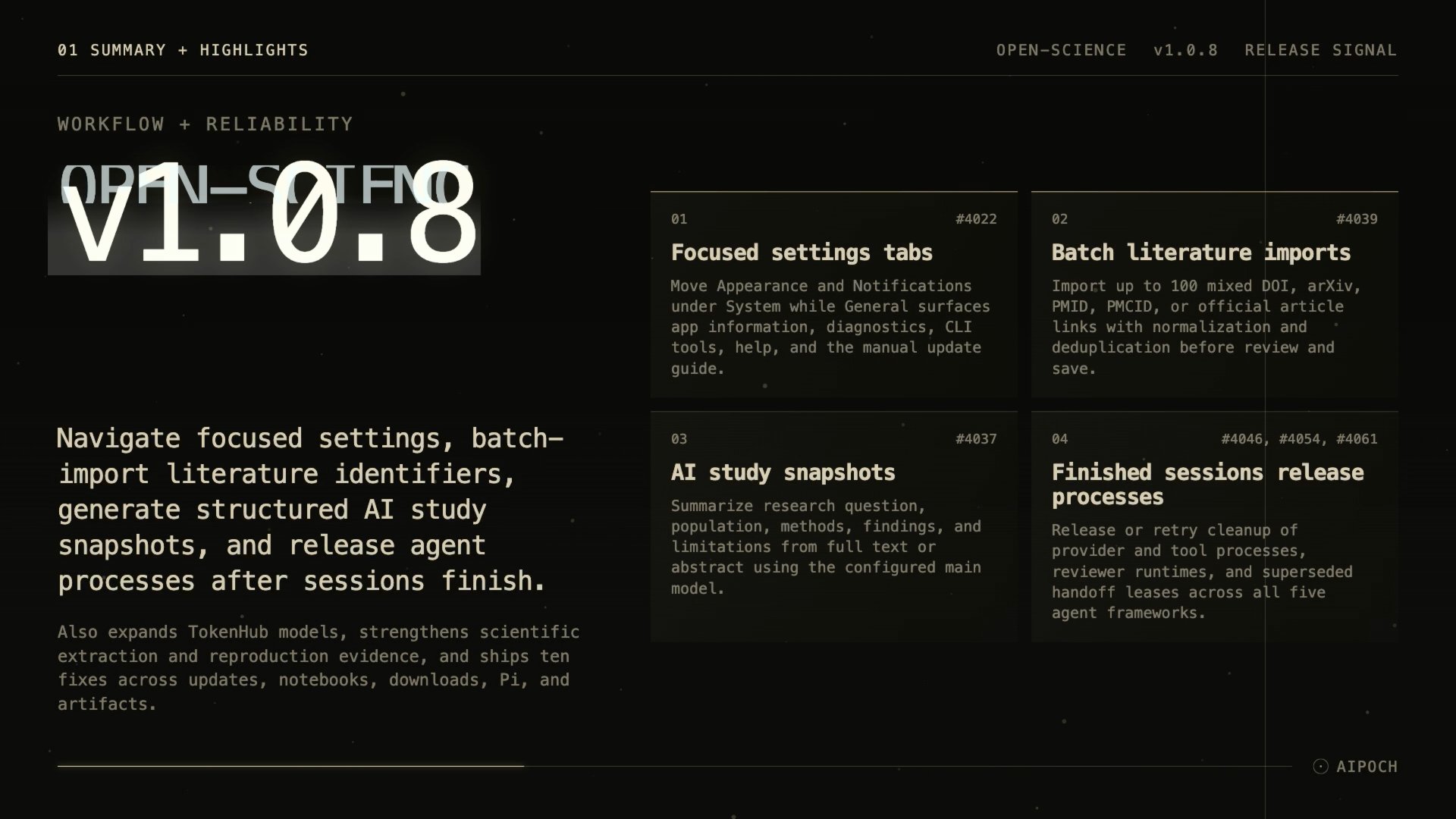
Open-Science v1.0.8 reorganizes settings, imports references in bulk from identifiers, adds AI study snapshots, and frees agent processes when sessions end.
Open-Science is AIPOCH's open-source, local-first AI research workbench, available at aipoch.com/open-science, that helps scientists run reproducible, inspectable work across models and platforms.
What new capabilities help researchers stay organized and keep the desktop responsive?
Tabbed settings
Settings previously mixed general preferences, appearance, notifications, diagnostics, and help in one long list, so reaching setup guidance meant hunting through unrelated options. General settings now split into focused tabs: Appearance and Notifications move under System settings, while General surfaces app information, diagnostics, command-line tools, and help resources — including a direct link to the manual installation and update guide. Researchers reach configuration and setup help from one organized place instead of digging through a crowded panel.
Bulk reference import
Building a reading set meant adding one reference at a time, and mixing DOI, arXiv, and PubMed identifiers was awkward. Add from DOI or link now accepts up to 100 mixed identifiers per import — DOI, arXiv ID, PMID, PMCID, or official article links — normalizing and deduplicating them before the usual review and transactional save. Researchers paste a batch of identifiers from a clipboard or reading list and resolve duplicates before anything lands in the library.
AI study snapshots
Judging whether a paper deserves a close read took time, and the detail view showed raw text only. The literature detail view gains an AI snapshot card that summarizes a paper into five structured sections — research question, study population, methods, main findings, and limitations — generated with the configured main model from the full text or abstract, and labeled by which it used. Researchers see a structured summary and know whether the model read the full text or only the abstract before committing to a deep read. The snapshot reflects the configured model and is not a substitute for reading the paper.
Finished sessions release their agent processes
Across many sessions in a long workday, provider and tool processes accumulated in memory and slowed the desktop. Completed sessions across all five agent frameworks now release their provider and tool processes: shared reviewer runtimes, superseded handoff leases, and failed cleanup attempts are retired or retried until confirmed. Sequential sessions no longer pile up memory, so the desktop stays responsive through many runs in one day.
What else is new in v1.0.8?
- Tencent TokenHub model refresh. TokenHub gains the Hy4 reasoning model and current DeepSeek V4.1 Flash routes with 1,000,000-token context windows, plus image input for GLM-5.3-Flash, Kimi K3, and MiniMax M3.
- eQTL Catalogue access restored. Queries work again after the upstream REST API was retired, now using indexed files, and the tool validates that coordinates use the GRCh38 assembly instead of silently returning misleading matches.
- More reliable PDF reading and extraction. Automatic ordering uses positioned text evidence to separate prose columns from table rows, crop boundaries are verified against the native source, ambiguous table cells keep their original text with a reliability warning, and the Windows PDF worker no longer crashes during teardown.
- Clearer update and recovery messages. Update dialogs now name the blocking process instead of printing full system paths, and desktop recovery failures keep their actual error evidence in diagnostic packages and logs instead of reporting only a generic failure.
- More honest R reproduction coverage. Scientific calls that can force arguments or dispatch methods now revoke stale file proofs, so downstream verification no longer overstates which files a result depended on.
Bug fixes that affect daily use
- macOS and Windows updates unblocked: ordinary read-only file holders such as the StoreKit agent no longer block macOS updates, and Windows no longer misclassifies the application's own backend processes as foreign during update preparation.
- Windows update inspection corrected: inspection no longer reports unknown occupancy when system tools are missing from PATH or scans run long, and stale Notebook receipts no longer block recovery after process-ID reuse.
- Saved downloads no longer error on unreadable folders: a saved download no longer ends with a permission error when the destination directory itself is not readable; the completed file stands.
- Sandbox network access restored: sandboxed notebook command-line tools fall back to the application's own Node runtime when the PATH version is too old to use the configured proxy, fixing network access inside the sandbox.
- Windows gateway checks no longer false-fail: protection checks no longer close a healthy shared gateway between probes and report a false runtime failure.
- Stale PDF-add notices cleared: searching again for a paper clears the previous "PDF could not be added" notice once the new search succeeds.
- Pi installs in the packaged desktop app: Pi now installs correctly instead of failing while locating its bootstrap files.
- Duplicate model notice removed: the composer no longer shows a duplicate unavailable-model notice next to the model picker status.
- Artifact download no longer crashes the backend: a download that finishes and then fails while releasing its capability no longer escapes as an unhandled error that can terminate the backend.
- Markdown provenance repaired: Markdown artifacts repair a stale provenance head left by older versions when opened, and the provenance panel now explains incomplete execution evidence explicitly.
Disclaimer
Open-Science assists researchers with literature, execution, and reproducible workflows, but it does not replace scientific judgment or peer review. AI study snapshots and summaries reflect the configured model and the text available at generation time; they are not a substitute for reading the source. Inspectable provenance evidence supports reproducible execution, but replay reproduces recorded steps rather than re-executing them, and solver-exact equivalence remains open.