By AIPOCH, the team behind AIPOCH Open-Science. Prepared September 23, 2026.
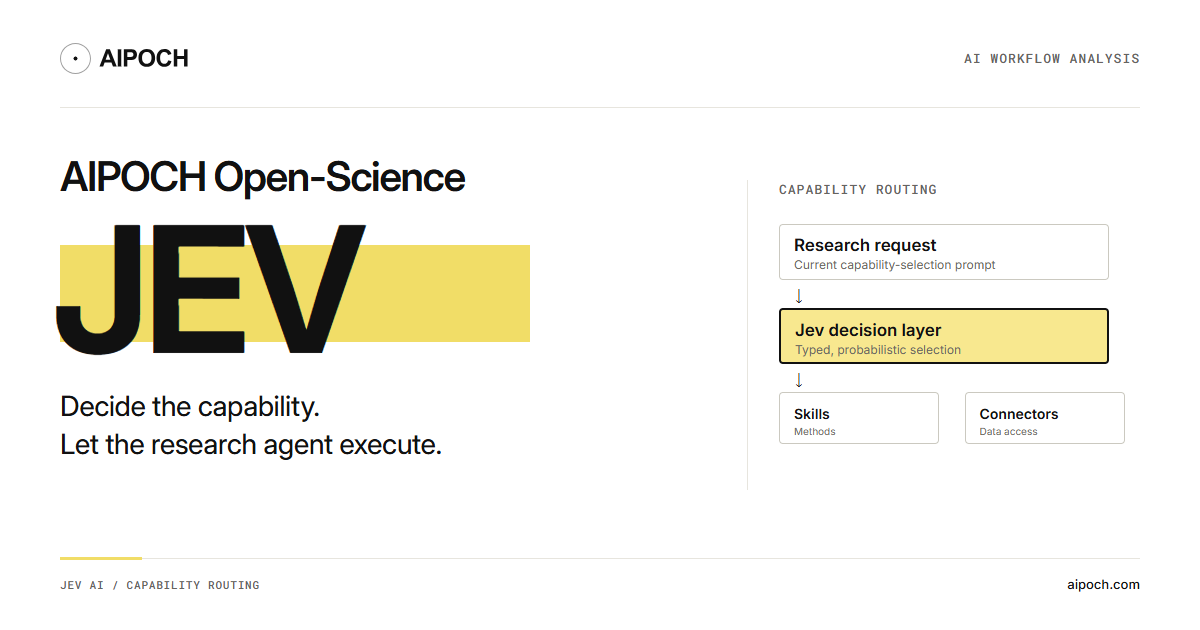
Jev is attracting attention because it makes bounded, typed decisions instead of acting as another chatbot. AIPOCH Open-Science applies that idea to research workflows: Jev can optionally help select relevant Skills and Connectors before a supported research-agent turn, while the conversation model performs the work.
Key Takeaways
- Jev is TypeSafe AI's decision model, not a general-purpose writing or chat model.
- Vercel reported fast first-day adoption on its AI Gateway, but early usage is not evidence of long-term performance.
- AIPOCH Open-Science first added optional Jev-based capability selection in v0.31.1 and expanded classification configuration in v0.32.0.
- Jev chooses potentially relevant capabilities. It does not perform the scientific analysis, grant permissions, or guarantee that a selected capability is correct.
Why Did Jev Become an AI Talking Point So Quickly?
TypeSafe AI introduced Jev on September 15, 2026 as its first public "System One" model. The company describes the model's interface as "unstructured state in, typed probabilistic decisions out" (TypeSafe AI). Instead of generating a paragraph, Jev answers predefined Choice, Score, or yes-or-no probability questions.
Vercel reported that nearly 13% of its paid AI Gateway teams used Jev within its first 24 hours on the platform, more than twice the GPT-5.6 family's first-day share in Vercel's comparison (Vercel). Jev is also listed by OpenRouter and Cloudflare.
Those signals establish fast early interest across several developer platforms. They do not establish durable adoption, scientific accuracy, or a universal latency advantage.
Jev Is a Decision Model, Not a Chat Model
Jev is useful when software already knows the allowed answer space but still needs a model to interpret messy input.
| Workflow need | General-purpose language model | Jev decision model |
|---|---|---|
| Output | Open-ended text, code, or structured output | A predefined choice, score, or probability |
| Best fit | Explanation, generation, analysis, and conversation | Classification, routing, scoring, and bounded gates |
| Application responsibility | Parse and validate the response | Define the questions, options, thresholds, and next action |
| Main risk | Unsupported content or invalid structure | A validly typed but incorrect decision |
A constrained output cannot invent a category outside the supplied options. The judgment can still be wrong, so confidence needs calibration and consequential decisions need validation or human review.
How AIPOCH Open-Science Uses Jev Before the Research Agent Starts
AIPOCH Open-Science v0.31.1 introduced an optional classification service for automatic capability selection. Its version-tagged catalog includes TypeSafe AI's jev-latest and OpenRouter's typesafe/jev-1.13 (source catalog).
The integration separates two jobs:
- Capability selection: the classifier reviews the current request together with available capability names and descriptions, then returns up to three clear Skill or Connector matches.
- Research execution: the main conversation model uses the selected capabilities to work on the request, subject to the existing permissions, runtime, and user choices.
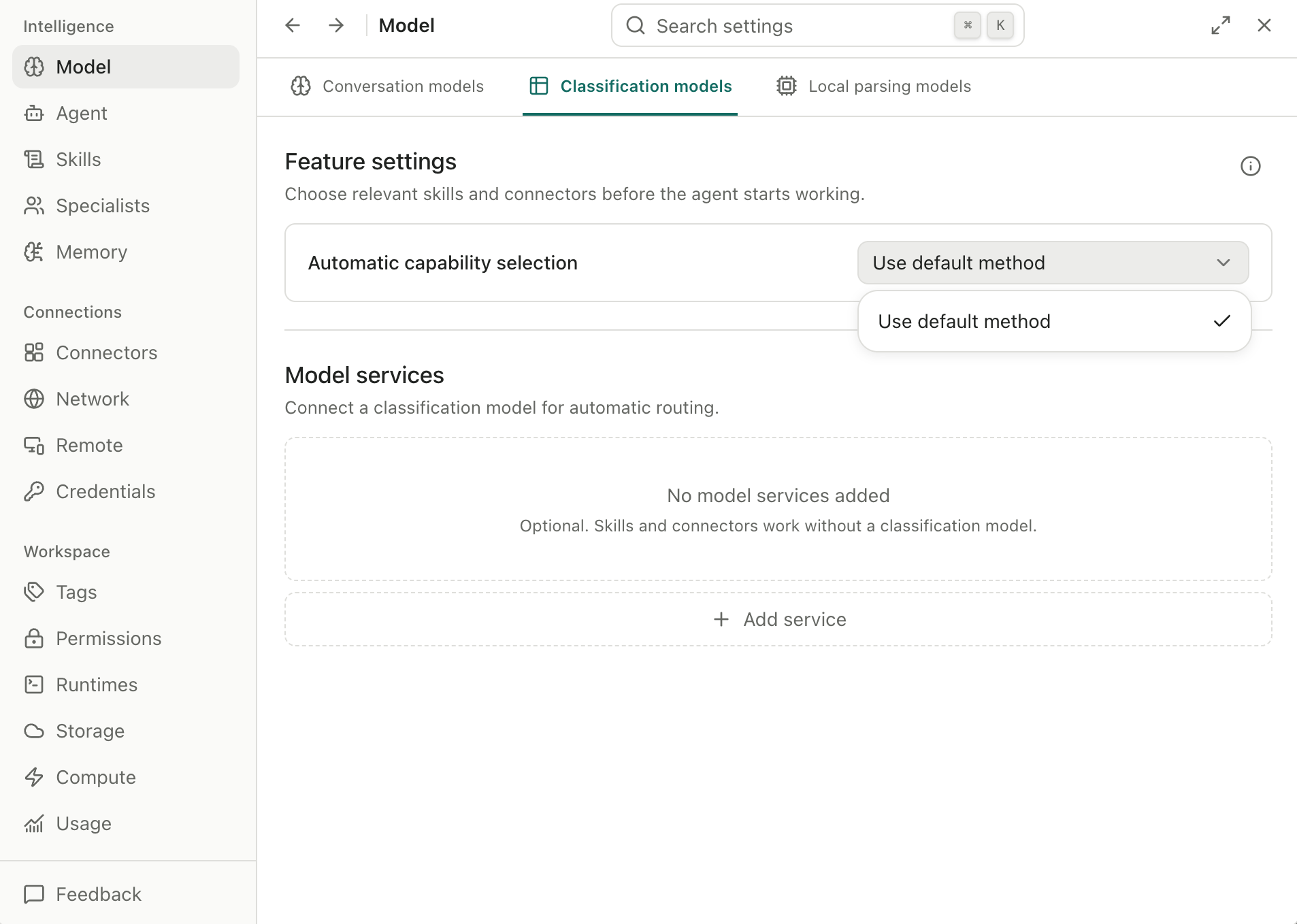
AIPOCH Open-Science keeps classification models separate from conversation models. Skills and Connectors continue to work when no optional classification service is configured.
The merged implementation notes set important boundaries. Explicit user selections remain authoritative. Missing configuration, uncertainty, invalid responses, or service failures preserve the existing selector. The classifier receives the current request plus capability names and descriptions, not conversation history or local file paths, and its prompts and answers are not persisted. Teams should still review provider data terms.
Why This Separation Matters in a Scientific Workbench
Scientific work often begins with a routing problem. A request to interpret a marker-gene list may need a gene-set enrichment capability. A request about a sequencing accession may need an archive connector. A request to reproduce an analysis may need a coding or Notebook workflow.
Using a dedicated decision model for this bounded step lets the main model focus on research. The classifier follows a narrow contract: propose candidate capabilities, then return control to the workbench. Jev is not a replacement for a research agent.
Selecting a gene-enrichment connector does not validate the input list, choose a statistical background, interpret biological significance, or review the result. AIPOCH Open-Science keeps those steps in the research workflow, where methods, evidence, permissions, and researcher judgment remain visible.
How to Configure Jev in AIPOCH Open-Science
The feature is optional. To configure it:
- Open Model > Classification models > Add service.
- Choose a supported TypeSafe AI or OpenRouter route, enter the required credentials, and save the service. Credentials are checked before the settings are accepted.
- Select the saved service under Automatic capability selection. Adding a service alone does not activate it.
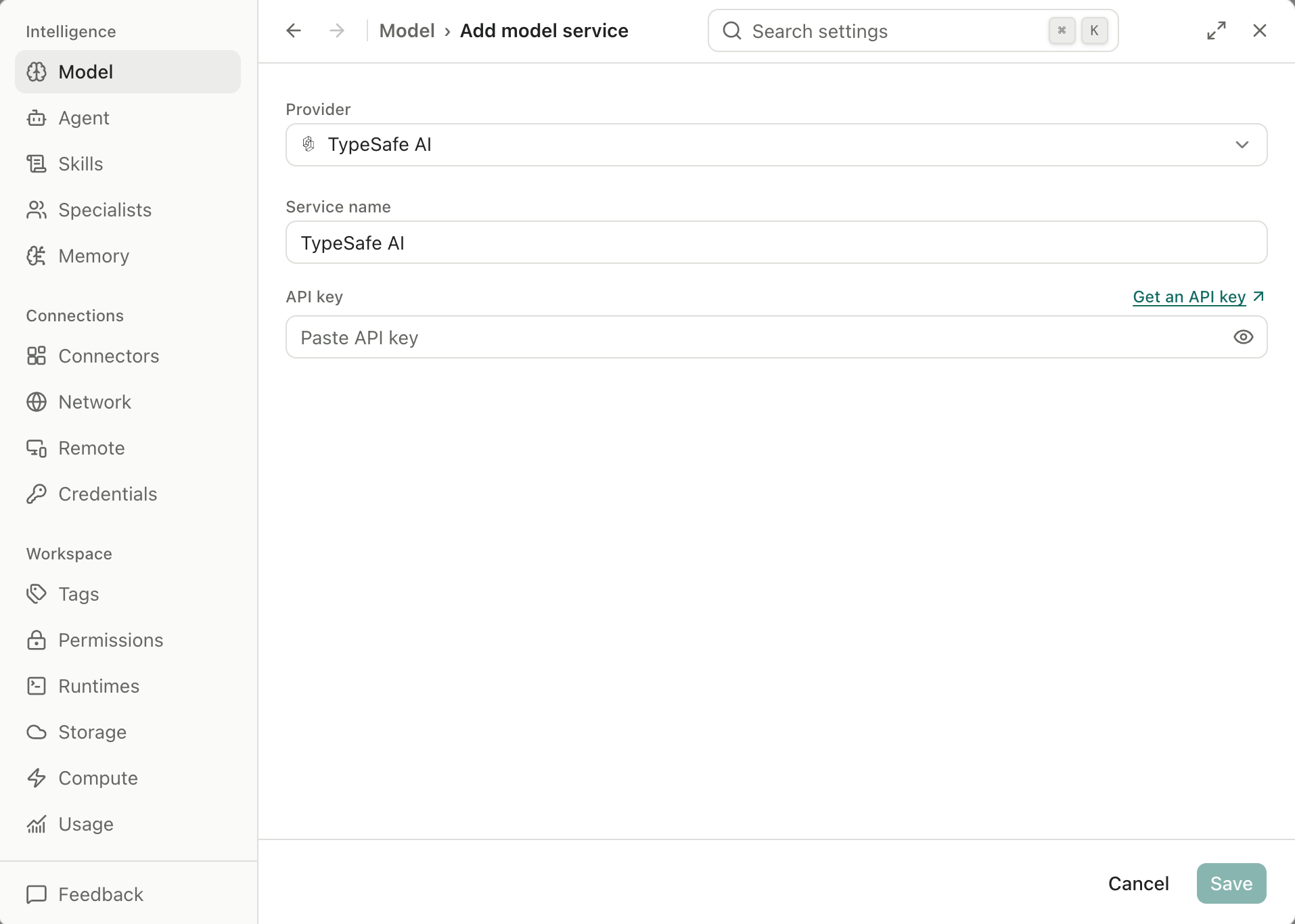
The TypeSafe AI configuration form shows an empty API-key field. It documents setup, not a completed classification call or measured performance result.
In v0.31.1, the optional route applies only to eligible primary CodeBuddy and Codex Chat Completions turns. Claude, OpenCode, native Codex Responses, reviewers, delegated tasks, and continuations keep their existing paths. AIPOCH Open-Science v0.32.0 subsequently added custom TypeSafe-compatible classification services.
What Should Researchers and Agent Builders Do Now?
Treat Jev as a routing component to evaluate, not as a scientific authority.
- Start with a bounded task. Use requests where the appropriate capability can be checked manually.
- Compare routing outcomes. Record what the dedicated classifier selects versus the default method.
- Inspect failures and fallbacks. Confirm that uncertain or unavailable classifications do not block the research workflow.
- Review data flow and permissions. Check what the classification provider receives and what the selected capability is allowed to do.
- Keep human review for high-impact work. A probability is evidence about model confidence, not proof of scientific correctness.
Do not replace the main research model with Jev, assume every backend uses it, or repeat vendor performance claims as AIPOCH benchmark results.
Frequently Asked Questions
Is Jev an LLM or chatbot?
Jev is a hosted decision model from TypeSafe AI. It returns typed choices, scores, and probabilities rather than open-ended chat responses.
Do I need Jev to use AIPOCH Open-Science Skills and Connectors?
No. Dedicated classification is optional. Skills and Connectors continue to work with the default capability-selection method.
Does AIPOCH Open-Science send the full conversation to Jev?
The v0.31.1 implementation says the classifier receives the current selection request and capability names and descriptions, not conversation history or local file paths. Teams should still evaluate the provider's current data terms before configuration.
Which version first added Jev support?
AIPOCH Open-Science v0.31.1 first shipped the dedicated classification service and Jev catalog entries. Version v0.32.0 added custom TypeSafe-compatible classification endpoints.
From AI Hype to a Testable Research-Workflow Decision
Jev's launch matters because it makes a clear architectural argument: not every model call needs to generate language. In AIPOCH Open-Science, that argument becomes testable. A bounded classifier can propose relevant Skills and Connectors, while the main research agent, existing permissions, and the researcher retain responsibility for execution and review.
Explore the open-source implementation, read the v0.31.1 release overview, or download the latest AIPOCH Open-Science release and test capability selection with a task whose expected route you already understand.
AIPOCH Open-Science supports research workflows and does not replace scientific judgment, domain validation, or peer review. Jev performance claims from TypeSafe AI are vendor-reported unless explicitly identified otherwise.