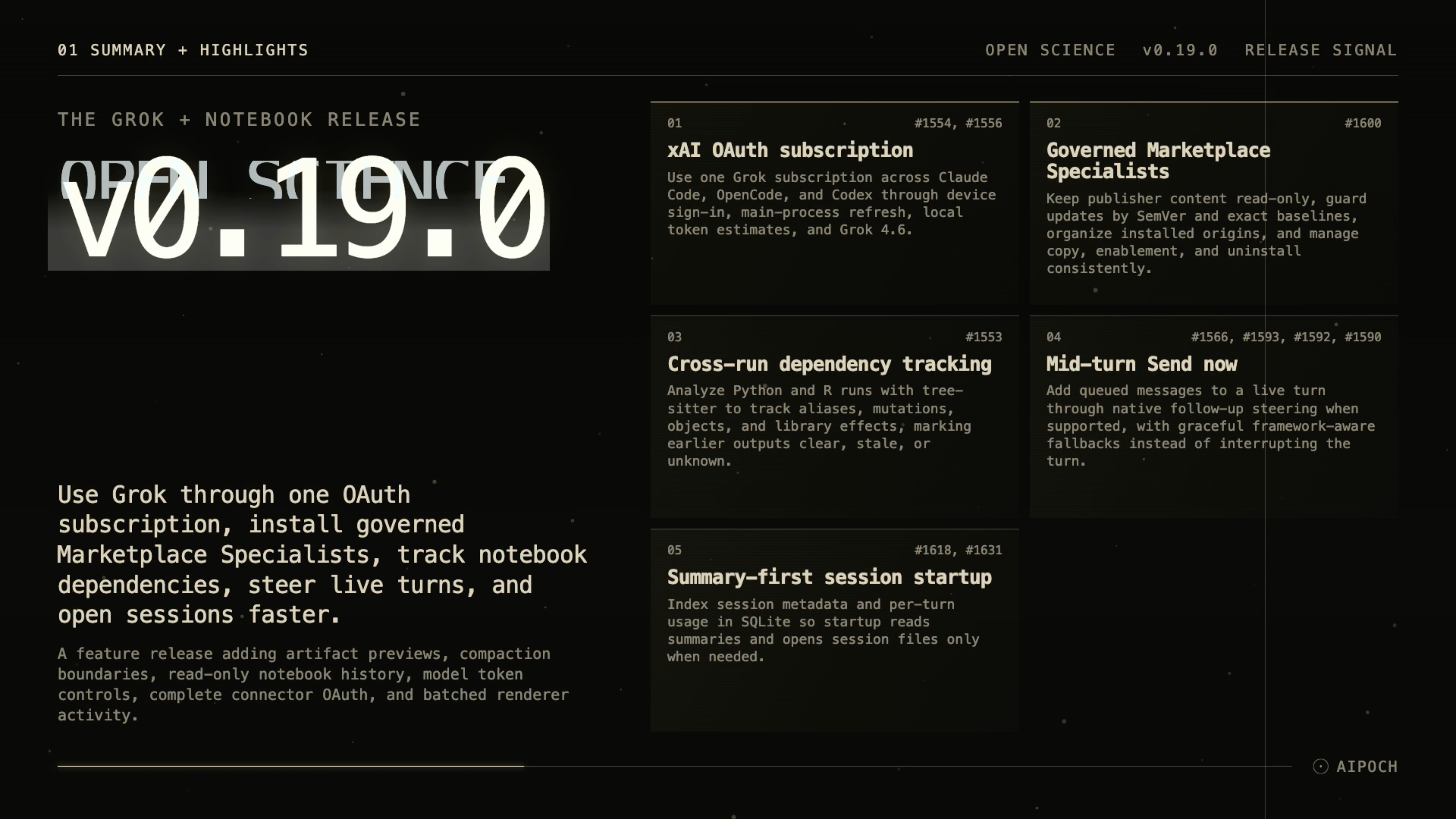
Open Science v0.19.0 adds Grok OAuth, governed Marketplace Specialists, notebook dependency tracking, mid-turn steering, and faster session startup.
Open Science is the local-first AI research workbench from AIPOCH, designed to support reproducible execution while keeping research activity and inspectable provenance evidence visible.
Published on August 24, 2026, v0.19.0 is a feature release focused on provider access, governed Specialist packages, notebook state, live-turn control, and faster workspace navigation.
What new capabilities help researchers connect, inspect, and stay in flow?
xAI (Grok) OAuth subscription
Researchers who use different agent runtimes can otherwise face separate provider setup paths for each protocol. That adds configuration work and makes it harder to use one subscription consistently across research sessions.
Open Science v0.19.0 adds an app-owned xAI device-code sign-in that can use one Grok subscription across Claude Code through Anthropic Messages, OpenCode through Chat Completions, and Codex through Responses. Traffic is routed through the xAI Responses API, Grok 4.6 is the default model, token counts for the Anthropic route are approximated locally, and the main process refreshes tokens with one retry after an authorization failure.
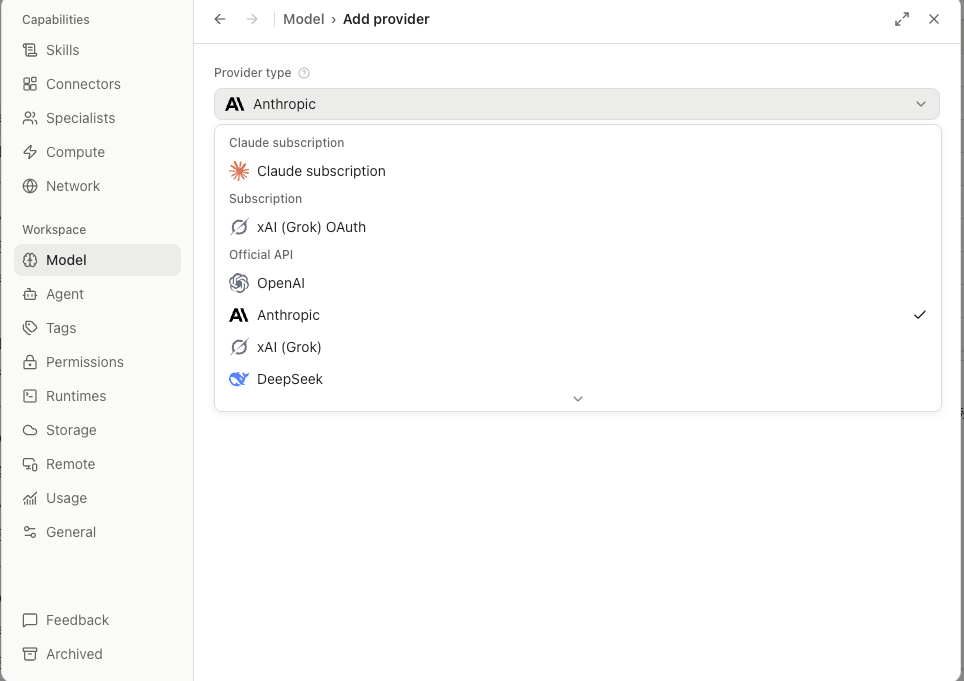
Researchers can use a single xAI subscription across all three supported agent protocols. Compatibility still depends on the active framework and its supported endpoint route; this is not a unified model gateway.
Governed Marketplace Specialists
Installed Specialist packages need a clear boundary between publisher-owned content and local preferences. Without one, manual replacement or an ambiguous update can make it difficult to tell which package version is installed and which parts remain publisher controlled.
Marketplace-installed Specialists now carry an explicit Marketplace origin. Publisher content is read-only, while the icon, color, and enabled state remain editable. Manual ZIP overwrite is blocked, updates require a higher semantic version against an exact content baseline, and Installed views separate All, Custom, Marketplace, and Built-in groups. The managed detail view supports quiet update availability, an editable copy, enable or disable controls, and tailored uninstall confirmation.
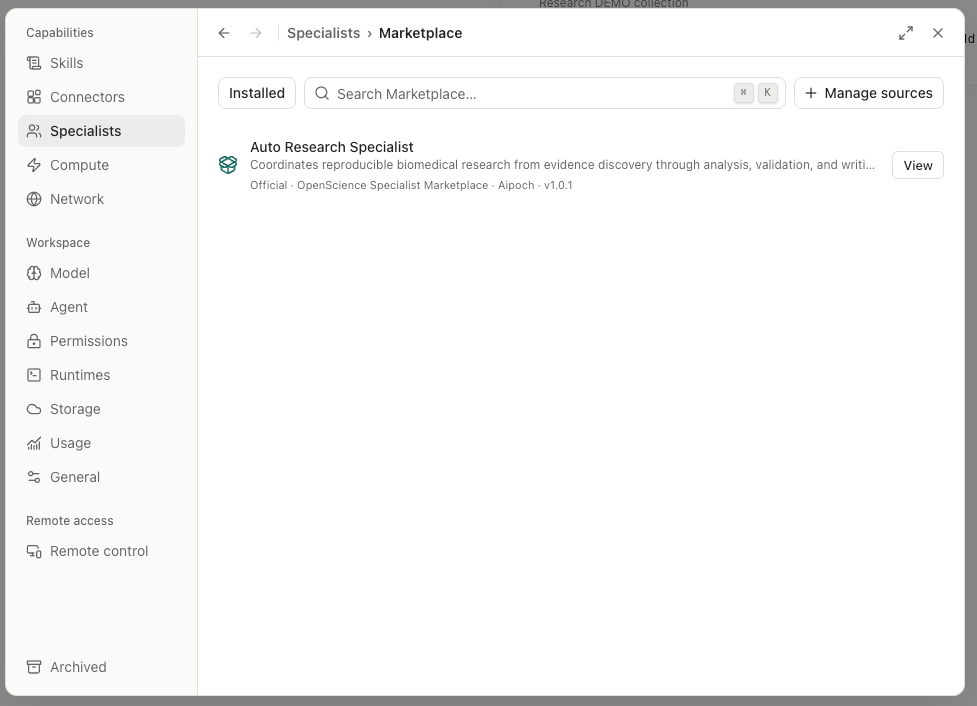
This gives researchers a more inspectable package lifecycle while preserving local presentation choices. Creating an editable copy is the supported path when publisher content needs modification.
Notebook cross-run dependency tracking
Notebook outputs can become misleading when a later run changes a variable, mutates an object, or alters a library-managed state that an earlier result depended on. A static output may still look current even when its inputs have changed.
Version 0.19.0 analyzes completed Python and R runs in process with tree-sitter WASM. The analysis tracks aliases, root-object mutations, classes, common Python and R object models, copy and reference behavior, and selected scientific-library effects. Earlier outputs can be labeled clear, stale, or unknown according to the dependency evidence available.
Researchers can identify outputs that may need to be rerun instead of assuming every displayed result reflects the latest variable state. These labels describe tracked execution dependencies; they do not validate scientific methods or conclusions.
Mid-turn Send now
A queued follow-up can become urgent while an agent turn is still running. Interrupting and resending the entire turn risks losing momentum or leaving the session in a confusing resume state.
In v0.19.0, Send now can add a queued message to a live turn through the framework's native follow-up steering when that capability is available. The compatibility layer does not open a second prompt interaction, defers queued sends correctly around permission responses, surfaces resume failures on the queued item, and uses framework-aware fallbacks when native steering is unavailable.
Researchers can steer supported live turns without canceling them. Behavior remains framework dependent, so fallback handling may differ from native steering.
Summary-first session startup
Large workspaces become slow to open when the application must parse every session file before showing navigation, counts, search results, and usage information.
Open Science v0.19.0 indexes session query metadata and per-turn usage in SQLite as a materialized view. Healthy startup reads these summaries and opens a full session file only when that session is opened or exported. Session-renderer history scans are also reduced to one per stream batch.
Researchers can reach projects and sessions faster without removing the underlying session files or their detailed records.
What else is new in v0.19.0?
- Message-artifact previews. Managed file links and Markdown artifact images in messages can resolve by stable artifact and version ID, managed path, or unique filename, then open in the existing preview workbench with zoom controls.
- Notebook preview states. Figures can appear inside tool groups, the current-session preview follows the latest output, previews open when notebooks become available, and terminated notebooks remain available as read-only previews.
- Compaction transcript boundaries. Context compaction appears as a non-interactive transcript boundary with distinct active, completed, failed, and canceled states instead of looking like a tool call.
- Archive undo. The standard desktop undo shortcut restores the most recently archived item.
- About and feedback access. The About screen now presents app identity, updates, Help Center, and release-note resources in a redesigned layout, with a feedback entry in Settings.
- Custom model token controls. Custom providers can define separate context-window, input-cap, and output-cap values through editable presets; reasoning controls are limited to shapes the model supports.
- Complete connector OAuth lifecycle. First-save authorization uses a cancellable dialog that is reused for sign-in, recovery, retry, and finish-later flows. Runtime invalidation can show a session-local action toast, and pre-registered redirect URIs are supported.
- DeepSeek vision model.
deepseek-v4-flash-vision-expjoins the model catalog. - Batched renderer activity. Tool bursts coalesce into IPC batches, live non-text events drain in batches, and installer logs are batched with capped renderer retention.
Bug fixes that affect daily use
- Agent identity and capability scope are isolated. Agent identity no longer leaks across capability boundaries.
- Live Send now avoids hung state. Follow-up steering no longer leaves resume or interrupt handling hanging while a turn remains active.
- Notebook kernel routing is more reliable. Input routes to the selected kernel, only used kernel tabs appear, idle input remains available during refresh, the R namespace survives cancellation, and historical runs can be analyzed without a live interpreter.
- Notebook boundaries reject malformed inputs. Parser runtimes load only when needed, protocol output lines are bounded, malformed host connector calls and unknown environment languages are rejected, the macOS developer-tools Python stub is skipped, and approved run status survives state reads.
- Codex and Claude failures are handled more clearly. Incompatible and transient Codex ACP failures are handled, the legacy Codex provider slot negotiates correctly, and persisted or live Claude API connection failures no longer appear as reports.
- Composer and queue state stays visible. Slash shortcuts remain visible, Specialist selection appears while switching, messages show during runtime admission, and retained plan-approval revisions refresh correctly.
- Delegation history avoids collisions. Imported subagent history marks incomplete records and prevents replayed activity collisions.
- Updater handoffs are preserved. In-flight checks finish before download begins, and the macOS update handoff remains intact.
- Startup recovery is clearer. Database checks are separated from composition delays, loading animation remains continuous, and catalog recovery overlays can be dismissed.
- Session choices stay scoped. Composer model choices remain attached to their sessions, unsaved local titles survive newer remote upserts, overlapping idle sends are rejected without failing the live turn, stale registry reachability refreshes on focus, and Specialist-switch recovery is exposed.
- Stale reads are rejected. Preview, tag-mutation, and granted-folder refresh snapshots do not overwrite newer state.
- Artifacts, compute, and connectors recover more safely. Finalization uses the default repository, retried jobs deduplicate, transient custom MCP connections recover, Specialist controls align, context navigation disables during deletion, and unexpected action failures are localized.
- Notebook static context stays bounded. Static notebook context is kept within its configured budget.
Install or update
Open Science v0.19.0 is available for:
- macOS 12 or later on Apple Silicon or Intel: download the matching DMG.
- Linux x64: download the AppImage or Debian package.
- Windows 10 or 11 x64: download the Windows installer.
Choose the appropriate package from the Assets section of the Open Science v0.19.0 release. The onboarding wizard can inspect the environment and configure an app-managed agent runtime, and an existing installation can update in place.
Official macOS release builds are Developer ID signed and notarized. Windows builds do not yet have an Authenticode certificate, so SmartScreen may show an “unrecognized app” prompt. Confirm that the installer came from the official release page before continuing.
Resources
- Open Science v0.19.0 release notes and downloads
- Open Science product page
- AIPOCH
- AIPOCH Blog
- Specialist AI Agents in Open Science: Roles and Scope
- What Model-Agnostic Means in Open Science
- How Open Science Extends a Research Agent
FAQ
Is Open Science v0.19.0 a feature release?
Yes. Open Science v0.19.0 is a feature release published on August 24, 2026. Its main additions cover xAI OAuth, governed Marketplace Specialists, notebook dependency states, live-turn follow-ups, artifact previews, and summary-first startup.
Can one Grok subscription work with Claude Code, OpenCode, and Codex?
Yes. In v0.19.0, one xAI OAuth subscription can route supported traffic for Claude Code, OpenCode, and Codex through the xAI Responses API. Each runtime still uses its compatible protocol path, and provider choice remains constrained by framework compatibility.
Does a clear notebook dependency state prove that an output is scientifically valid?
No. clear, stale, and unknown describe the dependency evidence tracked across Python and R runs. They do not validate the analysis method, source data, statistics, interpretation, or conclusion.
Can researchers edit a Marketplace Specialist's publisher content?
No. Marketplace publisher content is read-only in v0.19.0. Researchers can still change the icon, color, or enabled state, or create an editable copy when they need to modify the package content.
Which platforms support Open Science v0.19.0?
Open Science v0.19.0 provides packages for macOS 12 or later on Apple Silicon and Intel, Linux x64, and Windows 10 or 11 x64.
Disclaimer
Open Science assists researchers with AI-supported workflows and supports reproducible execution, but it does not replace scientific judgment, independent validation, domain expertise, or peer review. Researchers remain responsible for checking sources, methods, analyses, and conclusions before use.