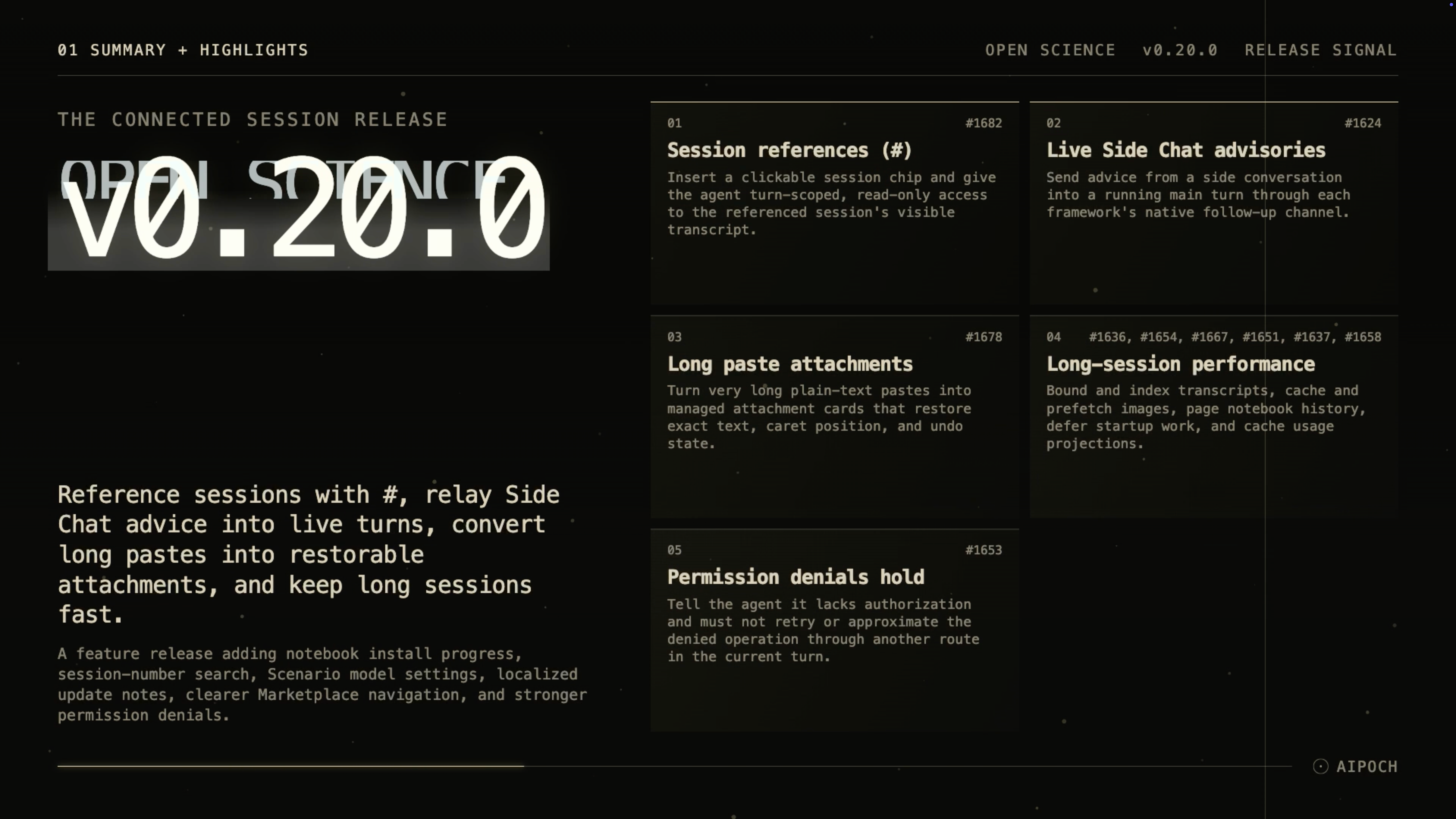
Open Science v0.20.0 connects research sessions, relays Side Chat advice into live turns, restores long pastes, and keeps long-running workspaces responsive.
Open Science is the local-first AI research workbench from AIPOCH, designed to support reproducible execution while keeping research activity and inspectable provenance evidence visible.
Published on August 25, 2026, v0.20.0 is a feature release focused on connected session context, live-turn guidance, durable text handling, and bounded long-session work.
What new capabilities help researchers connect sessions and stay responsive?
Open Science v0.20.0 lets researchers reference prior sessions, relay advice from Side Chat, preserve very long pasted text, and navigate growing workspaces with less waiting.
Session references with #
Research questions often span several conversations, but manually copying earlier context into a new prompt can lose structure and introduce stale or incomplete details.
The v0.20.0 composer adds a # session picker. Selecting a session inserts a clickable chip into the draft and sent message, while the agent receives turn-scoped, read-only access to the referenced session's visible transcript. The chip also gives the researcher a direct route back to the source session.
Researchers can build one conversation on another without merging their permanent histories or granting broad write access. The referenced context is limited to the current turn and the transcript content visible to the user.
Live Side Chat advisories
A side conversation can surface an important correction while the main agent is already working. Waiting for the next full prompt may delay that guidance, while canceling the running turn can discard useful progress.
Side Chat advisories can now reach a running main turn through the active framework's native follow-up channel. If live injection is unavailable, Open Science keeps a durable fallback and relays the advice with the next user message instead of silently losing it.
Researchers can add timely context without restarting every long-running task. Delivery still follows the capabilities of the selected agent framework, so the durable next-message path remains important when live steering is not possible.
Long pasted text as restorable attachments
Very large plain-text pastes can crowd the composer, make review difficult, and increase the risk of losing the original text while editing around it.
In v0.20.0, a plain-text paste longer than 10,000 characters or 300 lines becomes a managed attachment card. The Show in text field action restores the exact text and caret position, and undo can re-stage the attachment after restoration.
Researchers can keep protocols, logs, draft sections, and other long text intact without filling the composer with thousands of visible characters. The attachment preserves the submitted text; it does not evaluate or validate its contents.
Long-session performance
Large research sessions can accumulate long transcripts, many images, notebook runs, usage records, and review history. Loading all of that work at once can slow startup, scrolling, and navigation.
Version 0.20.0 bounds and indexes transcript rendering, caches renderer image blobs, and prefetches the next transcript batch before the scroll edge. Notebook history loads progressively with scroll anchoring and a bounded page cache. Startup no longer waits for the last transcript or runtime probes before entering Home, usage projections can be reused for ten minutes, and review history uses batched indexed queries.
These changes keep long sessions easier to open and browse while preserving the underlying session records. Some data still loads progressively as it becomes relevant instead of appearing all at once.
Permission denials hold for the current turn
A denied operation should stop. Retrying the same action through another command, tool, route, or permission request can work against the researcher's explicit decision.
After a permission denial in v0.20.0, the agent is told that it lacks authorization and must not retry or approximate the denied operation through another route in the current turn.
Researchers get a clearer boundary between approval and refusal. This behavior strengthens current-turn denial handling; it does not replace broader network sandboxing, directory-level access controls, or credential isolation.
What else is new in v0.20.0?
The release also improves session discovery, notebook setup visibility, model-policy configuration, Marketplace navigation, and localized update information.
- Session-number search. Global search can find sessions by number, rank exact matches first, and display stable number metadata on session rows.
- Notebook package-install progress. Session activity shows the requested package count, elapsed time, and expectation guidance while an environment is being prepared.
- Scenario models card. Settings consolidates subagent, reviewer, and vision model policies into one accordion beside a merged main-model section.
- Simplified Marketplace navigation. Installed becomes the management home, while Marketplace uses a separate browsing route with an explicit return path.
- Localized release notes. Dynamic release notes in the update dialog follow the selected interface language.
Bug fixes that affect daily use
The v0.20.0 fixes focus on notebook safety, provenance continuity, connector failures, session state, compute selection, and reliable renderer events.
- Notebook environments are handled more safely. Runtime targets are exposed consistently, environments still bound to sessions are protected from removal, REPL errors remain concise, interrupted environment prefixes are validated, and flag-like package names are rejected in named environments.
- Provenance follows delegated work more accurately. Handoff-directory producer execution is captured, and producers from ancestor conversation branches are accepted.
- Completed artifacts remain visible. A later save conflict no longer hides a completed run during artifact finalization.
- Connector failures are clearer. Versioned IDs and request timeouts receive clearer handling, with actionable errors when a connector gate blocks progress.
- Session and workspace state stays coordinated. Side Chat updates are published, the main agent wakes after delegated work settles, Codex resume errors link to Agent settings, the mobile sidebar remains usable, and duplicate onboarding submissions are prevented.
- Python dependency uncertainty is narrower. Conditional definitions no longer make unrelated names uncertain during cross-run tracking.
- Concurrent CLI sessions retain compute choices. Each session preserves its selected compute-host binding.
- Settings and renderer events are steadier. Package-install controls align with runtime ownership, token-usage refresh is stabilized, and a failing renderer subscriber does not prevent delivery to others.
Install or update
Open Science v0.20.0 is available for macOS, Linux, and Windows from the official GitHub Release assets.
- macOS 12 or later on Apple Silicon or Intel: download the matching DMG.
- Linux x64: download the AppImage or Debian package.
- Windows 10 or 11 x64: download the Windows installer.
Choose the appropriate package from the Assets section of the Open Science v0.20.0 release. The onboarding wizard can inspect the environment and configure an app-managed agent runtime, and an existing installation can update in place.
Official macOS release builds are Developer ID signed and notarized. Windows builds do not yet have an Authenticode certificate, so SmartScreen may show an “unrecognized app” prompt. Confirm that the installer came from the official release page before continuing.
Resources
Use the official release and product pages for current packages and capability boundaries, with related AIPOCH articles for model, Specialist, Skill, and Connector context.
- Open Science v0.20.0 release notes and downloads
- Open Science product page
- AIPOCH
- AIPOCH Blog
- Specialist AI Agents in Open Science: Roles and Scope
- What Model-Agnostic Means in Open Science
- Open Science Skills, Connectors, and Specialists Explained
FAQ
Is Open Science v0.20.0 a feature release?
Yes. Open Science v0.20.0 is a feature release published on August 25, 2026. Its main additions cover session references, live Side Chat advisories, managed long-paste attachments, long-session responsiveness, and clearer permission denials.
How do # session references work in Open Science?
They provide turn-scoped, read-only context. In v0.20.0, selecting a session from the composer's # picker inserts a clickable chip and lets the agent read the referenced session's visible transcript for that turn without merging the two session histories.
When does pasted text become an attachment?
Plain text becomes a managed attachment when it exceeds 10,000 characters or 300 lines. The researcher can restore the exact text and caret position with Show in text field, and undo can re-stage the attachment.
Can Side Chat advice reach an agent that is already running?
Yes, when the active framework supports its native follow-up channel. If live injection is unavailable, Open Science preserves the advisory and relays it with the next user message.
Which platforms support Open Science v0.20.0?
Open Science v0.20.0 provides packages for macOS 12 or later on Apple Silicon and Intel, Linux x64, and Windows 10 or 11 x64. Windows builds remain unsigned, while official macOS builds are signed and notarized.
Disclaimer
Open Science assists researchers with AI-supported workflows and supports reproducible execution, but it does not replace scientific judgment, independent validation, domain expertise, or peer review. Researchers remain responsible for checking sources, permissions, methods, analyses, and conclusions before use.