What this research found
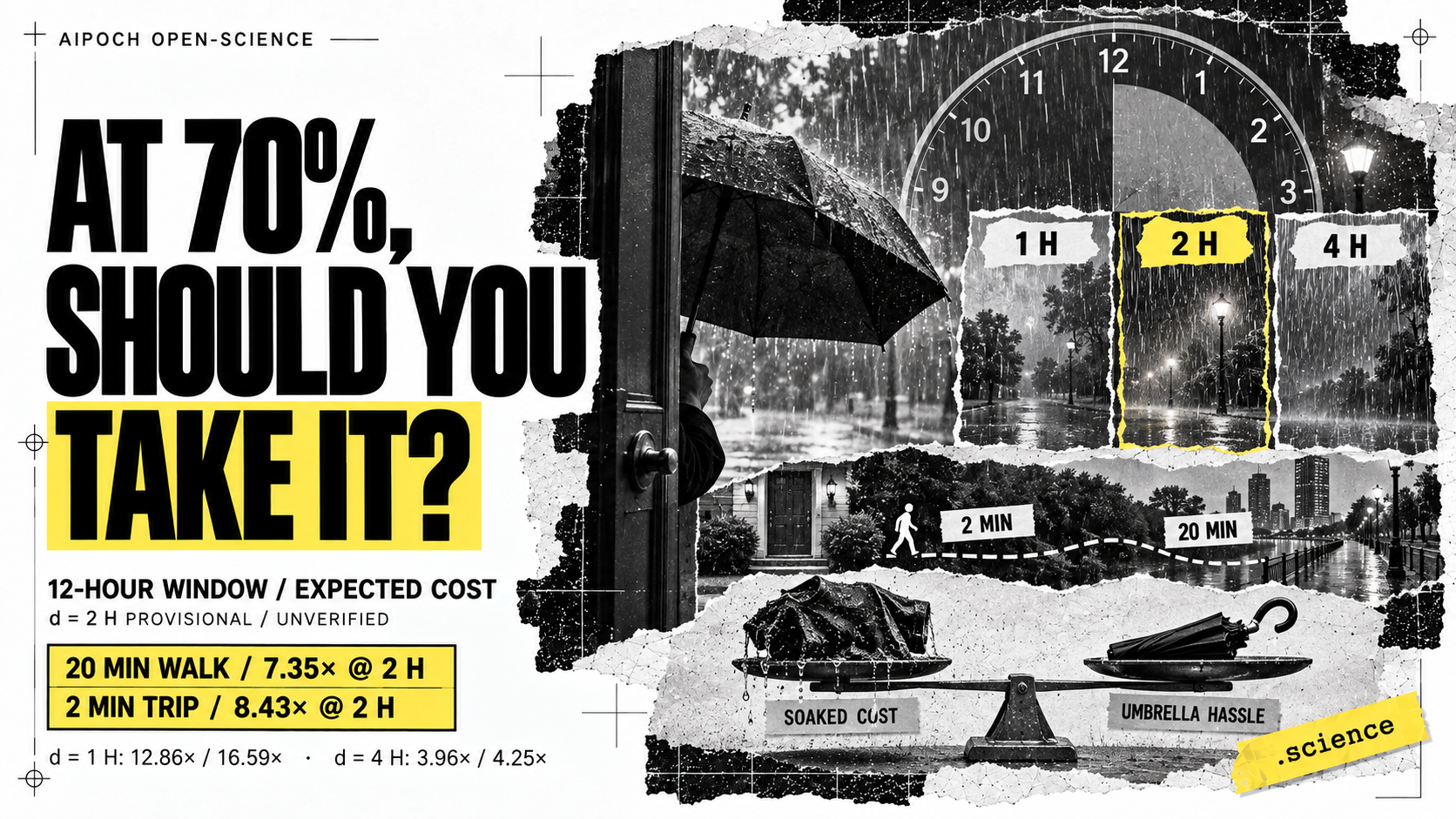
At 70% should you take it
Research question
Does a 70% rain forecast tell everyone to make the same decision?
Builds an umbrella decision model around a stated rain probability, exposure time, and the relative inconvenience of carrying an umbrella versus getting wet. The session compares rain-timing assumptions and saves a break-even table and figure.
Data and comparison design
Write down the cost of carrying protection and the loss from being caught without it. Compare expected losses under the forecast probability rather than choosing a universal probability cutoff. The model separates a calibrated event probability from a person-specific decision threshold.
Recorded findings
The continuous-rain-block model is now the main model.
For exposure e hours and a rain block lasting d hours:
P(wet) ≈ 0.70 × (d + e) / 12
break-even ratio = 1 / P(wet)
| Trip | d = 1 h | d = 2 h | d = 4 h |
|---|---|---|---|
| 20-minute walk | 12.86× | 7.35× | 3.96× |
| 2-minute trip | 16.59× | 8.43× | 4.25× |
Interpretation: for the 20-minute walk, if a typical rain episode lasts about 2 hours, getting soaked must be roughly 7.35 times worse than carrying the umbrella for the umbrella to be worth it. For the 2-minute trip, the corresponding threshold is 8.43×.
I would defend the continuous-block model over the constant-hazard model because rain is temporally clustered rather than arriving independently at every instant. The all-or-none model is a useful limiting case, giving 1 / 0.70 = 1.43×, but it assumes any outdoor exposure overlaps the day’s rain event. The exact answer depends on typical rain duration d; 2 hours is my provisional middle value, and it is explicitly unverified here. Local climatological rainfall-duration data would be the right way to replace it.
The figure uses DejaVu Sans, an open-licensed Bitstream Vera derivative; the SVG source contains no Arial or Helvetica references. The .science package contains the table, figure, producing Python script, and handoff note.
At 70%, take it when the soaked-to-umbrella hassle cost ratio exceeds the threshold implied by the exposure time and the typical rain-block duration.
- umbrella_break_even.science — complete export package.
What the comparison shows
A forecast can be equally informative for two people who rationally choose different actions because their costs differ. The decision calculation does not itself verify forecast calibration.
Assumptions and limits
The continuous rain-block duration is an explicitly unverified scenario parameter. This illustrates sensitivity to exposure and costs, rather than deriving a personal forecast from the headline rain probability.
Sources and research materials
The original .science export and matching poster are preserved byte-for-byte from the upstream case. The package contains the conversation, session metadata, and the resources inventoried in its internal manifest. This introduction summarizes the archived record; the research, external sources, and model evaluations were not rerun for this import.
Run this kind of analysis on your own question
Start a session and see how an AI co-scientist accelerates your research. Pay-as-you-go, nosubscription required.