What this research found
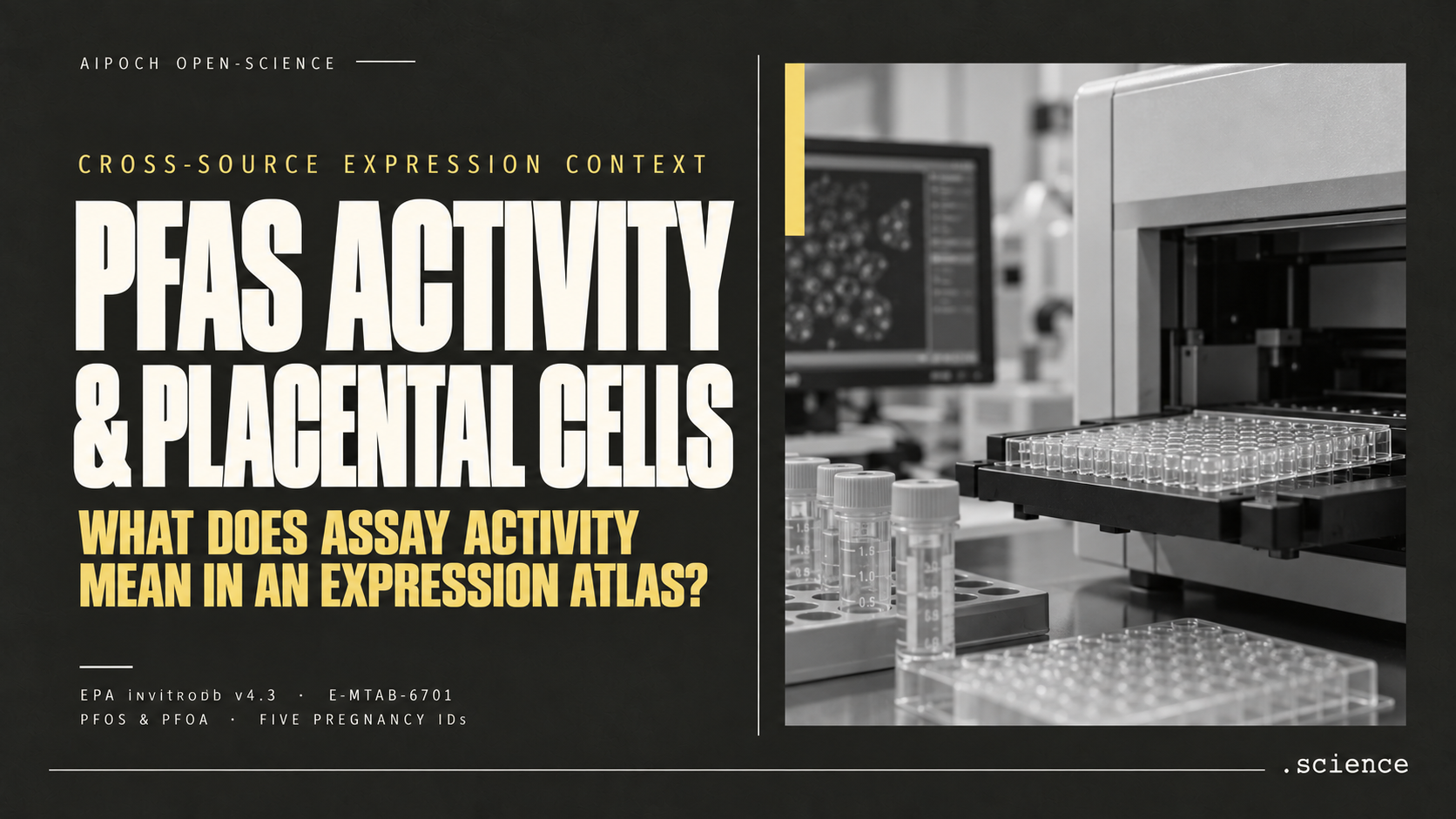
PFAS assay activity and placental cell-type expression
Research question
Which assay-linked genes also appear in the placental expression data, and how much does mapping strictness matter?
This case examines how public in-vitro activity records for selected PFAS chemicals relate to target-gene expression in a public placental single-cell atlas. It combines processed EPA invitrodb v4.3 assay exports with the E-MTAB-6701 atlas, retaining chemical–assay–gene mappings, donor variation and sensitivity analyses. It is a descriptive cross-source assessment, not a PFAS exposure experiment or a test of placental toxicity.
Data and comparison design
The analysis treats assay-to-gene mapping and gene expression as separate evidence layers. Expanded mappings admit a broader set of links; strict human biochemical mappings require narrower target attribution. Expression indicates potential cellular context, not chemical exposure or target engagement.
Recorded findings
| Gene-linking rule | PFOA-associated genes | PFOS-associated genes |
|---|---|---|
| Expanded mapping | 45 | 142 |
| Strict human biochemical mapping | 7 | 42 |
| Expression source | Five pregnancy IDs | Cell-type expression, not a matched exposure experiment |
| Interpretation | Overlap depends on mapping rules | Counts do not establish relative toxicity |
This case examines how public in-vitro activity records for selected PFAS chemicals relate to target-gene expression in a public placental single-cell atlas. It combines processed EPA invitrodb v4.3 assay exports with the E-MTAB-6701 atlas, retaining chemical–assay–gene mappings, donor variation and sensitivity analyses. It is a descriptive cross-source assessment, not a PFAS exposure experiment or a test of placental toxicity.
The saved analysis selects PFOS and PFOA by assay coverage, freezes a 200-gene panel before inspecting expression, and uniquely matches 197 genes. It retains 18,547 placenta-origin cells from five pregnancy IDs; the primary minimum-cell rule yields 41 donor–cell-type groups, 18,400 cells and 12 cell types. Expanded active-assay mappings implicate 45 expression-matched genes for PFOA and 142 for PFOS; stricter human biochemical mappings reduce these to seven and 42. These are assay-linked transcript contexts, not confirmed placental targets or a relative toxicity ranking.
Important limits include five early-gestation donors, three unresolved gene symbols, incomplete assay-quality information and no matched PFAS exposure or placental outcome measurements. Neither chemical has explicit sample-QC-pass records in the selected assay data. The sources cannot establish placental exposure, target engagement, causality, a safe dose or adverse fetal effects. Detailed methods, donor intervals and sensitivity results remain in the retained report.
What the comparison shows
The large change in linked-gene counts shows that mapping rules shape the overlap. More mapped genes do not mean greater toxicity, and expressed targets do not establish an in-vivo PFAS effect.
Assumptions and limits
This is not an exposure experiment or placental toxicity test. Small donor numbers, incomplete assay QC and absent matched exposure/outcome data prevent claims about target engagement, safe doses, fetal harm or relative toxicity.
Sources and research materials
The unchanged research package comes from upstream Case 30. It includes the archived session, analysis materials, results and figures. The poster uses an AI-generated illustrative photograph. This introduction summarizes archived findings; the analysis was not rerun.
Related research
View all →
Run this kind of analysis on your own question
Start a session and see how an AI co-scientist accelerates your research. Pay-as-you-go, nosubscription required.