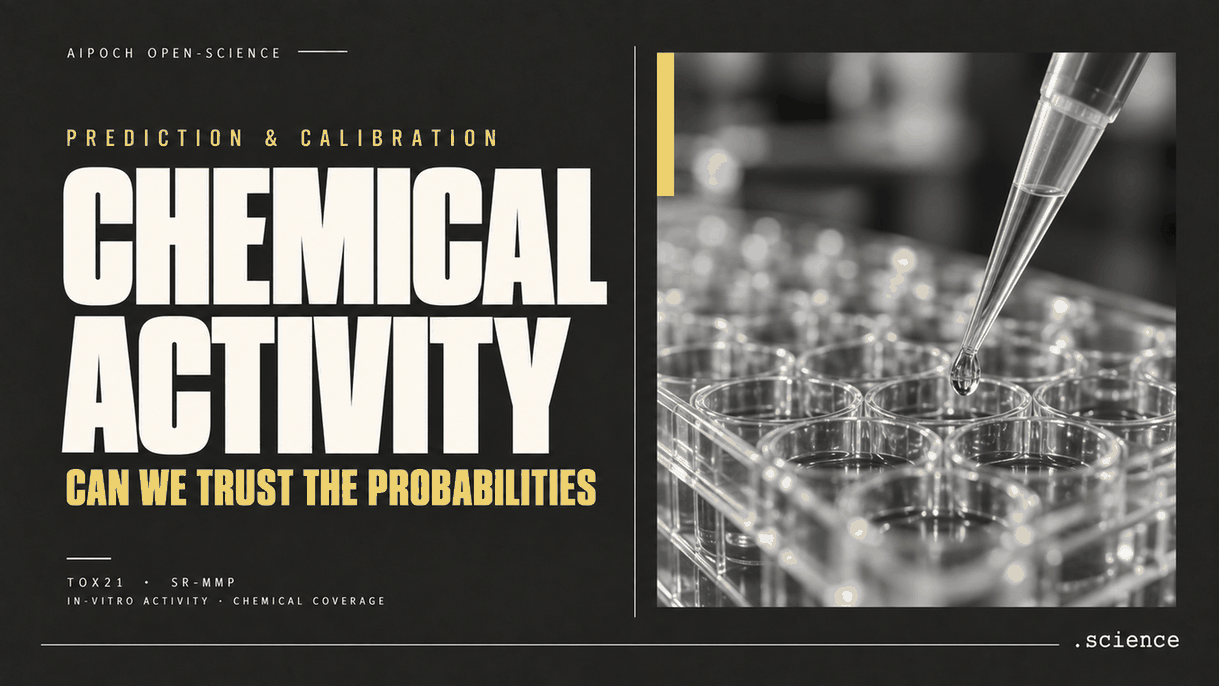
What this research found
Chemical Activity Predictions - Can We Trust the Probabilities
Research question
Can a model rank assay-active compounds and also assign reliable activity probabilities?
Use public Tox21 structures to assess manageable SR-MMP classification, probability calibration and chemical coverage. The endpoint is in-vitro mitochondrial membrane potential activity, not human liver toxicity. The selected deliverable is the second reviewed attempt (9-2).
Data and comparison design
Scaffold separation tests compounds outside the training cores. AUC measures ranking, whereas Brier score measures squared probability error. Calibration adjusts the probability scale; coverage heuristics ask a separate question about resemblance to known chemistry.
| Input or source | Role in this case | Source context |
|---|---|---|
| DeepChem/MoleculeNet Tox21 CSV | Benchmark structures and binary endpoint labels; preserve source provenance and inspect upstream usage terms. | Retain attribution and source terms; this README grants no additional reuse rights |
| NIH Tox21 challenge data | Label definitions and link to assay AID 720637. | Retain attribution and source terms; this README grants no additional reuse rights |
| NIH endpoint definitions | MMP endpoint context. | Retain attribution and source terms; this README grants no additional reuse rights |
| PubChem AID 720637 | Linked reference; the assay record itself was not downloaded by the original connector. | Retain attribution and source terms; this README grants no additional reuse rights |
Recorded findings
| Test measure | Before calibration | After calibration or scope |
|---|---|---|
| Brier score | 0.12964 | 0.11528 |
| Ranking AUC | 0.797 | Calibration and ranking are distinct evaluations. |
| Holdout | 945 structures | Scaffold-separated chemical population. |
| Coverage heuristic | Chemical resemblance screening | Not shown to remove high-error predictions. |
Of 7,831 source rows, 5,395 unique labeled structures remain. Training/calibration/test sizes are 3,508/942/945, with 518/168/168 actives. The scaffold-held-out test gives AUC 0.797186 and AP 0.515864 versus prevalence 0.177778. Calibration changes Brier from 0.129641 to 0.115279 and log loss from 0.444370 to 0.375025. At the calibration-F1-selected threshold, TP/FP/FN/TN are 125/219/43/558. A heuristic screen marks 773 supported and 172 flagged, without establishing that it removes high-error predictions.
The original session records scientific execution and repeatability checks; this local preparation does not re-execute them. Scientific artifacts included in this selected export:
These files are within session.science and its embedded archive; they are not separate files alongside this README. No empty inputs/expected/outputs/attachments directories or duplicate extracted datasets are created.
What the comparison shows
Improved probability calibration can coexist with unchanged ranking. Neither metric converts an in-vitro assay endpoint into a clinical toxicity probability.
Assumptions and limits
The endpoint is in-vitro mitochondrial membrane potential activity, not human toxicity. Sparse chemical strata, fingerprint collisions and single-split uncertainty limit generalization. A later check identified a displayed interval endpoint that should read −0.00413 rather than −0.00414; the original package remains unchanged, and the calibration conclusion is unaffected.
Sources and research materials
The unchanged research package comes from the upstream archive. It retains the original conversation and included scientific artifacts, including analysis code, results and figures. The poster is an AI-generated thematic illustration, not study evidence. This introduction summarizes archived findings; the analysis was not rerun. Later bounded checks do not certify the entire study or mean the original package was corrected.
Related research
View all →
In a Year's Worth of Weather Forecasts, Are Predictions of ‘Sunny’ Weather More Accurate, or Are Predictions of ‘Rain’ More Accurate?
View use case in AIPOCH Lab →
Mass Spectra - Can They Reveal a Chemical Family
View use case in AIPOCH Lab →
PFAS assay activity and placental cell-type expression
View use case in AIPOCH Lab →Run this kind of analysis on your own question
Start a session and see how an AI co-scientist accelerates your research. Pay-as-you-go, nosubscription required.