AIPOCH Open-Science passed 145 of 210 local runs on Terminal-Bench-Science 0.1, for a 69.05% pass rate. In the leaderboard snapshot supplied with the evaluation summary, the highest listed official entry was Codex with GPT-6 Astra at 68.10%. The numerical difference is 0.95 percentage points. The AIPOCH result is a local evaluation, has not been confirmed as an official leaderboard submission, and has not been independently reproduced for this article.
The benchmark is relevant because research work requires more than a plausible answer. An agent must use tools and data to produce an artifact that a task-specific verifier can check. AIPOCH Open-Science brings agent work, execution, files, and evidence into one workspace. For review and handoff after a run, a .science package can carry selected conversation branches, file versions, Notebook records, and verification evidence. Packaging a research record is a product workflow; it did not contribute to the benchmark score.
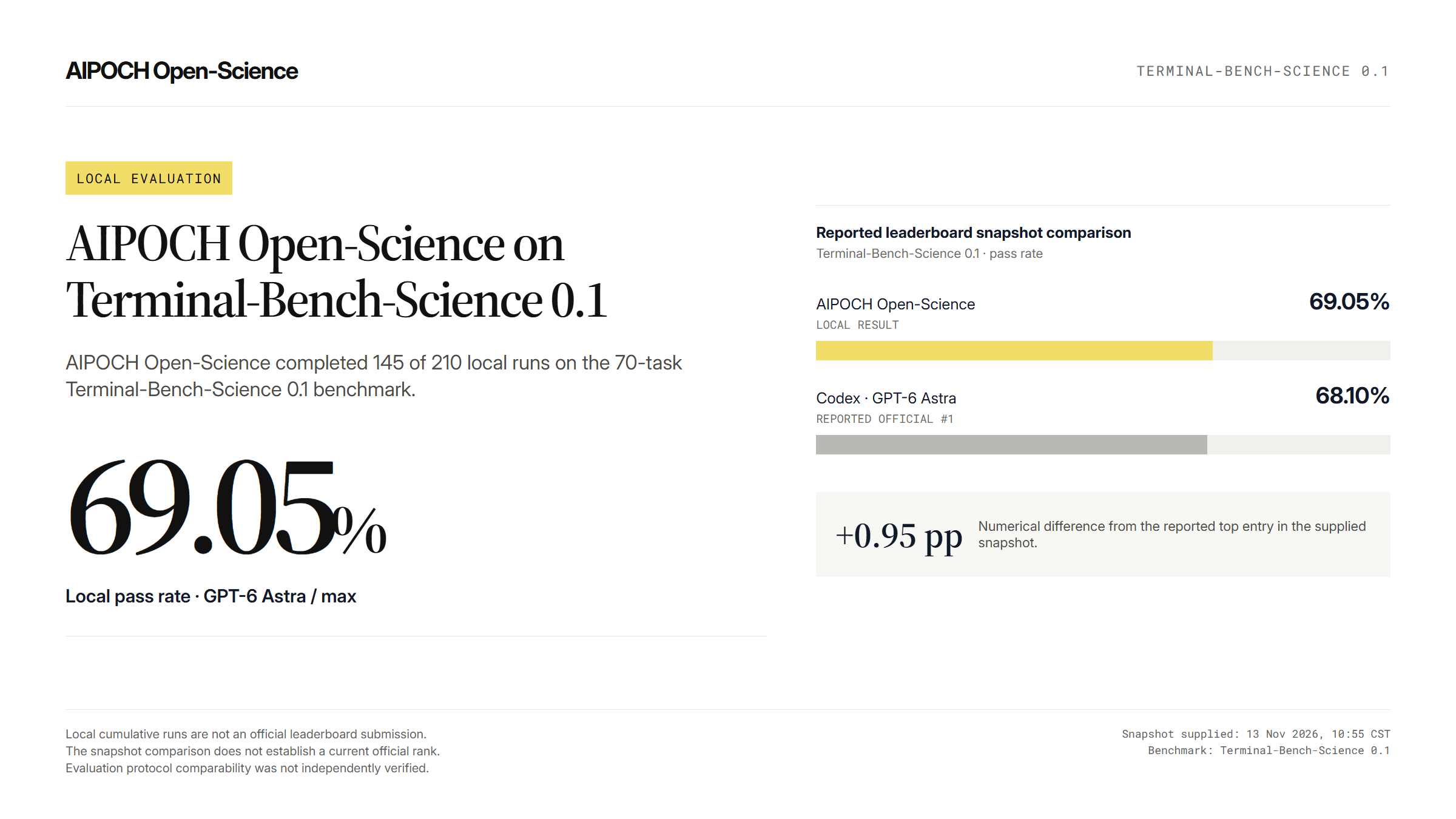
At a glance: 70 benchmark tasks; 210 local executions; 145 passed; 69.05% local pass rate. The 68.10% comparator is from the supplied November 13, 2026 leaderboard snapshot. Treat the comparison as a dated numerical reference, not an official placement for AIPOCH Open-Science.
What did AIPOCH Open-Science measure on Terminal-Bench-Science 0.1?
AIPOCH Open-Science's reported 69.05% result measures the share of successful local executions across 210 runs on the 70-task Terminal-Bench-Science 0.1 benchmark; 145 runs passed, and the score describes task-verifier outcomes rather than the quality of every intermediate scientific decision made during each attempt.
The Terminal-Bench-Science v0.1.0 release defines 70 expert-curated research workflow tasks across the life, physical, earth, mathematical, and engineering sciences. The v0.1.0 task directory contains 70 task definitions. The 145 passes and 210 runs come from AIPOCH's local evaluation summary.
Terminal-Bench-Science tasks ask agents to carry out scientific workflows, including analysis, computation, simulation, and validation. That makes a pass rate a useful measure of completed work under the benchmark's checks. It does not establish that every answer, citation, or scientific interpretation would pass a separate expert review.
Does 69.05% put AIPOCH Open-Science at the top of the official leaderboard?
The supplied snapshot places AIPOCH Open-Science's 69.05% local result 0.95 percentage points above the highest official entry shown there, but the local result is not an official leaderboard placement; readers should use the comparison as a dated score reference until the run protocol and a formal submission can be independently checked.
The AIPOCH result graphic labels 69.05% as a local result and 68.10% as the score in the supplied leaderboard snapshot. The Harbor public leaderboard is where readers can check official entries. The graphic reports our result; it does not independently verify the snapshot score. We could not confirm that score from the official leaderboard, so this comparison relies on the supplied record. The v0.1.0 release fixes the task set, but using the same tasks does not establish that the environment, tools, budget, and grading conditions matched.
The arithmetic is straightforward: 145 ÷ 210 × 100 = 69.0476%, rounded to 69.05%. Subtracting the reported 68.10% snapshot figure yields 0.95 percentage points after display rounding. The comparison is worth investigating precisely because the scores are close: small differences in task conditions or a few run outcomes could change the ordering. A reproducible submission and per-task evidence would make the claim stronger.
What should research teams take from this result?
The local result suggests that AIPOCH Open-Science can complete a substantial share of its local benchmark runs, while the next useful question for a research team is whether the agent's files, code, and verification trail can be inspected and reused on its own tasks rather than judged from one aggregate percentage.
The AIPOCH Open-Science product page describes a workspace that combines agents, Python and R execution, scientific connectors, and traceable artifacts. The .science package guide explains how selected research context can be handed off for inspection; imported sessions are read-only and do not rerun the sender's checks. The Terminal-Bench-Science project provides the public tasks and evaluation design for researchers to examine.
For a practical follow-up, choose a research question that resembles your own work, run it in AIPOCH Open-Science, and inspect the generated files and execution evidence. If you want a benchmark score, use the official benchmark harness and its verifier under a documented configuration. When a colleague needs to review the work, export only the relevant branches, file versions, Notebook records, and evidence in a .science package. Keep the benchmark score, the local run record, and the recipient's independent validation distinct.
For the broader context of AIPOCH's scientific-agent evaluations, see the Open-Science benchmark overview. The Terminal-Bench-Science 0.1 result is a new local data point; it should be read with its own denominator, model configuration, and comparison date.
Evaluation note: AIPOCH Open-Science used GPT-6 Astra with max reasoning for the local runs reported here. The 145/210 tally and leaderboard snapshot come from the supplied evaluation summary.