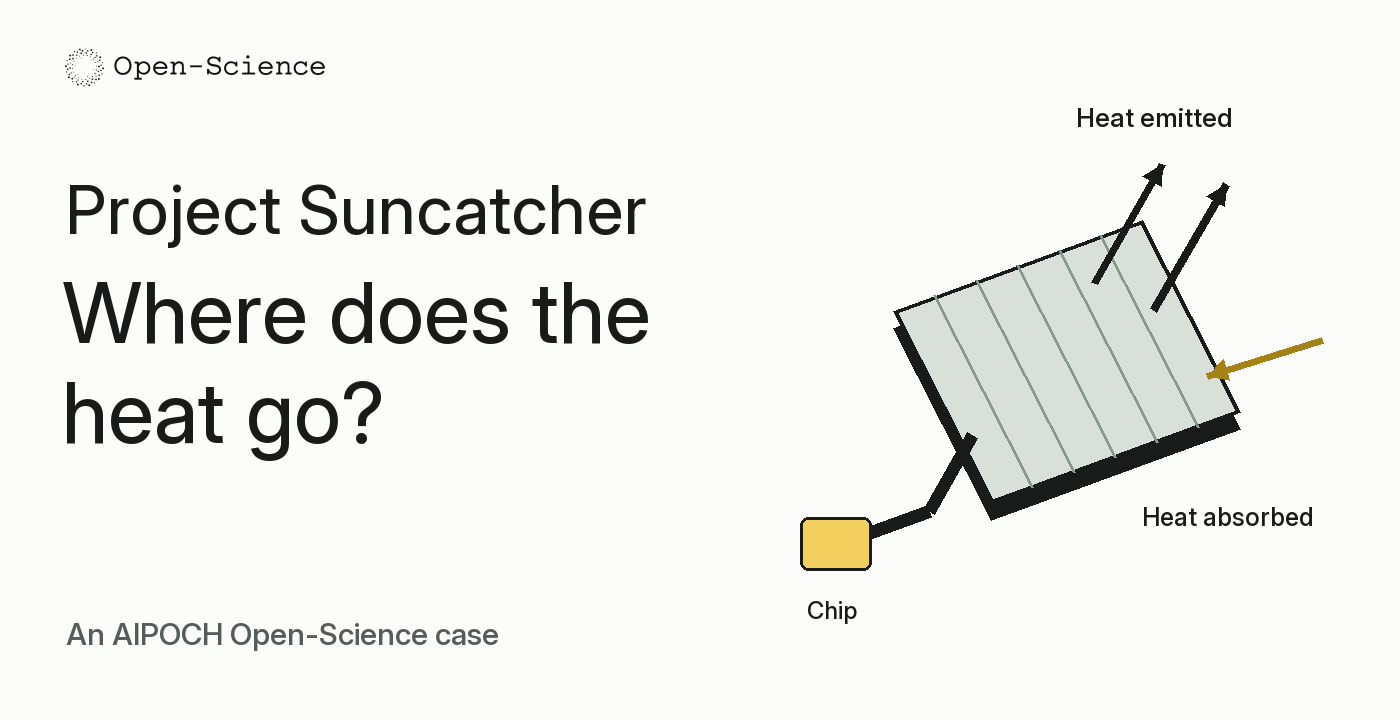
Google asked a satellite to write a haiku. On October 30, 2026, Google reported that its Project Suncatcher prototype had run Gemma 4 on an onboard TPU and sent the poem back from orbit. Thermal stress was among the tests still ahead. How much radiator area would a computer need to shed heat while it worked? Google’s account of the satellite response
An AIPOCH Open-Science case explores that question with a hypothetical computer producing a steady 1 kW of waste heat. The radiator surface stays at 300 K, about 27 °C. Changing only the environmental heat it absorbs per square metre nearly doubles the area needed. The inputs are teaching assumptions, and Google’s flight hardware dimensions are outside the scope of the study. Project Suncatcher heat-balance case
Why the same kilowatt can require different radiator areas
A radiator that absorbs more energy from its surroundings needs more emitting area to shed the same kilowatt of waste heat, because at a fixed surface temperature and emissivity, each square metre emits the same power while less of that power is available to carry away heat from the computer.
The baseline calculation assumes steady state, a uniform surface temperature of 300 K, and infrared emissivity of 0.9. An ideal 0 K radiative sink is a mathematical approximation. Under those assumptions the surface emits 413.37 W/m². The model accounts for environmental heating separately. Its input is the flux already absorbed per square metre of the same effective emitting area. Using incident sunlight directly would skip the absorption step. Baseline model and inputs
The calculation is A = Q / (εσT⁴ − q_abs). Here Q is the computer’s waste heat in watts, ε is emissivity, σ is the Stefan–Boltzmann constant, T is surface temperature in kelvin, and q_abs is absorbed environmental flux. A positive area can reject the load only when the denominator is positive.
| Absorbed environmental flux (W/m²) | Net outward flux (W/m²) | Required emitting area (m²) |
|---|---|---|
| 0 | 413.37 | 2.42 |
| 100 | 313.37 | 3.19 |
| 200 | 213.37 | 4.69 |
Take the middle row. Each square metre emits 413.37 W and absorbs 100 W, leaving 313.37 W for the computer’s heat. Dividing 1,000 W by 313.37 W/m² gives 3.19 m² of emitting surface. Converting that area into a panel footprint would require knowing which faces can radiate.
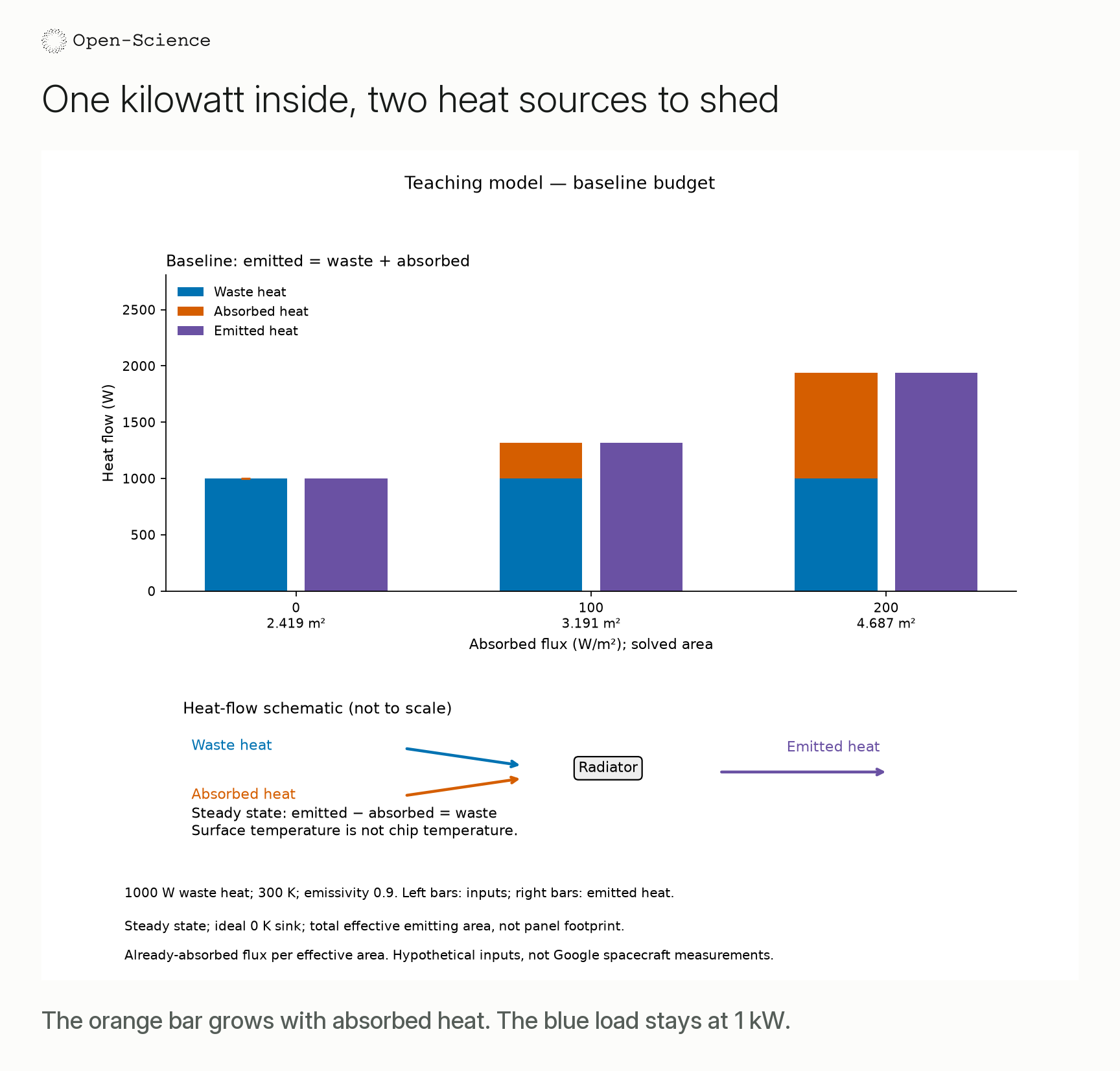
Blue shows the fixed 1 kW load. Orange shows absorbed environmental heat. Their sum matches the emitted power in purple. The area below each pair of bars is the surface needed to maintain that balance.
When a bigger radiator picks up more heat
A larger radiator at a fixed temperature can gain more heat from its surroundings when each square metre absorbs more power than it emits, because increasing the area multiplies the same net gain across a larger surface even as the computer’s waste heat stays fixed.
For a 5 m² radiator at 300 K and emissivity 0.9, an absorbed flux of 200 W/m² leaves about 1,067 W of net cooling capacity. At 500 W/m², net capacity falls to −433 W. Each square metre now absorbs about 86.63 W more than it emits. The negative sign means the radiator surface gains about 433 W from its environment at that temperature. Fixed-area results
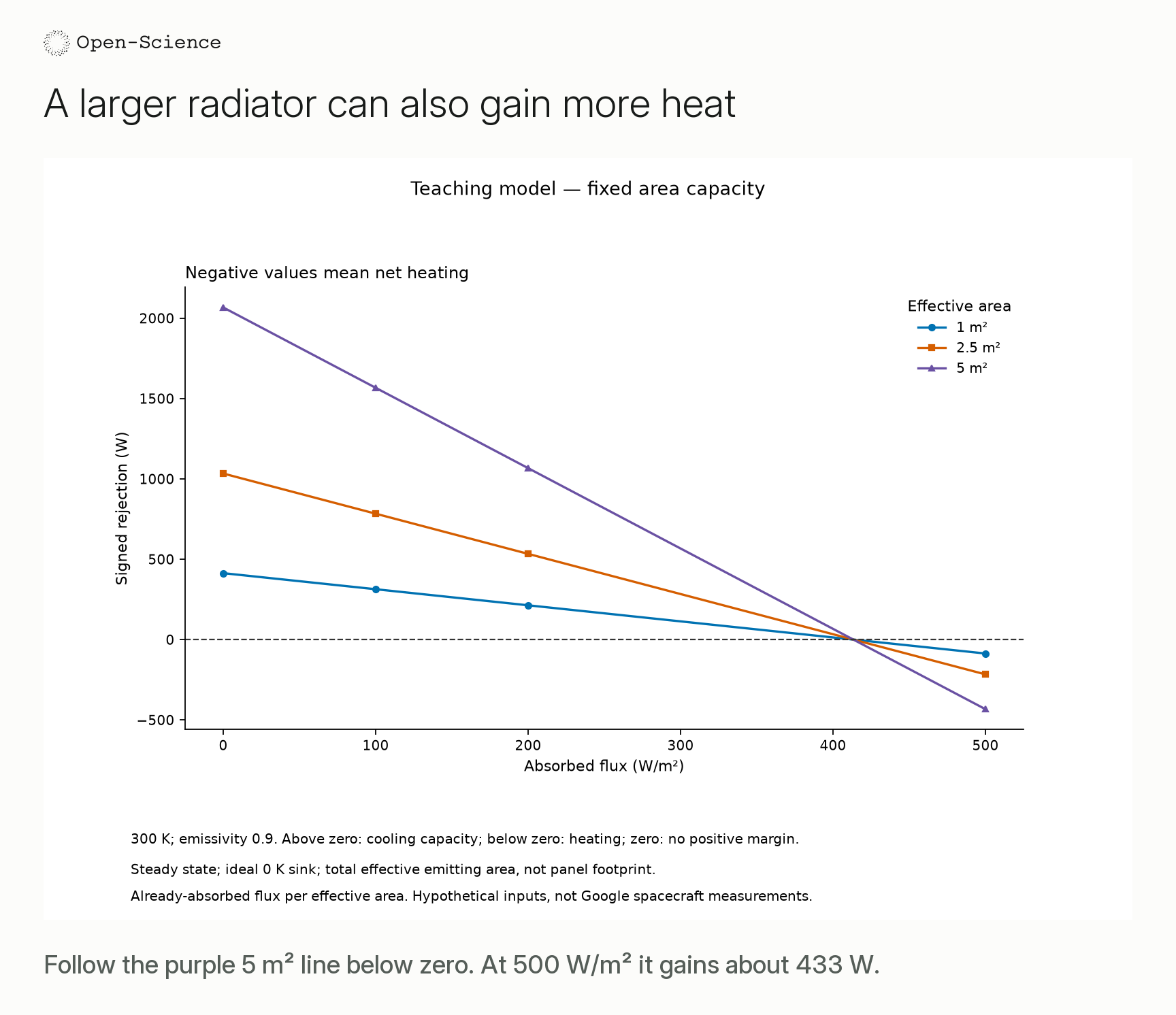
Follow the purple triangles for the 5 m² surface. Above the dashed line, the surface can shed heat from the computer. Below it, the surface gains heat from its surroundings.
The two calculations record that limit differently. When solving for required area, the case leaves the result blank if no positive area can shed the load. This happens in 480 of the 969 hypothetical combinations of emissivity and absorbed flux in the study grid. When area is fixed, the signed capacity tells you how much heat the surface gains or sheds. Case tables and figures
What about the chip temperature? The model fixes the radiator surface at 300 K. Estimating chip temperature would also require the thermal resistance along the path from the chip to the radiator. Predicting how temperature changes over time would require a transient model.
Check the result in AIPOCH Open-Science
The Project Suncatcher .science package lets you check the sign change against the saved report and fixed-area table, then use a writable copy in the AIPOCH Open-Science desktop app to test whether a different absorbed flux would leave enough capacity for the computer’s 1 kW load.
Download the package and open the 5 m² results. Subtract 200 and then 500 from 413.37 W/m² and multiply each difference by 5 m². Compare the two answers with the signed capacities in the table. Open the case and download the package
The imported record opens read-only. To try another value, choose Fork to continue in the desktop app, confirm that a suitable runtime is available, and request a new calculation. Compare your result with the original and distinguish the checks you ran from the verification evidence saved by the sender. AIPOCH Open-Science package guide