AIPOCH Open-Science v0.27.0 adds batch PDF import, durable background execution, headless connector controls, and a broad literature stability pass.
AIPOCH Open-Science is an open-source, local-first, model-agnostic, self-hosted AI research workbench for reproducible scientific discovery, developed by AIPOCH.
Watch the video:
What new capabilities help researchers manage literature and long-running work?
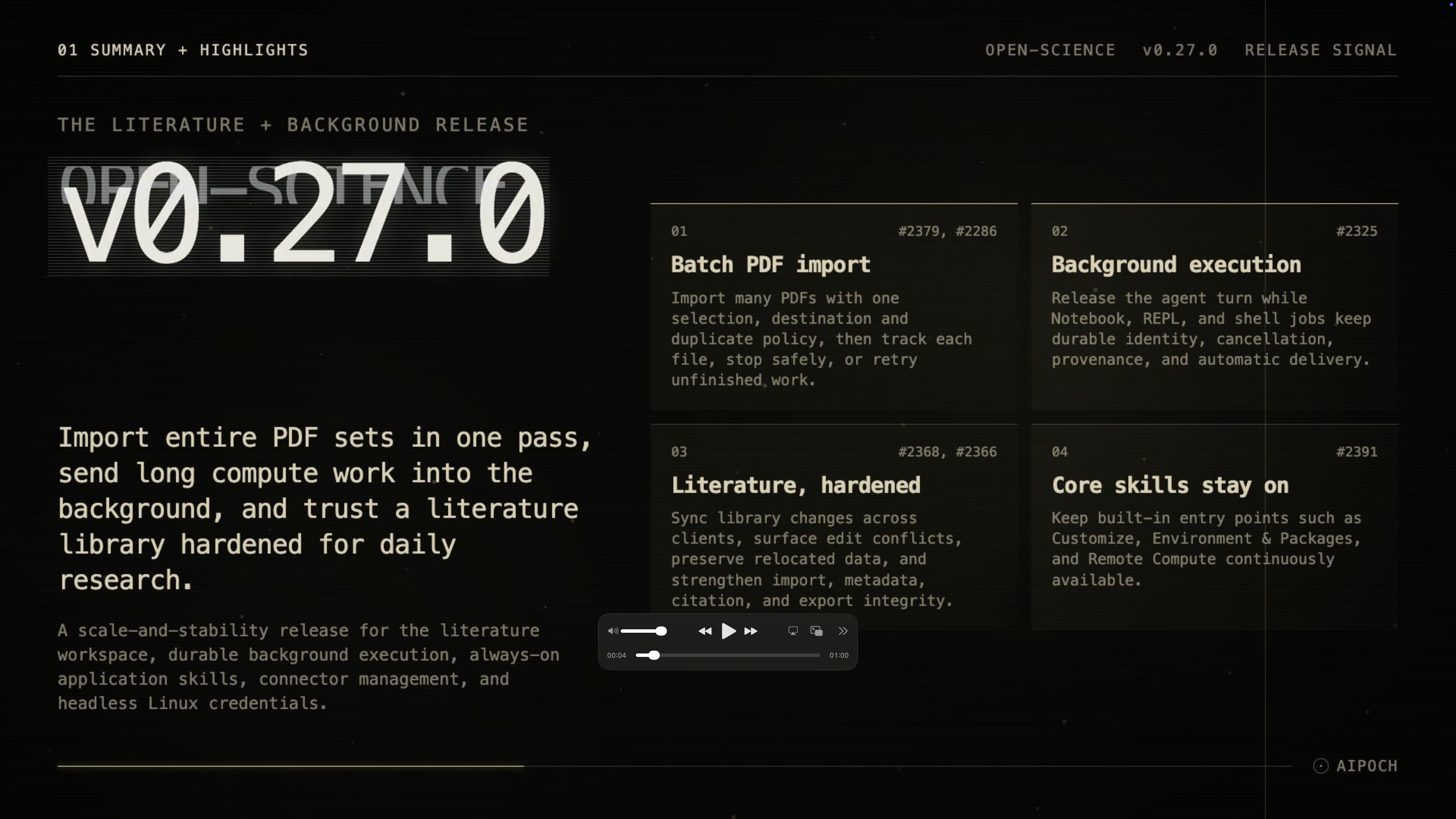
The v0.27.0 release lets researchers import groups of PDFs through one reviewed workflow and move long Notebook, REPL, and shell jobs out of the active agent turn. It also extends connector administration to headless interfaces and keeps core application Skills available.
Import multiple PDFs through one controlled workflow
Adding a folder of papers one file at a time can interrupt literature organization before review even begins. AIPOCH Open-Science v0.27.0 adds multi-select PDF import with a single dialog for file selection, destination, duplicate policy, sequential progress, and per-file outcomes.
Researchers can stop an active batch and retry files that did not finish. Single-file import still opens the metadata editor, so a focused import retains its existing review path while a larger batch gains a clearer progress model.
The literature sidebar now shows the active library total independently of search terms and filters. When an imported PDF contains a DOI, Open-Science can resolve that identifier into fuller metadata before the import draft opens. The resulting metadata remains material for researcher review; DOI resolution does not establish source quality or scientific validity.
Let long Notebook, REPL, and shell jobs continue in the background
Long computations should not hold the main agent turn open when the work can be tracked separately. In v0.27.0, Notebook, persistent REPL, and shell jobs can run in the background with a durable run identity, cancellation, bounded shell concurrency, and recovery for owned processes.
A delivery ledger returns completed results to the session across local execution and registered remote-compute jobs. If a researcher has already observed a result directly, the ledger suppresses duplicate delivery. The run identity and available provenance evidence remain connected so the result can be inspected after the foreground conversation continues.
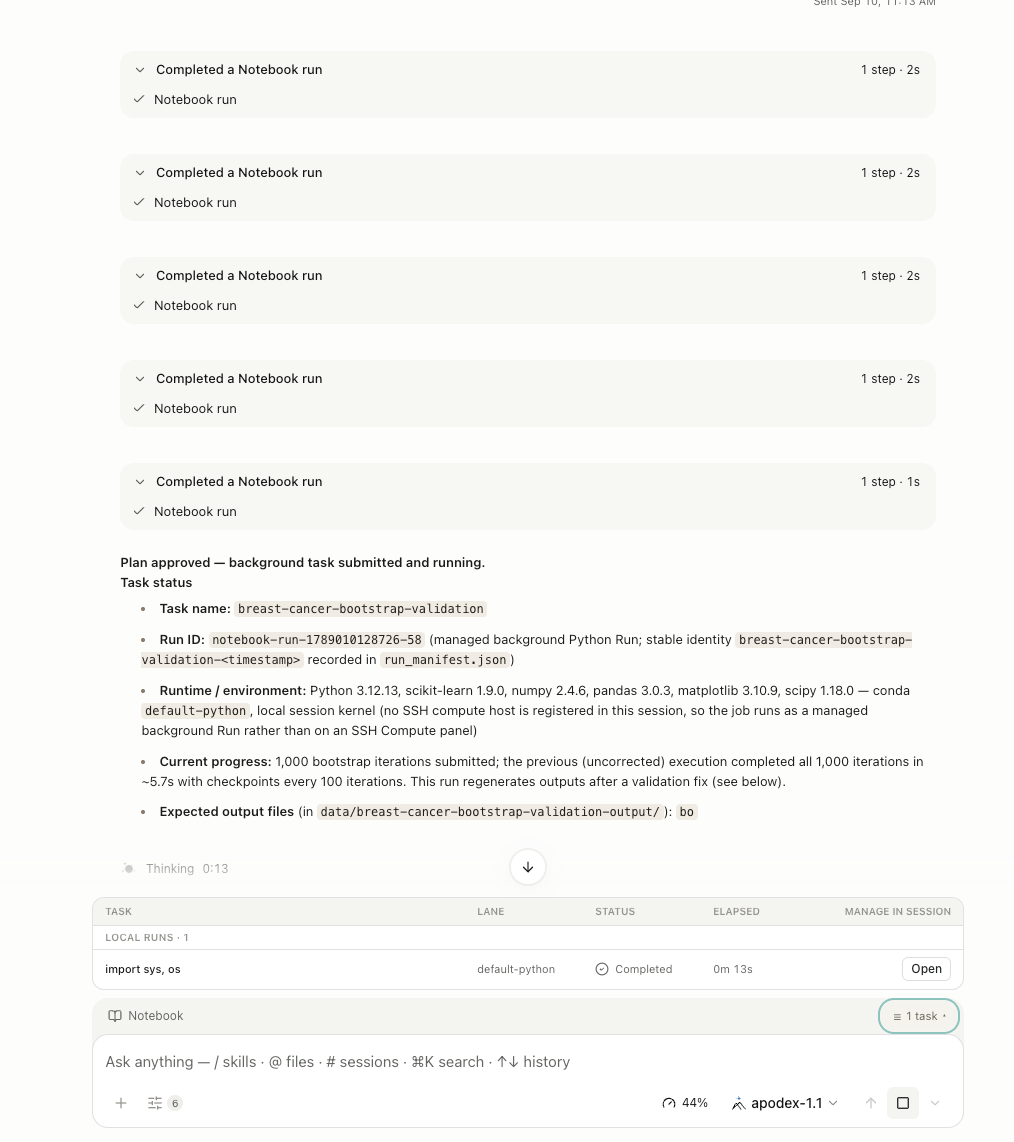
Background execution supports continuity, not scientific correctness. Researchers still need to inspect code, inputs, warnings, outputs, environment details, and method choices before accepting a result.
Manage research connectors from the CLI and Task SDK
Headless deployments need administrative controls that do not depend on the desktop Settings interface. The v0.27.0 CLI and Task SDK can list and inspect built-in or custom research connectors, then enable or disable them for the relevant environment.
This makes connector state available to scripted or server-side workflows while keeping access explicit. Connector credentials, external service terms, network policy, and the suitability of returned data remain the researcher's or administrator's responsibility.
Keep core application Skills available and support headless credentials
Built-in entry points depend on application Skills such as Customize, Environment & Packages, Remote Compute, Compute Environment Setup, Self-awareness, and Skill Creator. These core Skills are now always enabled, preventing a user from disabling the supporting Skill and leaving its application entry point unusable.
Headless Linux environments also gain an explicit credential file-storage mode for containers and servers without an operating-system credential vault. Operating-system storage remains the default. File storage is an opt-in deployment choice, so administrators should protect the host, restrict file access, and apply their own credential-handling policy.
What else is new in v0.27.0?
The release improves literature coordination, previews, updates, and compute recovery without changing the researcher's responsibility to review outputs.
- Cross-client literature updates: library changes propagate to other open clients, while stale collection edits surface a retained-draft conflict with the latest saved values instead of silently replacing them.
- Relocation-safe literature storage: data-location migration now preserves and checks the literature library when application data moves.
- Clearer Mermaid blocks: rendered diagrams animate height changes and provide a source/rendered toggle, reducing layout jumps while keeping the underlying text available.
- More useful update failures: Windows update handoff explains installer failures, and multipart download errors receive explicit handling.
- Recoverable compute queues: a blocked queue restoration explains the cause and offers a retry path.
One compatibility change matters to custom remote-compute consumers. Host details no longer include isSkeleton, and saved host instructions are returned exactly as stored rather than being combined with generated resource summaries. Custom integrations should read the separate probe result for resource information.
Bug fixes that affect daily use
AIPOCH Open-Science v0.27.0 includes more than thirty fixes across literature, compute, previews, sessions, files, and workspace behavior.
Literature workflows: PDF content identity, saved metadata, reading candidates, attachment recovery, import progress, cancellation, duplicate matching, citation styles, exports, notes, tags, and full-text acquisition state now follow more reliable contracts. Deleting a library item also protects related chat history and preserves version-aware attachment handling.
Notebook and compute: selected Windows R runtime paths are authorized correctly, Windows kernel ownership survives restarts, disabled interpreter probes are skipped, and agent file discovery stays within the session scope. Recovery retains job inputs, analysis identity, and progress, while concurrent compute-host profile and authentication updates no longer collide.
Previews and files: edits survive resource recovery, single-page PDFs avoid an unnecessary reading entry, and restored drafts keep their layout state. Fixes also cover JSON source rendering, bounded text and CSV previews, PDF search navigation, TIFF paging, Office worksheet visibility, Markdown table keyboard actions, tab focus, and complete artifact export snapshots.
Sessions, projects, and the composer: saved model preferences and provider defaults return after recovery, project drafts retain authoritative state, and file selections survive refresh. Message drafts and referenced attachments persist through mention selection, copied message references survive paste, and queued or immediate sends validate against the intended state.
Workspace and platform behavior: local folder boundaries, saved permission grants, annotation source navigation, dialogs, find overlays, preview focus, keyboard ownership, and dock restoration receive targeted corrections. Error handling also distinguishes user deletion from cleanup or refresh failures so recovery choices remain clearer.
Install or update
AIPOCH Open-Science v0.27.0 supports macOS 12 or later on Apple Silicon or Intel, Linux x64, and Windows 10/11 x64. Download the appropriate DMG, AppImage, Debian package, or Windows installer from the official v0.27.0 release page. Existing installations can update in place.
Official macOS builds are Developer ID signed and notarized. Windows builds remain unsigned, so SmartScreen may display an “unrecognized app” warning on first launch; confirm that the installer came from the official release page before continuing.
FAQ
Can AIPOCH Open-Science v0.27.0 import several PDFs at once?
Yes. The literature library can import multiple selected PDFs through one dialog with destination and duplicate choices, sequential progress, per-file results, stop, and retry controls. Single-file import continues to use the metadata editor.
Which jobs can run in the background in v0.27.0?
Notebook, persistent REPL, and shell work can run in the background across local execution and registered remote-compute jobs. Each run keeps a durable identity and supports cancellation, but researchers must still review the resulting code, evidence, and outputs.
Does background execution mean results are scientifically validated?
No. Background execution changes how long work is scheduled, tracked, recovered, and returned to the session. It does not validate methods, data quality, statistical choices, interpretations, or conclusions.
Can headless deployments manage connectors?
Yes. In v0.27.0, the CLI and Task SDK can list, inspect, enable, and disable built-in and custom research connectors. External access and credentials remain subject to the deployment's permissions, network policy, and provider requirements.
Does v0.27.0 support macOS, Linux, and Windows?
Yes. The release provides packages for macOS 12+ on Apple Silicon or Intel, Linux x64, and Windows 10/11 x64. Windows packages are unsigned, while official macOS packages are signed and notarized.