Introduction
Claude for Life Sciences and AIPOCH Open-Science address different parts of scientific AI work. Anthropic offers Claude models and a vendor-managed scientific product family. AIPOCH Open-Science is an open-source, local-first, model-agnostic workbench for building reproducible and inspectable research workflows around supported models, tools, files, compute, and artifacts.
This guide describes AIPOCH Open-Science v0.27.0 and Anthropic documentation as checked on September 10, 2026. Claude Science is currently described by Anthropic as a public beta, so plan access, platforms, integrations, and product behavior may change.
Connecting a supported Claude route to AIPOCH Open-Science provides model access through a compatible backend. It does not automatically import Claude Science, Anthropic's life-sciences connectors, Anthropic Agent Skills, partner integrations, database access, plan entitlements, or support services. AIPOCH Skills, Connectors, Specialists, permissions, execution environments, and artifacts remain separate workbench capabilities.
What Does “Claude for Life Sciences” Mean?
Claude for Life Sciences is Anthropic's name for a collection of life-science-oriented Claude capabilities, integrations, skills, services, and access routes—not a separate foundation model. Anthropic introduced the offering in October 2025 and now presents scientific connectors, Agent Skills, Claude Code, support, and partner integrations under its life-sciences story.
Claude Science is a more specific product: Anthropic describes it as a scientific workbench with code execution, scientific tools, compute access, artifacts, and project history. In this article, calling Claude for Life Sciences the “broader solution area” is our editorial classification based on how Anthropic groups these offerings; it is not an official Anthropic architecture term.
That clarification answers the entity-level query. The more important question is what happens around a model response: where references live, how tools are approved, where computation runs, and which evidence remains inspectable.
Model Access Is Only One Layer of a Research Workflow
A model can reason over selected context, while a research workbench coordinates the state and evidence required to turn that reasoning into reviewable work. Scientific projects commonly span papers, local files, database records, scripts, Python or R sessions, remote compute, intermediate tables, figures, and reports. If those elements live in unrelated chats and tools, the researcher must reconstruct the method after the fact.
AIPOCH Open-Science separates model choice from the workbench that holds this project context. A team can configure a documented Anthropic API route or an eligible Claude subscription route when supported by the installed backend and protocol. It can also use other documented providers without changing the identity of the workspace. Availability still depends on the account, region, backend, and current compatibility; the connection test in the installed application is the practical source of truth.
This separation matters because model access does not grant access to another vendor's scientific connectors, skills, databases, support, or administrative controls. Inside Open-Science, teams deliberately configure AIPOCH capabilities and decide which actions an agent may take. The resulting workflow can include project files, scientific Skills, controlled Connectors, Python and R execution, local or remote compute, and versioned artifacts—but researchers remain responsible for the methods, permissions, interpretation, and scientific validity.
The workbench choice should therefore answer operational questions:
- Can the team choose among supported model and agent backends?
- Can researchers preserve projects, sessions, references, files, and run history across restarts?
- Can Python or R execution be inspected beside the conversation?
- Can tools and Connectors be limited by explicit permissions?
- Do artifacts retain available code, inputs, environment, lineage, and review evidence?
- Can suitable work move between a local computer, a remote host, and an HPC environment?
- Which context stays local, and which context is transmitted to an external service?
An AIPOCH Open-Science Workflow With a Supported Claude Route
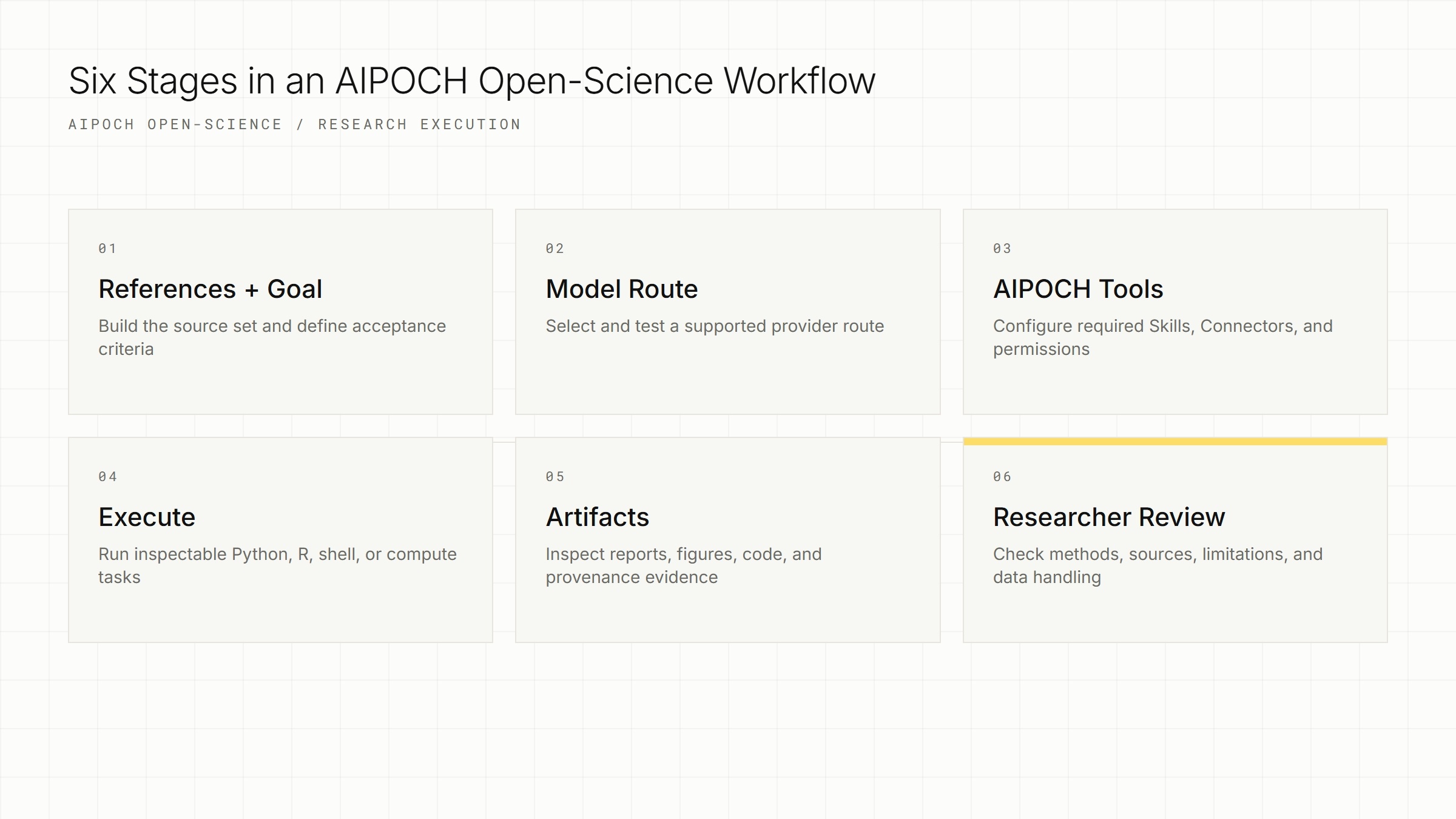
A useful Claude-powered workflow in AIPOCH Open-Science starts with evidence and acceptance criteria, not an open-ended chat. The following six-stage pattern is designed to leave a research record that another person can inspect.
1. Build a reference set and define the goal
Create a stable project and write down the research question, scope, expected outputs, constraints, and validation checks. In the Reference Library, researchers can bring in literature by DOI, PubMed identifier, arXiv identifier, or file; organize collections; link references to projects; compare and merge suspected duplicates; look for open-access PDFs through supported public sources; and format citations while retaining provenance information.
Version 0.27.0 expands this workspace with batch PDF import, metadata and identifier resolution, collection totals, and stability improvements. These features establish the input record before model analysis but do not guarantee complete records or PDF availability.
2. Connect and test the model route
Choose an available agent backend and provider route. For Claude, use the documented Anthropic API configuration or an eligible subscription route supported by the installed application. Test the connection with non-sensitive material first, and record the model and route used for the task.
3. Configure only the AIPOCH capabilities required
Enable the relevant AIPOCH Skills, Connectors, Specialists, and permissions. A Skill provides instructions and supporting resources for a task; a Connector provides controlled access to a local or external service. These are AIPOCH workbench capabilities, not automatically inherited Anthropic features. Review parameters, data sources, credentials, licensing, and approval boundaries before execution.
4. Execute in an inspectable environment
Use recorded shell actions or persistent Python and R kernels when computation is required. Open-Science supports local interpreters and managed environments, while documented remote SSH and Slurm paths can support suitable remote or HPC work. Version 0.27.0 also adds background execution and clearer interruption behavior, helping longer tasks continue without turning the chat response into the only record of work.
5. Inspect artifacts and provenance
Review reports, tables, figures, scripts, and intermediate outputs beside the session. Open-Science stores immutable artifact versions and can expose available producer code, execution history, referenced inputs, environment inventory, conversation context, and reviewer evidence. This makes it easier to ask not just “What did the model say?” but “Which inputs and steps produced this file?”
6. Apply researcher review
Check citations, calculations, method choices, assumptions, missing evidence, and data handling before using the result. Models and automated reviewers can help surface inconsistencies; they do not establish validity. For a reproducibility pilot, attempt to rerun a documented analysis from supplied files, then compare outputs, code, environment evidence, and deviations with the source procedure.
What AIPOCH Open-Science Contributes
AIPOCH Open-Science contributes an independent operating layer for research inputs, execution, evidence, and continuation. Its value is not an imitation of Claude's interface or a second prompt library. It is a workbench in which model selection is one configurable part of a broader project.
| Research requirement | AIPOCH Open-Science approach |
|---|---|
| Literature grounding | Reference Library with identifier-aware imports, files, collections, project links, duplicate review, supported open-access lookup, and citation provenance |
| Model strategy | Multiple documented providers, compatible gateways, and eligible Claude or Codex subscription routes, subject to backend compatibility |
| Desktop access | Current installers for macOS, Windows, and Linux |
| Project continuity | Persistent projects, sessions, files, previews, reference context, and run history |
| Scientific execution | Python, R, shell activity, local environments, remote SSH hosts, and documented Slurm workflows |
| Capabilities and access | Built-in or custom Skills, Connectors, and Specialists with tool-level permissions |
| Artifact review | Immutable versions with available production, lineage, environment, and reviewer evidence |
| Inspectability | Orchestration source published under the Apache License 2.0 |
| Human control | Approval modes, scoped grants, activity visibility, stop controls, and optional reviewer workflows |
This describes documented architecture, not superior scientific performance. AIPOCH Open-Science is still evolving, so evaluate version-specific limitations against team requirements.
Which Operating Model Fits Your Team?
A Claude-native route may fit teams that prioritize Anthropic's vendor-managed scientific experience, curated integrations, support model, and existing organizational controls over maintaining an independent orchestration layer. The current Claude Science help documentation describes a public beta application for macOS and Linux and notes organizational enablement requirements. Verify current plans, platforms, administrative controls, connectors, data terms, and compute routes before adoption.
AIPOCH Open-Science may fit teams that want the research workspace to remain independent from one model provider. It is especially relevant when Windows support, local-first project records, source inspection, supported model choice, literature organization, Python or R execution, custom capabilities, remote compute, or detailed artifact provenance are priorities.
The tradeoff is ownership. Teams adopting Open-Science must evaluate releases, maintain the application, configure providers and Connectors, choose permissions, review external data flows, and validate outputs. A vendor-managed route may reduce some of that operational work; an independent workbench may offer more control and portability. Neither choice replaces scientific judgment.
For the broader feature, governance, and platform comparison, use the canonical pillar page: Claude Science vs. AIPOCH Open-Science.
Data Flow and Provenance Checklist
Local-first does not mean that every action stays offline. According to the AIPOCH Open-Science data and permission documentation, project data, settings, artifact versions, provenance evidence, and logs remain on the local computer by default. Model requests send necessary context to the configured provider, while web searches, remote Connectors, and remote compute may send selected parameters or content to external services.
Before using Claude or another provider with research data, document:
- Which prompts, attachments, reference excerpts, file excerpts, and tool results leave the computer.
- Which provider, Connector, or compute credentials are stored and where.
- Which actions require approval and which permissions remain active.
- Which code, inputs, environment details, literature records, and artifacts remain available for review.
- Which information must be removed, anonymized, or kept outside the workflow.
Apply institutional policies and provider terms to unpublished findings, licensed datasets, personal information, clinical data, and protected systems. Product labels do not resolve governance by themselves.
How to Start With a Bounded Pilot
Start with one task that has known inputs, observable outputs, and explicit review criteria. Download AIPOCH Open-Science, complete the environment and provider checks, create a project, organize a small reference set, and select the narrowest permission profile that fits the work.
A useful pilot can organize a small literature collection, attempt to rerun a documented analysis, or generate a report and figures. Record the expected method and artifacts first; afterward, inspect citations, files, code, environment evidence, deviations, and limitations—not only the prose response.
If Claude is the preferred model route, confirm compatibility in the installed version. If the route is unavailable, choose another documented provider or postpone the test rather than assuming access. The goal is to evaluate the workflow and evidence trail under real team constraints.
Conclusion
Claude for Life Sciences is an entry point into Anthropic's scientific AI offerings; AIPOCH Open-Science is a separate, open-source workbench for organizing supported models within a local-first research workflow. A Claude route can provide model access inside Open-Science, but Anthropic product capabilities and AIPOCH workbench capabilities remain distinct.
Teams that value Anthropic's vendor-managed scientific experience may prefer a Claude-native route. Teams that want cross-platform access, model choice, literature organization, inspectable execution, persistent project records, and artifact provenance can evaluate AIPOCH Open-Science with a bounded pilot. In either model, researchers remain responsible for data governance, methods, verification, and interpretation.
FAQ
What is Claude for Life Sciences?
Claude for Life Sciences is Anthropic's life-science-oriented collection of Claude capabilities, integrations, skills, services, and access routes. It is not a separate foundation model.
Is Claude Science the same as Claude for Life Sciences?
No. Claude Science is a dedicated scientific workbench in public beta. “Claude for Life Sciences” is a broader label used for Anthropic's life-science-oriented offerings; describing it as a broader solution area is this article's classification, not an official architecture term.
Can AIPOCH Open-Science use Claude?
Yes, when a documented Anthropic API or eligible Claude subscription route is compatible with the selected backend, account, region, and installed Open-Science version. Model access does not import Claude Science, Anthropic Skills, connectors, databases, entitlements, or support.
What does AIPOCH Open-Science add around model access?
Open-Science organizes literature, persistent project context, AIPOCH Skills and Connectors, permissions, Python or R execution, local or remote compute, versioned artifacts, provenance evidence, and researcher review around supported models.
Disclaimer
Connecting Claude to AIPOCH Open-Science does not create a partnership, product integration, feature transfer, or equivalence between AIPOCH and Anthropic. Claude, Claude Science, Claude for Life Sciences, and related Anthropic product names are trademarks or product names of Anthropic. AIPOCH Open-Science is an independent AIPOCH product.
This article is for informational purposes only and does not constitute medical advice, clinical guidance, diagnostic or treatment recommendations, or validated scientific conclusions. Product availability and capabilities may change after the fact-check date. Diagrams and workflows are illustrative and do not represent validated research findings.
AIPOCH Open-Science is a research workflow tool. It does not replace researcher judgment. Researchers remain responsible for verifying outputs, sources, methods, permissions, data handling, and fitness for use. External links are provided for reference; AIPOCH does not control or endorse third-party content.