Claude Science and AIPOCH Open-Science both bring AI into research workflows. The decision is where your team wants control over models, execution, project records and handoffs. Open-Science adds an independent, open-source workbench and portable .science packages that can carry selected conversation branches, file versions, Notebook records and verification evidence to another project or computer. See the official package guide.
This is a documentation-based comparison, checked on October 19, 2026 against the Open-Science v1.0.0 release and Anthropic's current Claude Science page. It is not a controlled test of speed, scientific accuracy or feature parity. AIPOCH develops Open-Science and is not affiliated with or endorsed by Anthropic.
What decision does this comparison help you make?
Choose the workbench around the research record your team must maintain and the operating responsibilities it can take on. Model quality is one part of that decision; data access, executable environments, permissions and handoff evidence also matter.
Claude Science is Anthropic's scientific workbench, centered on Claude. Its documentation describes tools, compute and research outputs with associated history. Anthropic also states that the application can run on the researcher's infrastructure. It would be misleading to reduce this choice to “cloud versus local.”
AIPOCH Open-Science is an open-source, local-first, model-agnostic, self-hosted AI research workbench for reproducible scientific discovery. It separates the workspace from a single model provider. The team chooses compatible model routes and assumes responsibility for the application, configured services and scientific review.
The practical question is whether you prefer Anthropic's integrated product path or an independently operated workbench whose source and model connections your team can inspect and configure.
How do the documented capabilities compare?
Both products offer scientific execution and evidence-related features, but matching feature names do not establish matching implementations. Use this table to identify pilot questions, then inspect the relevant product documentation.
| Decision area | Claude Science | AIPOCH Open-Science |
|---|---|---|
| Product and model relationship | Anthropic's scientific application centered on Claude | Independent workbench with supported provider and agent-backend choices |
| Source and extension control | Follow Anthropic's documented product and extension interfaces | Published workbench source under Apache License 2.0; inspect and modify subject to license terms |
| Desktop availability | Official page currently lists macOS, Windows and Linux beta | v1.0.0 publishes desktop installers for macOS, Windows and Linux |
| Research execution | Official page describes local kernels and configured remote compute | Documented Notebook execution, local runtimes and registered SSH/Slurm hosts |
| Output evidence | Official page describes code, environment and conversation associated with outputs | Version-specific provenance and supported rerun/comparison checks; evidence completeness must be inspected |
| Handoff | Check current export documentation and organizational requirements | Selected history, file versions and evidence can travel in a .science package; importing is read-only |
| Operating responsibility | Vendor product rules plus the team's infrastructure and data responsibilities | Team-managed application, compatible providers, runtime preparation, tool permissions and update policy |
Sources: Claude Science, Open-Science v1.0.0, installation, verification and package exchange.
Windows availability is no longer a sufficient reason by itself to choose one product. Account eligibility, organizational enablement and platform-specific execution still need testing on the intended installation.
What does AIPOCH Open-Science contribute to the research record?
AIPOCH Open-Science brings the inputs, execution history, saved outputs and available review evidence into a workspace the team can operate independently. Its useful unit of evaluation is a completed, inspectable task rather than a chat response.
Start with a small set of source files and an explicit acceptance rule. Organize the relevant literature, prepare a compatible runtime, execute the analysis and inspect the resulting files. The Notebook guide explains how to distinguish displayed code from recorded execution and inspect the evidence associated with a particular result version.
Then decide what a collaborator should receive. A report alone may be sufficient for reading. A .science package is useful when the recipient also needs selected branches, files and recorded evidence. Package contents depend on export selection; Side Chat conversations and private reading bookmarks are excluded. Importing does not run code or restore credentials. A sender's verification record describes the sender's check, not a rerun on the receiving computer. The package guide sets out these boundaries.
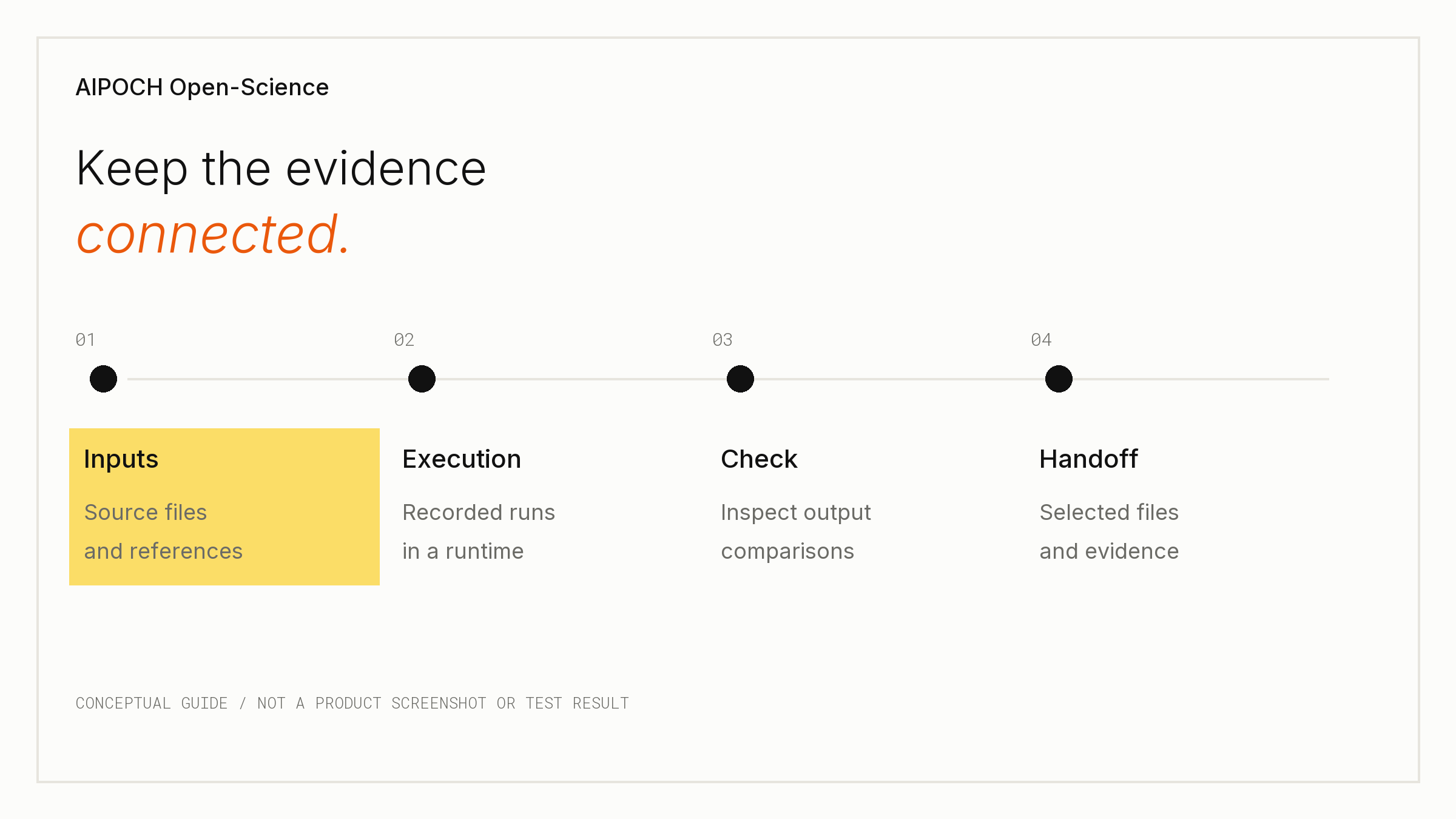
This distinction matters during review: a readable record, a successful rerun and a scientifically appropriate method answer different questions. Use the reproducibility evidence checklist when that distinction is the main concern.
How should teams interpret capability catalogs?
Catalog counts describe different kinds of resources and should not be added into a single score. A Connector is not a database count, and a marketplace entry is not a built-in capability.
For Open-Science v1.0.0, the release inventory contains 23 user-facing built-in Skills and 36 built-in Connectors. The official repository also documents 25 provider presets. Official marketplace catalogs checked on October 19, 2026 list 525 Skills and 10 Specialists, available separately. These figures are dated inventory descriptions; they do not establish scientific quality or service availability. Marketplace and built-in resources may overlap, so do not sum them.
For either product, inspect the particular resource needed for your task: its method, permissions, credentials, terms and dependencies. A larger catalog does not resolve whether one required data source or runtime works in your institution.
Where can data leave the workflow?
Local storage and local compute do not establish an offline workflow. Draw the route taken by prompts, attachments, retrieved excerpts, tool parameters and remote results before using sensitive material.
Anthropic's current page says raw datasets and compute stay on the user's infrastructure while prompt and response content is processed by Anthropic under the applicable retention terms. That boundary still requires examination of what enters each prompt.
For AIPOCH Open-Science, model requests send necessary context to the selected provider. Searches, remote Connectors, remote compute and application services introduce additional external routes. A compatible local model endpoint can change the model-processing boundary, but it does not establish that every enabled operation is offline.
Use the published data-flow explanation for a closer inspection, then record your actual endpoints and institutional restrictions.
Which route fits your team, and what should you test?
Claude Science may fit a team that prefers Anthropic's integrated scientific product, existing account arrangements and documented administrative controls. Open-Science may fit a team that prioritizes source inspection, compatible provider choice and selected research-record exchange. Both choices require operational and scientific review.
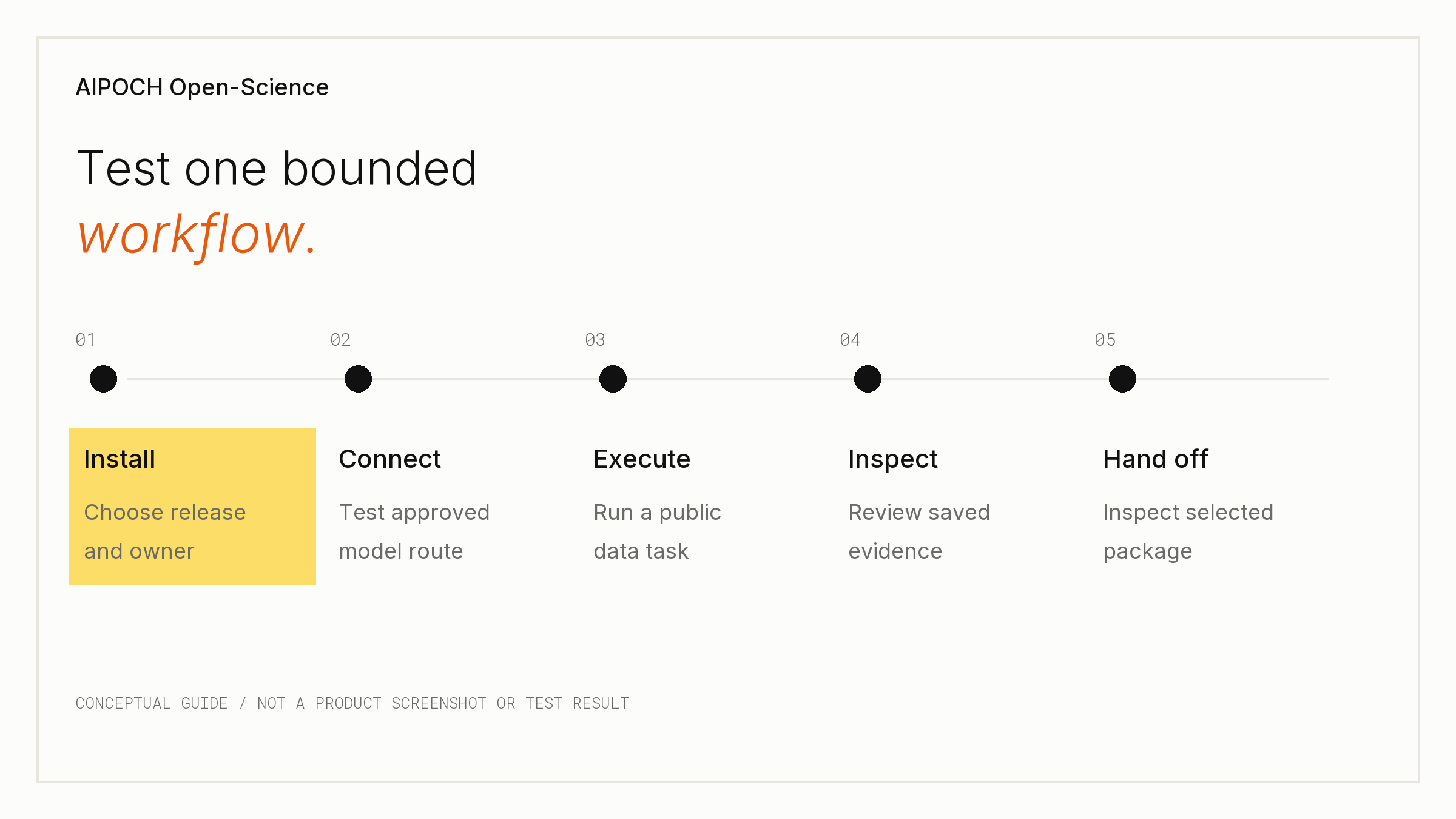
For an Open-Science pilot, assign an owner to each of the following:
- Deployment: choose a release and installation method; record the actual installed version.
- Model access: test an approved provider/backend combination with non-sensitive material.
- Execution: run one small task in the intended environment and retain its inputs and outputs.
- Evidence: inspect one saved version, attempt a supported check and record unavailable evidence.
- Handoff: export selected work and inspect the received record before continuing separately.
Use the deployment and governance checklist to prepare that pilot. For a domain-specific task, see the published bioinformatics workflow discussion and paper-reproduction case review. For the distinction between model access and workbench capability, see the Claude for Life Sciences guide. Those articles answer narrower questions; their historical version references should be checked against current official documentation.
Start with a reviewable AIPOCH Open-Science task
Evaluate AIPOCH Open-Science with one public-data task and a defined handoff requirement. Keep its source inputs, execution records, saved outputs, comparison criteria and .science package together. Choose the workbench only after the pilot shows which responsibilities your team can support and which evidence remains missing.
FAQ
Is AIPOCH Open-Science a Claude Science alternative?
Yes, for teams seeking an independently operated, open-source research workbench. It supports documented model routes, but adopting it does not import another product's sessions, integrations or account entitlements.
Does Claude Science support Windows now?
Anthropic's official page checked on October 19, 2026 lists Windows, macOS and Linux beta availability. Confirm the current installer, account access and administrative requirements before adoption.
Can AIPOCH Open-Science use Claude?
Yes, when the chosen Claude route is supported by the installed version, backend and account. Test that route in the application; model access does not transfer Claude Science's workbench features.
Does a .science package prove a result reproduced?
No. It can carry selected research records and verification evidence, but importing it does not execute the analysis; a received verification record concerns the sender's check.
Disclaimer
This article is informational and does not provide medical advice, clinical guidance or validated scientific conclusions. It compares dated public documentation, not controlled scientific performance. Diagrams are conceptual, not product screenshots or test results.
AIPOCH Open-Science supports research workflows. Researchers remain responsible for data handling, methods, interpretation and independent verification. External references do not imply affiliation or endorsement.