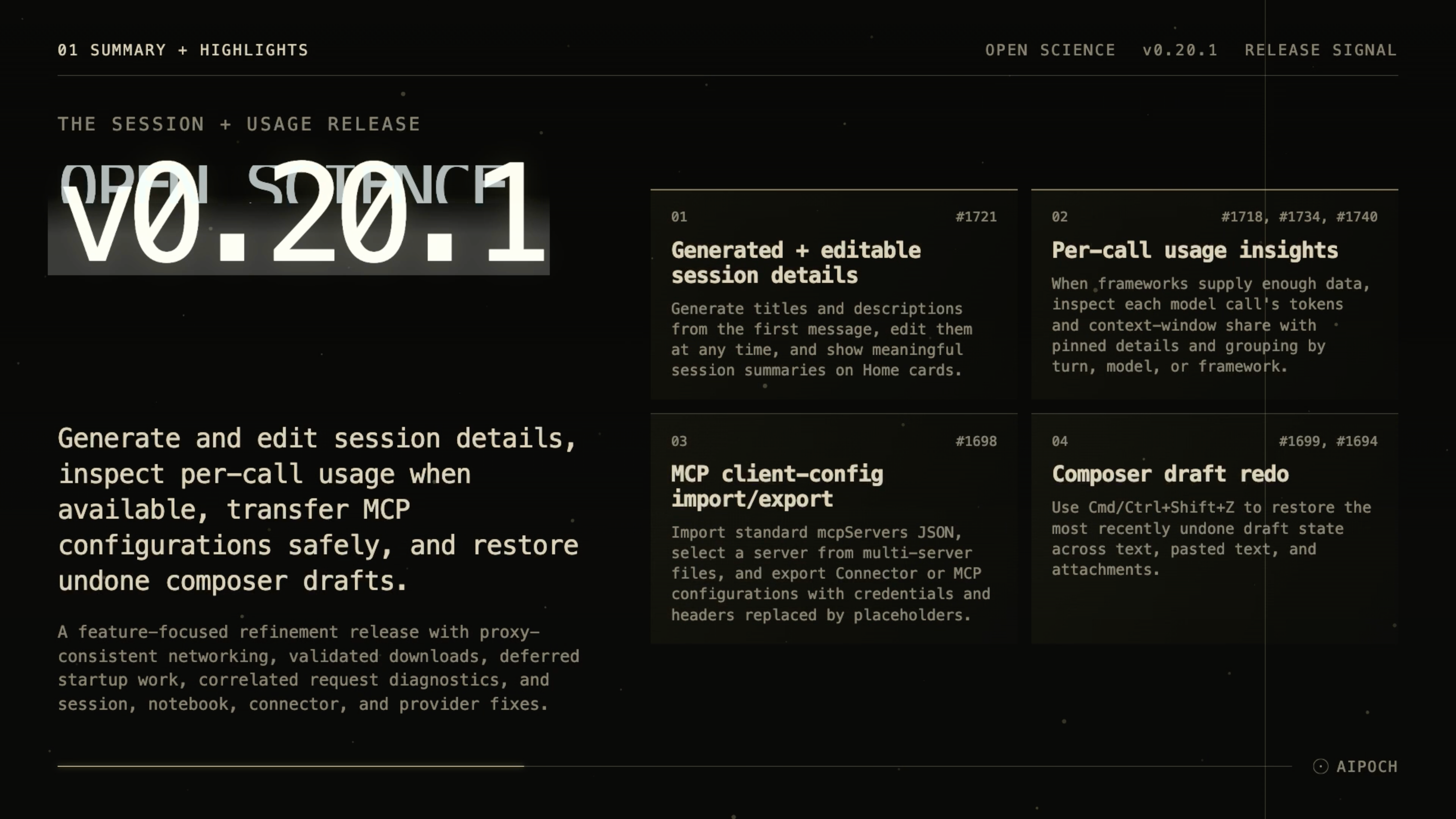
Open Science v0.20.1 makes sessions self-describing, exposes per-call usage, transfers MCP client configs safely, and adds redo for composer drafts.
Open Science is the local-first AI research workbench from AIPOCH, designed to support reproducible execution while keeping research activity and inspectable provenance evidence visible.
Published on August 26, 2026, v0.20.1 is a feature-focused refinement release that improves session identification, model-usage inspection, MCP configuration portability, composer history, networking, and diagnostics.
What new capabilities help researchers describe sessions and inspect resource use?
Open Science v0.20.1 gives sessions clearer identities, records model-call usage when frameworks provide sufficient data, and makes configuration and draft state easier to move or restore.
Generated and editable session details
Long-running projects can accumulate many sessions whose first lines do not clearly explain their purpose. Generic or truncated labels make it harder to return to the right analysis later.
New sessions can generate a title and description from the first message through a restricted runner that cannot use tools. Each session gets one generation attempt, and an edit dialog with character counters lets the researcher replace or refine the generated details at any time. Starting an edit supersedes a generation that is still running, and the model used for session details can be configured.
Home cards can now summarize what a session is about instead of relying on a clipped opening line. Generated details are organizational metadata; researchers can edit them whenever the wording is incomplete or misleading.
Per-model-call usage insights
Turn-level totals can hide how individual model calls consume context, especially when one research turn involves several calls or multiple frameworks and models.
When the active framework reports enough information, v0.20.1 stores validated token and context-window records for each model call. The Context window dialog provides Turns and Calls modes, with stacked input, cache, and output bars, a three-metric summary, pinned call details, turn lanes, and grouping by turn, model, or framework. History projection is deferred until the dialog opens.
Researchers can inspect where reported context and tokens were used without treating estimates as universal measurements. Per-call details are available only when the framework supplies the required data, so missing records should remain unknown rather than inferred.
MCP client-config import and export
Moving an MCP server setup between compatible hosts often requires copying JSON by hand and separating reusable configuration from private credentials.
Open Science v0.20.1 can import the standard mcpServers client configuration used by other MCP hosts. When a file contains several servers, the researcher can select which one to import. Open Science can also export either an Open Science Connector or an MCP client configuration, while replacing exported credentials and headers with ${NAME} placeholders. Unsupported formats receive explicit diagnostics.
Researchers can transfer server definitions without intentionally exporting live secrets. Placeholders still need to be configured in the destination environment, and researchers remain responsible for reviewing endpoints, tools, and data flows before use.
Composer draft redo
Undo is most useful when an accidental reversal can also be restored. A draft history that supports only undo makes text, pasted content, or staged attachments harder to recover after one step too many.
The standard redo shortcut, Cmd/Ctrl+Shift+Z, reapplies the most recently undone composer state. Redo participates in the same draft history as typed text, pasted text, attachments, caret restoration, and staged-upload lifecycle handling.
Researchers can move backward and forward through recent composer changes without rebuilding an undone draft manually. Redo restores draft state; it does not replay an already submitted agent turn.
What else is new in v0.20.1?
The release also improves request tracing, proxy consistency, download safety, startup work, file-preview persistence, and failure diagnosis.
- Correlated HTTP diagnostics. Web and task requests receive correlation IDs that connect command, session, and run logs, including rejected boundaries.
- Proxy-consistent networking. Downloads and spawned requests now follow the configured proxy mode uniformly.
- Validated downloads and external links. Downloads are checked and external links are classified consistently before opening.
- Deferred startup work. Context-window history waits until its dialog opens, notification refresh bursts are coalesced, and user-skill scanning is deferred.
- Reduced file-preview persistence work. Preview state avoids redundant reads and writes.
- Clearer Codex MCP failures. Underlying causes are logged to support diagnosis.
- Abortable GitHub skill imports. A stalled import can be stopped instead of remaining indefinitely in progress.
Bug fixes that affect daily use
The v0.20.1 fixes protect conversation history, interrupted work, remote compute, connectors, providers, notebooks, delegation, session state, and renderer recovery.
- Conversation history survives concurrent writers. Graph ownership is enforced before authority writes, unknown framework identifiers are preserved, and projections are validated.
- Interrupted work retains useful state. Interrupted turns keep usage records, and interrupted Codex sessions can resume without empty-data failures.
- Remote compute cleans up safely. Pending approvals for deleted sessions are canceled, polling work stops during shutdown, and remote-job coordination is hardened.
- Connector boundaries are stricter. Scalar identifier inputs are preserved, bundled tool arguments are validated, parser response resources are bounded, and OAuth authorization URLs are restricted.
- Provider failures lead to clearer next steps. Connection errors guide researchers toward settings, while Responses artifact-completion failures produce diagnostics instead of disappearing silently.
- Composer and queue states are clearer. The placeholder stays hidden during IME composition, and the queue discloses that its lifetime is transient.
- Notebook state is more stable. CommonJS loading is documented, REPL errors are compacted in state context, and concurrent runtime-setting updates no longer conflict.
- Delegation admission is validated. Delegate requests are checked before admission, and restricted inference prompts remain isolated.
- Sessions and projects retain consistent metadata. Archive operations preserve activity timestamps, updates remain monotonic, reviewer submission lifecycle is committed, and session plans preserve structured clarification questions.
- Remote-access pairing is hardened. Pairing authorization receives stronger validation.
- Renderer recovery is more reliable. Asynchronous job and provider state can recover while lifecycle and file interactions receive additional checks.
- Custom forms stay valid. Elicitation enforces form-schema invariants.
- Resource use is bounded. Provider and file operations enforce their configured limits.
Install or update
Open Science v0.20.1 is available for macOS, Linux, and Windows from the official GitHub Release assets.
- macOS 12 or later on Apple Silicon or Intel: download the matching DMG.
- Linux x64: download the AppImage or Debian package.
- Windows 10 or 11 x64: download the Windows installer.
Choose the appropriate package from the Assets section of the Open Science v0.20.1 release. The onboarding wizard can inspect the environment and configure an app-managed agent runtime, and an existing installation can update in place.
Official macOS release builds are Developer ID signed and notarized. Windows builds do not yet have an Authenticode certificate, so SmartScreen may show an “unrecognized app” prompt. Confirm that the installer came from the official release page before continuing.
Resources
Use the official release and product pages for current packages and capability boundaries, with related AIPOCH articles for model, Connector, Skill, and Specialist context.
- Open Science v0.20.1 release notes and downloads
- Open Science product page
- AIPOCH
- AIPOCH Blog
- What Model-Agnostic Means in Open Science
- Open Science Skills, Connectors, and Specialists Explained
- Specialist AI Agents in Open Science: Roles and Scope
FAQ
Is Open Science v0.20.1 only a bug-fix patch?
No. Open Science v0.20.1 is a feature-focused refinement release published on August 26, 2026. It adds generated and editable session details, per-call usage views, MCP configuration transfer, composer redo, and correlated request diagnostics alongside fixes.
Can researchers edit an automatically generated session title and description?
Yes. A new session can generate one title and description from its first message, and the researcher can edit both fields at any time. Opening the edit dialog supersedes generation if it is still running.
Does every model call show token and context-window data?
No. Per-call usage appears only when the active framework reports enough validated information. Open Science records available input, cache, output, and context-window details without inventing values for calls that do not provide them.
Does MCP export include live credentials?
No. Exported credentials and headers are replaced by ${NAME} placeholders. The destination environment must provide the required values separately before the imported server can authenticate.
What is the redo shortcut in the Open Science composer?
Use Cmd+Shift+Z on macOS or Ctrl+Shift+Z on Windows and Linux. It restores the most recently undone composer draft state across text, pasted text, attachments, and caret position.