Tesla's Roadster page describes a Thrust configuration with a claimed 0–60 mph time under one second. What would that launch require? An AIPOCH Open-Science research case lets readers inspect the assumptions and saved calculations in a .science package. Its subject is a hypothetical Roadster-like car; the calculated times are neither Tesla measurements nor proof of production-vehicle performance.
The short answer: The case's chosen tire-grip assumption cannot produce a one-second launch on its own. Adding independent forward thrust can produce a sub-second modeled time, but the conclusion depends on assumed mass, wheel power, drag, and thrust. The point of opening the research package is to see how that answer was reached, not merely to repeat its quickest number.
Research scope and disclaimer: This article examines a hypothetical AIPOCH Open-Science model, not a Tesla vehicle test. Its assumed mass, grip, power, downforce, drag, and thrust are research inputs, not verified Tesla specifications. The results neither establish nor refute Tesla's stated under-one-second 0–60 mph performance for the Thrust configuration. Evaluating that claim would require measurements of a real vehicle under a stated timing protocol. This article is for research discussion and is not a vehicle safety assessment or engineering recommendation.
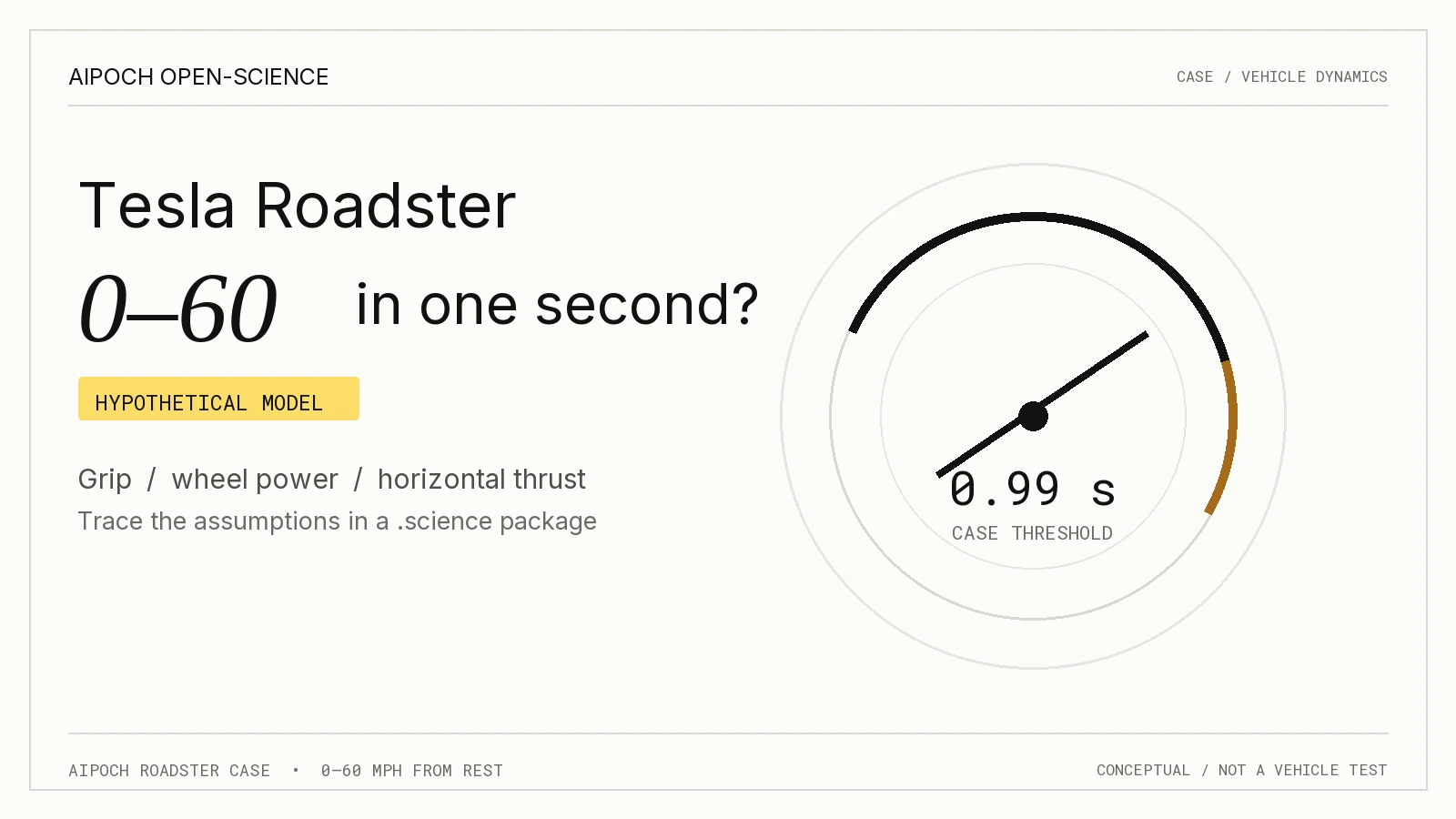
Conceptual cover based on the case question. The threshold is a model criterion, not a Tesla test result.
Can the Tesla Roadster 0-60 time really be under one second?
A one-second launch is possible in the AIPOCH Open-Science case only under specified hypothetical forces: its tire-only model misses the target, while a model with 600 kW of wheel power and 40 kN of independent horizontal thrust reaches 60 mph in about 0.79 seconds for a 1,800 kg car.
The AIPOCH Roadster case (2026) defines 60 mph as 26.8224 m/s, starts timing from rest without rollout, and records about 2.28 seconds for ideal tire-only acceleration at its adopted friction coefficient of 1.2. Tesla's Roadster page (2026) attributes its under-one-second claim to the rear-thruster-equipped Thrust configuration.
Tesla's product claim and the case's calculation answer different questions. The case asks which assumed combinations can cross a strict 0.99-second threshold. It does not use measured Tesla mass, tire data, thrust curves, or a vehicle test. A modeled 0.995-second run would be under one second in ordinary speech but fail the study's 0.99-second goal. Published Roadster performance claims therefore cannot be validated by matching a single simulated time.
Timing conventions also matter. The case measures from a stationary start to exactly 60 mph, with no rollout subtraction. Before comparing a published acceleration claim with any simulation, a reader would need to know whether the published timer starts at first vehicle movement, after a rollout distance, or at another trigger. The case deliberately fixes its own definition so comparisons among its scenarios are consistent; it does not establish the timing convention of a Tesla test.
Reaching 60 mph in 0.99 seconds requires an average acceleration of about 27.1 m/s², or 2.76 g, under the case's timing convention: divide 26.8224 m/s by 0.99 seconds, then divide by standard gravity. The average is neither a peak-acceleration estimate nor a passenger-safety assessment.
Which assumptions make the AIPOCH Open-Science Roadster model work?
The AIPOCH Open-Science Roadster study fixes a deliberately simplified launch environment so readers can isolate the effect of grip, power, thrust, and mass; the striking acceleration times are conditional on those inputs, including ideal traction control and stable road contact, rather than predictions about a finished vehicle.
The AIPOCH case introduction (2026) sets the main vehicle masses at 1,800 kg and 2,000 kg, the second including a 200 kg equipment increment, and fixes tire friction at 1.2 for the main comparison. The case report (2026) treats horizontal thrust as independent of the wheel-power cap and excludes its propellant and energy requirements.
| Main input | What the case assumes | Why the reader should notice |
|---|---|---|
| Launch target | 60 mph from rest; pass at or below 0.99 s | Fixes the question before comparing runs. |
| Tire grip | Constant coefficient of 1.2 | Does not change with speed, load, temperature, or surface. |
| Wheel power | 300, 600, and 1,000 kW, plus an unlimited reference | Extra grip helps only while the wheels can provide force. |
| External thrust | Specified constant horizontal force | Its energy source and propellant are outside the model budget. |
| Vehicle mass | 1,800 kg, then 2,000 kg | Tests the cost of an assumed 200 kg addition. |
The study also assumes ideal all-wheel drive, sufficient low-speed torque, a level road, and stable ground contact. Those are useful simplifications when asking which modeled constraint matters first. They are much less useful as evidence that the hardware needed for a particular result exists or remains safe and controllable through a real launch.
Why do grip, downforce, and thrust lead to different 0–60 times?
The case separates three forces that are easy to blur together: tire grip caps wheel force, downforce raises that grip limit only when wheel power can use it, and a horizontal thruster adds forward force outside the wheel-power cap, so equal numerical force settings yield different modeled launch times.
The AIPOCH case (2026) uses ideal all-wheel drive on level ground and models wheel force as the lesser of available grip and wheel power divided by speed, with a separate forward-thrust term. Tesla's Roadster description (2026) identifies suction and cold-gas thrusters as different systems in its vehicle concept.
The calculation can be summarized without treating the model as a real car specification:
F_wheel(v) = min[μ(mg + D_const + D_aero(v)), P_wheel / v]   for v > 0
m dv/dt = F_wheel(v) + T_horizontal − F_drag(v)
Here μ is assumed tire friction, D_const is downforce imposed from rest, D_aero(v) grows with speed, P_wheel is the wheel-power ceiling, and F_drag(v) opposes motion. At v = 0, the code uses the finite grip limit instead of dividing by zero. Horizontal thrust is a separate modeled force, with no propulsion power or fuel budget included. At 600 kW with drag, the saved 1,800 kg results make the distinction concrete:
| Modeled addition | Saved 0–60 time | Meets the case's 0.99 s goal? |
|---|---|---|
| No added force | 2.28882 s | No |
| 30 kN horizontal thrust | 0.94493 s | Yes |
| 30 kN constant downforce | 1.24948 s | No |
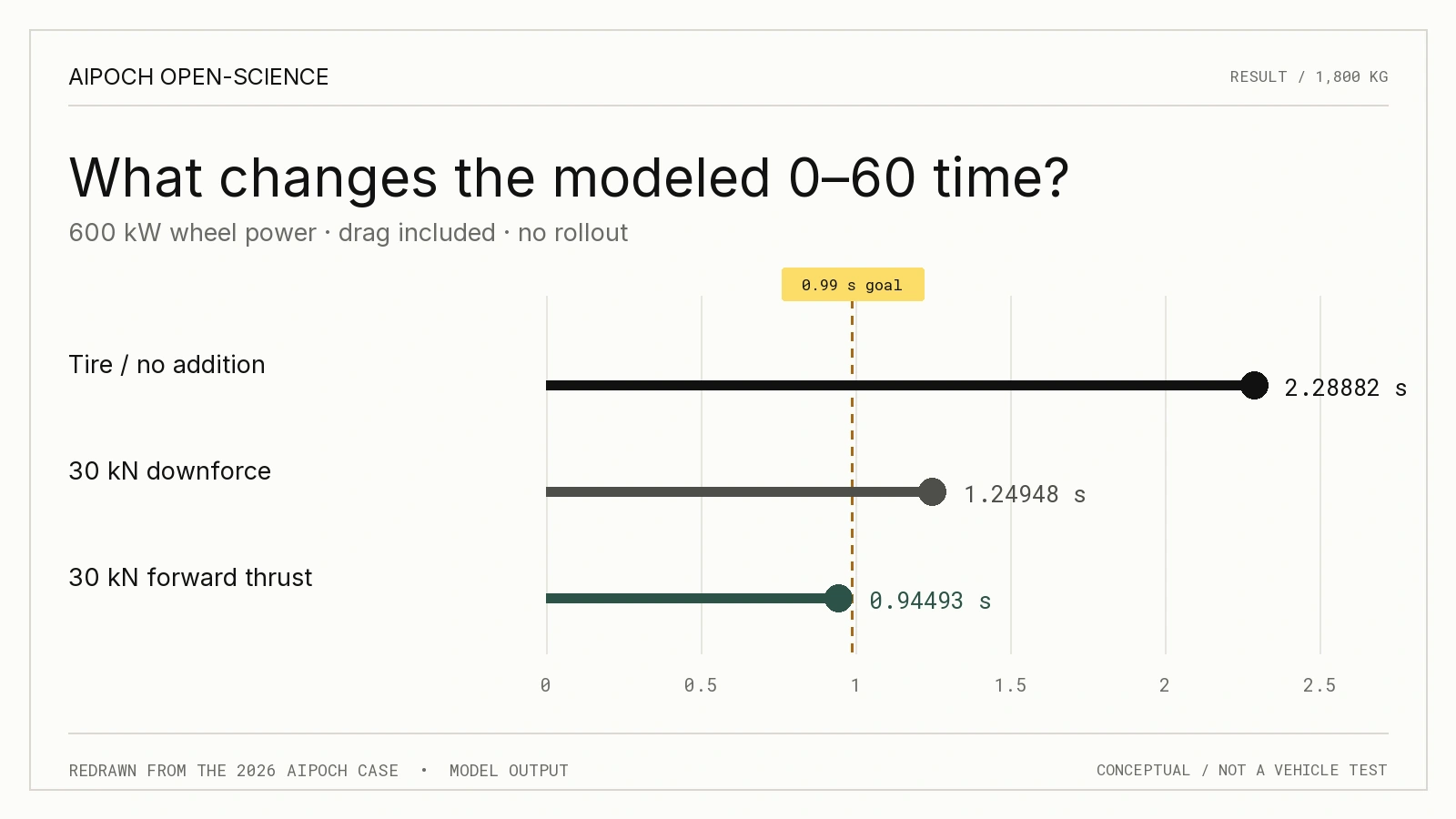
Redrawn from the AIPOCH Roadster case; all three scenarios include modeled drag and use the same 0.99-second goal. The graphic is not an app screenshot or a real-vehicle test.
Constant downforce is an imposed input from rest. Aerodynamic downforce is a separate model term that grows with speed and starts at zero. The extra thruster's energy, propellant, tank mass, and operating duration sit outside the wheel-power budget; the table therefore compares modeled arrival times, not complete hardware designs or energy efficiency.
The simplest calculation makes the grip problem visible. With no extra downforce, maximum tire force is friction coefficient × mass × gravity; dividing by mass leaves acceleration equal to friction coefficient × gravity. At the adopted coefficient of 1.2, the case obtains 11.77 m/s² and an ideal 2.28-second trip to 60 mph before drag or wheel-power limits. To reach the 0.99-second target using that tire-only law would require an effective coefficient of about 2.76. That figure is a requirement inside the simplified equation, not a claim about a real tire.
Downforce can raise the available tire force, but only if the drivetrain can actually supply it. At 600 kW, adding 30 kN of constant downward force leaves the saved launch at about 1.25 seconds; at 1,000 kW the same scenario reaches about 0.92 seconds. The independent thruster behaves differently because the model adds its forward force even after the wheels have become power-limited. This explains the counterintuitive table without treating downward force and forward thrust as interchangeable technologies.
Does adding 200 kg change the result?
Adding 200 kg changes a borderline outcome in the saved model: at 600 kW with drag, 30 kN of horizontal thrust moves from about 0.94 seconds at 1,800 kg to about 1.004 seconds at 2,000 kg, crossing from pass to miss against the 0.99-second goal, while 40 kN still passes.
The AIPOCH case introduction (2026) defines the 2,000 kg version as including a prescribed 200 kg equipment increment. The case's version comparison (2026) records about 0.79 and 0.85 seconds for the two masses with 40 kN thrust, while 30 kN changes from a pass to a miss.
| Horizontal thrust at 600 kW, with drag | 1,800 kg | 2,000 kg |
|---|---|---|
| 30 kN | 0.94493 s — pass | 1.00425 s — miss |
| 40 kN | 0.79026 s — pass | 0.84589 s — pass |
The useful question is not simply whether more mass slows a car. In the tire-only idealization, mass cancels from acceleration because both available tire force and vehicle inertia scale with mass. Once fixed thrust, drag, and a finite wheel-power ceiling enter the calculation, that cancellation no longer settles the outcome. The 200 kg comparison reveals where a seemingly comfortable headline claim becomes sensitive to the assumed hardware mass.
The comparison is especially useful because the successful and unsuccessful times are close to the same fixed goal. A 30 kN thrust setting passes at 1,800 kg but misses at 2,000 kg; raising assumed thrust to 40 kN gives both versions more room. The second version is a sensitivity test, not a prediction that a Tesla thrust system weighs 200 kg. The report also keeps a separate 1,400/1,800/2,200 kg sweep; those are already total masses, so adding the 200 kg version increment again would double-count it.
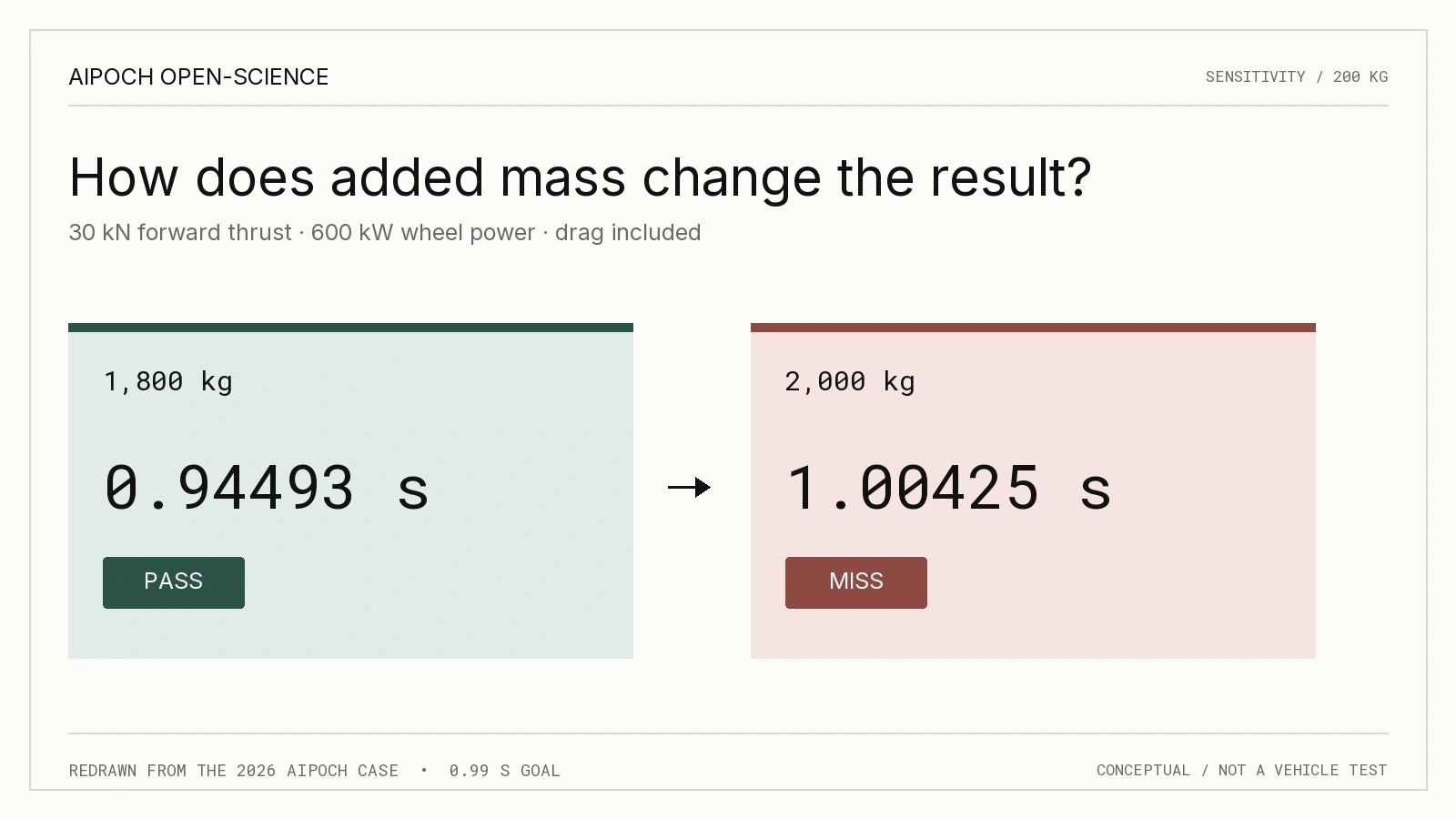
Redrawn from the AIPOCH Roadster case; both runs assume 600 kW wheel power and modeled drag. The 200 kg difference is a study assumption, not measured Tesla equipment mass.
Where is the model's one-second boundary?
The case does more than select a fast example: it maps the combinations of tire friction and independent thrust that meet its 0.99-second target, then compares the boundary before and after the 200 kg mass increment; the heavier version requires more thrust at the same assumed grip.
The AIPOCH Roadster case (2026) samples friction from 0.8 to 1.6 and horizontal thrust from zero to 60 kN at 600 kW with drag. The case's versioned boundary results (2026) place the refined crossing at friction 1.2 near 27.7 kN for 1,800 kg and 30.8 kN for 2,000 kg; across 4,961 sampled combinations, 270 change from pass to fail.
The grid uses 0.02 friction steps and 0.5 kN thrust steps. At friction 1.2, the first passing sampled thrust values are 28.0 kN and 31.0 kN. Those rounded grid values are distinct from the refined crossings in the table below:
| Boundary at assumed friction 1.2 | 1,800 kg version | 2,000 kg version |
|---|---|---|
| Refined thrust at 0.99 s | 27.6739 kN | 30.7690 kN |
| First passing sampled thrust | 28.0 kN | 31.0 kN |
| Passing points in full grid | 2,663 of 4,961 | 2,393 of 4,961 |
The distinction matters when reading a heat map or table in the package. A color change at a sampled 0.5 kN increment does not mean nature has a sharp threshold at that exact sample. The refined numerical crossing estimates the model's boundary between samples. Neither operation measures uncertainty in real tires, vehicle mass, or a thrust system; the map is a sensitivity study of assumed inputs.
Can the model verify Tesla's real-world 0-60 performance?
The Roadster study can explain what its assumed physics permits, but it cannot verify a real Tesla 0-60 run: the package contains calculations and saved numerical checks, while physical validation would require measured vehicle inputs, a defined timing protocol, and evidence that the force-generating hardware works under the same conditions.
The AIPOCH case report (2026) explicitly describes the car as hypothetical and lists tire behavior, load transfer, propulsion limits, and thruster resources as untested. The case's reproduction audit (2026) records matching saved tables and figures in the tested environment, a check of numerical consistency rather than a road test.
The report says the consolidated model integrates time across speed and splits the calculation where wheel force changes from grip-limited to power-limited. The saved audit then compares regenerated tables and figures. That is valuable for understanding whether the researcher's numbers follow the stated implementation. It does not resolve whether a real launch can maintain traction and stable contact, how force changes with speed, or how much propellant and equipment the thrusters require.
For a reader evaluating the claim, the next evidence would have to connect a real vehicle to the model: measured acceleration under a stated start convention, vehicle mass, tire and surface conditions, thrust over time, and the operating limits of the supporting hardware. The package shows how to frame those questions. It cannot supply the missing measurements by itself.
How can readers inspect the AIPOCH Open-Science .science package?
The Roadster .science package lets readers trace a specific modeled time back to the case's inputs, code, saved tables, and recorded checks; the most revealing path is to compare the two mass versions and ask which assumptions flip the 30 kN result across the 0.99-second boundary.
The AIPOCH Roadster case (2026) offers the downloadable .science package alongside its summary. AIPOCH's .science guide (2026) describes selected conversation branches, file versions, and recorded evidence in packages, with imported research remaining read-only until the reader creates a writable Fork.
The .science import preserves selected research history for inspection; contents depend on the sender's export selection, and Side Chat conversations and private reading bookmarks are excluded. Imported history is read-only and does not automatically execute code or restore credentials. The package's reproduction_audit.json describes checks performed by the sender, not a new run on the reader's computer. A writable Fork is a separate choice for continuing research.
To investigate the Tesla Roadster 0-60 question in AIPOCH Open-Science, open the Roadster research case, download its .science package, and follow the 30 kN row from the report into the versioned inputs. The useful conclusion is conditional: a sub-second modeled launch depends on the assumed forces, and added equipment mass can erase a marginal pass.