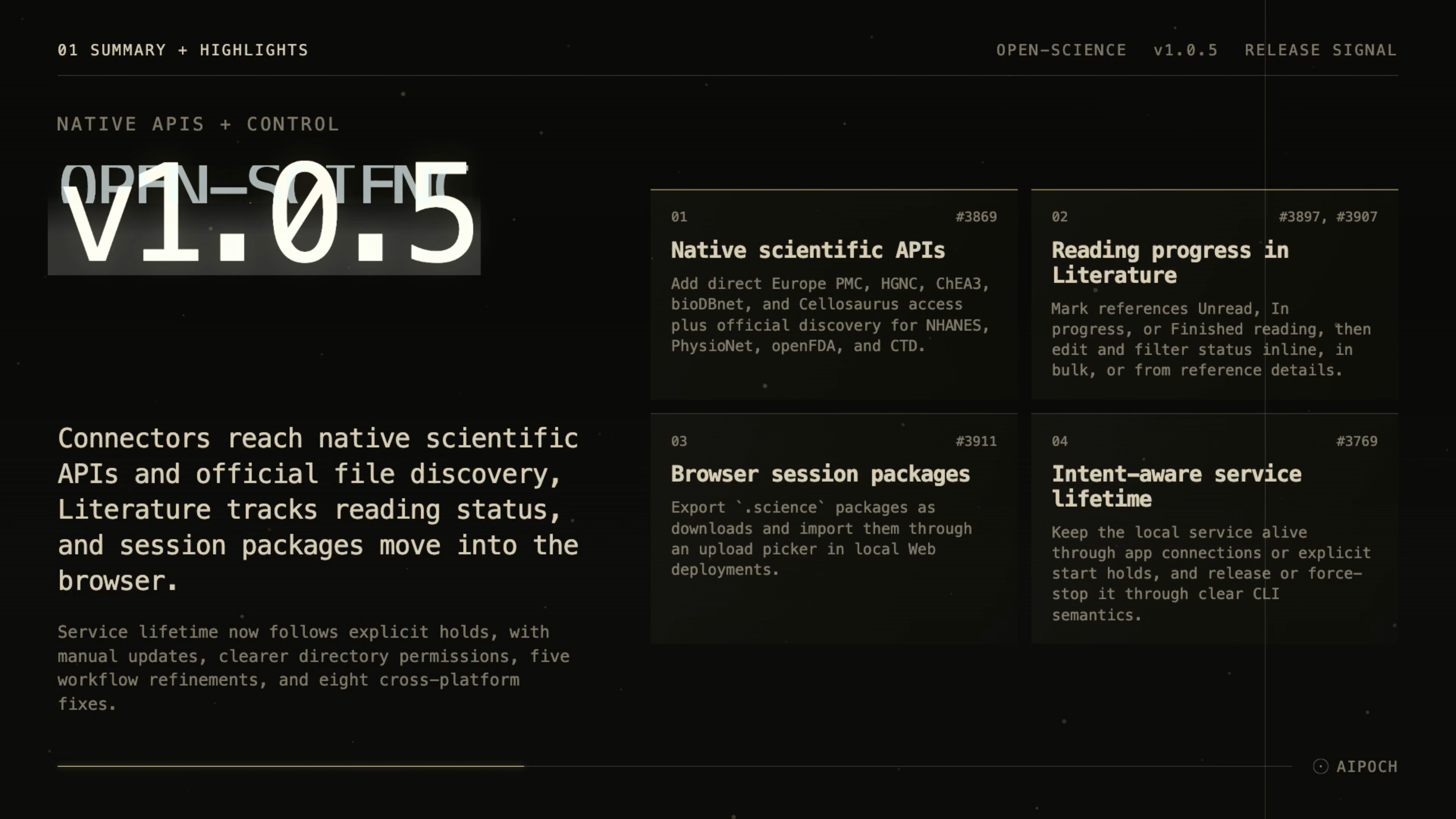
Version 1.0.5 brings native science APIs, reading status, browser .science packages, explicit service holds, and cross-platform reliability fixes.
AIPOCH Open-Science is AIPOCH's open-source, local-first AI research workbench; a .science package can carry selected conversation branches, file versions, Notebook records, and verification evidence for review, handoff, and archiving in another project or computer.
What new capabilities help researchers reach data and manage research flow?
AIPOCH Open-Science v1.0.5 helps researchers reach native scientific APIs, track reading progress, move .science packages through a local browser, and keep background work alive intentionally, bringing data access, literature triage, research handoff, and service control into clearer daily workflows.
The v1.0.5 GitHub release (AIPOCH, 2026) records native source APIs, reading status, browser package transfer, and explicit service holds as implemented capabilities.
The versioned connector documentation (AIPOCH, 2026) defines opt-in scope, transmitted identifiers, official URL return behavior, and access notes for the new source integrations.
The versioned CLI lifecycle guide (AIPOCH, 2026) explains how app connections, start holds, plain stop, and stop --force affect the local service.
Native scientific APIs and official file discovery
Research questions often cross services with different query syntax, identifiers, pagination, and access rules. Version 1.0.5 adds direct Europe PMC Boolean, core, and abstract search; HGNC gene metadata; ChEA3 enrichment ranks; bioDBnet conversion and orthology; Cellosaurus RDF and STR tools; and official file discovery for NHANES, PhysioNet, openFDA, and CTD.
The integrations are opt-in and return official URLs with provenance instead of presenting opaque downloads. Submitted search terms, gene names, DOIs, and other identifiers go to the relevant public services. Access-gated sources return official instructions, and AIPOCH Open-Science does not claim that a researcher is authorized to access restricted material.
Manually managed reading status in Literature
Literature collections become easier to triage when a researcher can distinguish references waiting to be read from papers already underway or completed. Version 1.0.5 adds Unread, In progress, and Finished reading states in a dedicated column, with inline, detail-page, bulk, and filtered editing.
Reading status is a researcher-managed workflow field, not an inferred judgment about whether the paper was understood, assessed correctly, or used as evidence. Bulk actions retain page, exclusion, count, and selection scope so researchers can review which references will change before treating the result as an updated reading plan.
Browser export and import for .science packages
Local Web deployments can now export a .science package as a browser download and import one through a browser upload picker. The transfer runs between the browser and the researcher's own local service, so a browser-only local workflow no longer needs a command-line fallback for package transfer.
A .science package can include selected conversation branches, file versions, Notebook records, and verification evidence. Imported sessions remain read-only, do not execute code, do not restore credentials or permission grants, and include files according to the export selection. Side Chat conversations and private reading bookmarks remain excluded.
Received verification records describe the sender's checks rather than proving that the receiving computer reran them. Researchers should inspect imported packages as untrusted content, review the included files and evidence, and create a separate writable continuation only after checking local dependencies, services, and permissions.
Service lifetime controlled by connections and explicit holds
Closing one application window no longer stops the local service or unrelated background work when another connection or explicit hold still needs the service. Keeping the app open or running open-science start holds the service alive, and background work can continue while the hold remains active.
Plain open-science stop releases the caller's hold. open-science stop --force requests a whole-service shutdown. Researchers should inspect active work before using the force option because an explicit hold signals continuing intent, not an idle process that can always be stopped without consequence.
What else is new in v1.0.5?
Beyond the four headline workflows, AIPOCH Open-Science v1.0.5 adds a Home use-case gallery, durable manual update routes, a visible security-policy link, clearer authorized-folder displays, stronger DOCX output, and smaller interface refinements for publication checks, references, replay, imports, and managed R setup.
The v1.0.5 New Features section (AIPOCH, 2026) lists the use-case gallery, update entry points, security-policy link, and compact authorized-directory display as shipped work.
The v1.0.5 Improvements section (AIPOCH, 2026) records DOCX layout preservation, shorter publication-check actions, streamlined reference details, clearer imported-session actions, and Bioconductor guidance for managed R on Windows.
The versioned security guidance (AIPOCH, 2026) provides the policy destination now linked from Settings → About.
-
Use-case gallery: The Home page can browse published examples, open their details, and import a verified session package with visible download progress and cancellation. A gallery label does not remove the need to inspect the package, methods, and evidence.

-
Manual update routes: Settings and update surfaces retain download and instruction links, while a read-only command reveals the confirmed installer. The links help researchers recover when an automatic path is unavailable; package choice and installation requirements still need review.
-
Authorized-folder display: Settings shows a compact folder list with read/write badges and grant-time tooltips instead of raw JSON, making an existing permission scope easier to inspect.
-
DOCX reports: Generated and previewed reports preserve intended table styles, borders, and page layout more faithfully, with a maintained template-based Markdown-to-DOCX workflow available on demand.
-
Literature and replay polish: Publication checks show a short action with Crossref attribution and last-check time; reference details consolidate tags and type; imported package and replay surfaces use clearer action boundaries.
Which bug fixes affect daily use?
AIPOCH Open-Science v1.0.5 repairs network-permission state, OpenCode 2.x startup, macOS and Windows notebook paths, application-managed Skill references, collapsed transcript position, and wide Markdown tables, focusing the bug-fix round on startup, access boundaries, and reading continuity rather than adding new scientific claims.
The v1.0.5 Bug Fixes section (AIPOCH, 2026) names repairs across network access, agent runtimes, Notebook startup, Skill references, transcript groups, and Markdown tables.
The AIPOCH Open-Science security guide (AIPOCH, 2026) defines network and permission boundaries that remain relevant when Full access is granted or later downgraded.
The AIPOCH Open-Science product page (AIPOCH, verified 2026) states that external calls still depend on active approvals, permissions, provider policies, and service availability.
- Network access: Full-access sessions admit public network destinations without extra approval prompts, while downgrading from Full closes existing connections; global domain grants also appear in Network settings immediately.
- Agent runtime compatibility: OpenCode 2.x starts and works again while the 1.x path remains available.
- macOS Notebook startup: Notebook processes can find command-line tools whose Node runtime is outside the desktop app's inherited
PATH. - Windows provider startup: Chats no longer wait for protection configuration before a provider request begins.
- Managed Skill references: Notebook work can read application-managed Skill reference files without requesting unrelated folder access.
- Reading continuity: Collapsing tool groups preserves the current reading position, and wide Markdown tables reveal their scrollbar on hover or keyboard focus.
How can readers install or update AIPOCH Open-Science?
Researchers can install AIPOCH Open-Science v1.0.5 as a signed desktop application on supported macOS, Windows, and Linux systems, or run the standalone CLI and local Web interface through Homebrew, npm, platform archives, Debian packages, or RPM packages that match the operating system and processor.
The v1.0.5 Install section (AIPOCH, 2026) supports macOS 12 or later on Apple Silicon or Intel, Windows 10 or 11 x64, and Linux x64 or ARM64.
The v1.0.5 release assets (AIPOCH, 2026) provide signed desktop packages, standalone CLI archives, Linux CLI packages, checksums, provenance records, and release certification files.
The AIPOCH Open-Science product page (AIPOCH, verified 2026) confirms that the workbench is available across macOS, Windows, and Linux while model and external-service availability depends on the selected setup.
| Platform | Version 1.0.5 package path |
|---|---|
| macOS 12+ on Apple Silicon | ARM64 desktop DMG or standalone CLI archive |
| macOS 12+ on Intel | x64 desktop DMG or standalone CLI archive |
| Windows 10/11 x64 | Code-signed desktop installer or standalone CLI zip |
| Linux x64 or ARM64 | AppImage or Debian desktop package; CLI archive, .deb, or .rpm |
Existing desktop installations can use the in-app updater. Version 1.0.5 also retains manual download and instruction links and adds a read-only way to reveal the confirmed installer. For a fresh or manual installation, choose the matching asset from the AIPOCH Open-Science v1.0.5 release.
For the standalone CLI, the release documents brew install aipoch/tap/open-science on macOS or Linux, or npm install --global @aipoch/open-science with Node.js 22.13 or later. Versioned standalone archives include a bundled Node runtime for supported macOS, Linux, and Windows architectures.
Where can readers verify the release and learn more?
Readers can verify AIPOCH Open-Science v1.0.5 against the dated GitHub Release and versioned documentation, then use AIPOCH product, launch, .science, connector, and resource-control pages to understand how the shipped features fit the broader research workbench without treating earlier blog posts as release evidence.
The AIPOCH Open-Science v1.0.5 release (AIPOCH, 2026) is the authoritative record for implemented capabilities, fixes, install assets, maturity notes, and known limitations.
The AIPOCH Open-Science product page (AIPOCH, verified 2026) explains the wider workbench, data-access boundaries, .science package scope, supported platforms, and researcher responsibilities.
The AIPOCH Open-Science documentation (AIPOCH, verified 2026) describes package selection, browser and desktop handoff boundaries, read-only imports, writable forks, and received verification records.
- AIPOCH Open-Science v1.0.5 release notes and assets
- AIPOCH Open-Science product overview
- AIPOCH home
- AIPOCH Open-Science v1.0.3 connector and Literature workflows
- AIPOCH Open-Science
.scienceresearch handoff guide - Per-agent resource access controls in AIPOCH Open-Science
FAQ
Do the new connector tools download access-gated data automatically?
No. Version 1.0.5 sends submitted queries or identifiers to the selected public service and returns official URLs with provenance. Access-gated sources provide official access instructions, and AIPOCH Open-Science does not assert that a researcher has authorization to retrieve restricted material.
Is Literature reading status inferred from agent activity?
No. Unread, In progress, and Finished reading are manually managed states. The field helps organize a reading workflow but does not certify that a paper was understood, evaluated correctly, or suitable as evidence.
Does browser import execute a .science package or restore credentials?
No. A browser import sends the selected package to the researcher's local service and opens an inspectable, read-only research record. Imported history does not execute code, restore credentials, or transfer permission grants, and received verification records do not prove a rerun on the receiving computer.
What keeps the local service running in v1.0.5?
An open application connection or an explicit open-science start hold keeps the local service alive. Plain stop releases the caller's hold, while stop --force requests a whole-service shutdown that can interrupt work still depending on the service.
Do the update and reliability fixes change scientific responsibility?
No. Manual update entry points, network fixes, runtime compatibility, and Notebook startup repairs improve access and continuity. Researchers remain responsible for source authorization, methods, data governance, interpretation, validation, and final decisions.
What limitations and responsibilities apply?
AIPOCH Open-Science v1.0.5 assists researchers with data access, literature organization, browser package transfer, execution, and recorded artifacts, but the release does not establish source authorization, rerun imported work automatically, guarantee solver-equivalent reproduction, validate scientific conclusions, or replace scientific judgment and peer review.
The v1.0.5 Known Limitations (AIPOCH, 2026) keeps imported sessions read-only, distinguishes replay from re-execution, and states that solver-exact equivalence, cloud-GPU submission, whole-system sandboxing, local GPU compute, and real-time multi-user collaboration remain unavailable.
The AIPOCH Open-Science product FAQ (AIPOCH, verified 2026) states that researchers remain responsible for methods, data governance, interpretation, validation, and final decisions.
The versioned security guidance (AIPOCH, 2026) requires researchers to review imported packages, external services, permissions, credentials, and connected tools within the actual deployment context.
Imported .science sessions are inspectable records, not executable replicas. Side Chat conversations, private reading bookmarks, and credentials are excluded; included files depend on export selection; and a received verification record describes the sender's checks rather than a rerun on the recipient's computer.
Connector results also retain source-specific limits. Official URLs and provenance help inspection, but access rules, service coverage, data quality, and identifier semantics remain the researcher's responsibility. A reading-status label records workflow progress, not evidence quality or scientific agreement.
AIPOCH Open-Science supports reproducible execution and inspectable provenance evidence, but researchers must still assess sources, permissions, methods, statistics, citations, and outputs. Start with the v1.0.5 release, review package and connector boundaries, and preserve human review throughout the workflow.