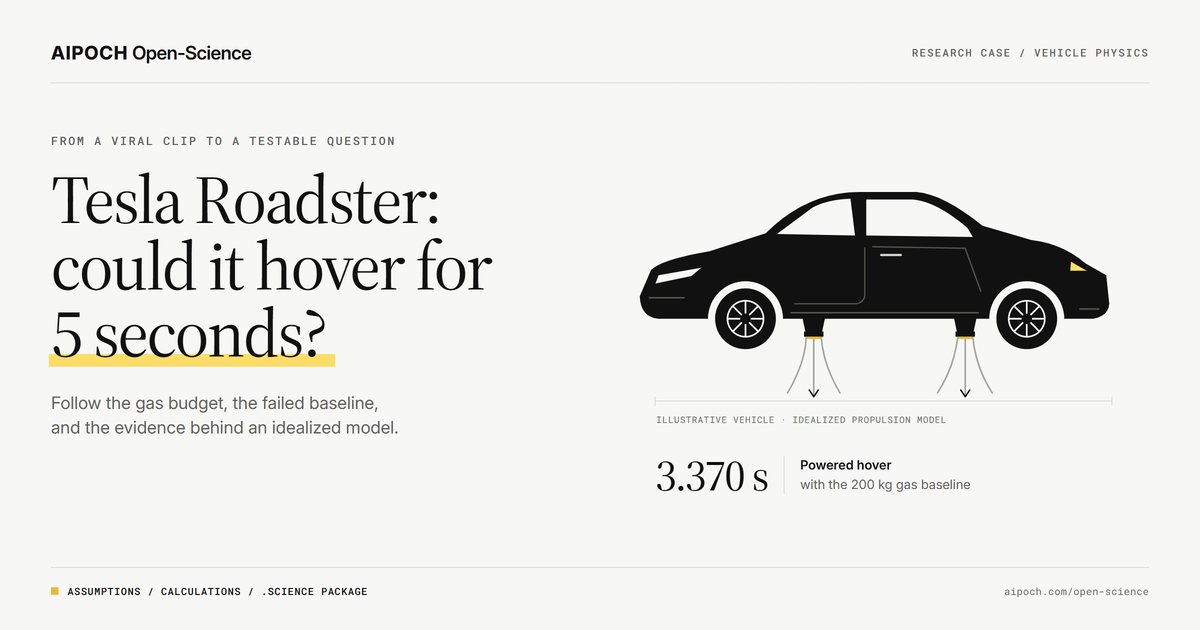
The cited Tesla Roadster demonstration does not establish a stationary five-second hover. The official Tesla X post prompted a narrower engineering question for this case: under explicit assumptions, how much compressed-gas propellant would a Roadster-mass vehicle need to rise, hover for five seconds, and descend?
The public AIPOCH Open-Science Roadster hover case links a .science package that preserves the assumptions, equations, Notebook records, saved tables, failure cases, and figures behind a worked answer. In the package’s ideal one-dimensional model, the 200-kilogram baseline reaches the target height but runs out of propellant before completing five seconds of hover.
The calculation has two different endpoints. About 265 kg, independently recomputed from the archived equation, reaches the end of the two-second ascent plus five-second hover. At this zero-reserve boundary, the gas is exhausted at the hover endpoint. It does not provide continued support or a controlled descent afterward. The archived result of about 348 kg is the zero-reserve fuel boundary for the prescribed nine-second trajectory, subject to the thrust constraint. Neither value is a Tesla specification or an engineering recommendation.
Key takeaways
- The hypothetical baseline provides 3.37 seconds of fueled hover, or 1.37 seconds with the prescribed descent reserve.
- More gas extends endurance but also adds weight; the thrust limit constrains the chosen path.
- The
.sciencepackage preserves the reasoning and outputs for inspection; import does not rerun the calculation.
Did the Tesla Roadster flying car actually hover for five seconds?
The cited Tesla Roadster demonstration does not establish a stationary five-second hover, so the public material cannot supply the measured mass, thrust history, gas conditions, and control data needed to reconstruct that maneuver for the actual vehicle or to determine the prototype’s sustained-hover capability.
The accessible footnotes of the Tesla Roadster page, retrieved October 28, 2026, name Rocket and Thrust without providing the complete configuration text needed for this analysis. The CBS News report (2026) describes an airborne rotation followed by a landing.
The “Tesla flying car” question therefore has two separate parts: what the demonstrated vehicle can do, and what a stated propulsion model would require. The case addresses the second part. Sustained hover requires upward force, attitude control, a propellant budget, and an exit from the maneuver; a brief clip cannot determine all of those quantities.
Searches for “Tesla Roadster SpaceX package” concern vehicle equipment. An AIPOCH .science package instead carries the research record behind the calculation.
What question does the AIPOCH Open-Science case actually model?
The AIPOCH Open-Science case models a conditional engineering problem: whether a vertically controlled, Roadster-mass vehicle with a specified thrust limit and effective exhaust velocity can rise one metre, hover for five seconds, and descend, without treating any model input as a measured or published Tesla specification.
The public AIPOCH Roadster hover case (2026) fixes dry mass at 1,800 kg, initial gas at 200 kg, maximum upward thrust at 35 kN, and effective exhaust velocity at 500 m/s. The NASA Small Spacecraft State-of-the-Art review (2026) defines cold-gas thrust as expelling gaseous propellant through a nozzle without combustion.
Here, gas means compressed-gas propellant, not gasoline. The model treats all non-expelled mass as a fixed 1,800 kg. It does not establish a realizable tank-and-pipe design within that allowance or increase tank and installation mass when more gas is added. The payload version adds 200 kg of retained mass to that baseline.
The model prescribes three tasks:
| Task | Duration | Target |
|---|---|---|
| Ascent | 2 s | Rise smoothly from rest to 1 m and stop |
| Hover | 5 s | Remain at 1 m with zero vertical velocity |
| Descent | 2 s | Return smoothly to ground level and stop |
The ascent and descent use the quintic smooth-step path
q(s) = 10s³ − 15s⁴ + 6s⁵,
which begins and ends with zero velocity and acceleration. The force and propellant model is
T = m(g + a)
and
dm/dt = −T / vₑ,
where T is total upward thrust, m is instantaneous mass, a is commanded vertical acceleration, and g = 9.81 m/s². Here, vₑ = T / ṁ_out is the assumed total thrust per unit propellant mass flow, held constant at 500 m/s. With that effective definition, nozzle-pressure thrust is already included; adding it again would double-count the pressure contribution. The model omits pressure blowdown, wind, drag, tilt, and actuator delay.
How much compressed gas would five seconds of hover require?
Under the ideal variable-mass model, about 265 kilograms of initial gas reaches the end of the two-second ascent plus five-second hover, while about 348 kilograms is the zero-reserve fuel boundary for the prescribed nine-second trajectory, subject to the thrust constraint along the path.
The public AIPOCH case (2026) records a lower gas boundary of about 348 kg for the nine-second path at fixed retained mass. The NASA Glenn thrust equation, retrieved in 2026, expresses total thrust as momentum flow plus nozzle-pressure thrust, consistent with defining an effective exhaust velocity from their sum.
Substituting T/m = g + a into the mass equation and integrating gives:
ln(m_initial / m_final) = [g Δt + Δv] / vₑ
At the rest-to-rest endpoints used here, Δv = 0. Setting the final mass equal to retained mass gives the report's endpoint gas budget:
gas_min = retained_mass × [exp(g × duration / vₑ) − 1]
Height and acceleration history disappear from this endpoint expression because the velocity change integrates to zero. Thrust limits and intermediate fuel availability still have to be checked along the path; the endpoint formula alone does not establish trajectory feasibility.
| Endpoint | Modeled duration | Initial gas needed | Evidence status |
|---|---|---|---|
| End of five-second hover | 7 s | 264.993 kg | Independently recomputed from the report's equation |
| End of prescribed descent | 9 s | 347.634 kg | Archived result and matching arithmetic recomputation |
The extra initial allowance for descent is about 83 kg. Carrying that allowance also increases consumption earlier in the flight, so the difference is not simply gas expelled during descent.
At either zero-reserve endpoint, the gas is exhausted. The report's endpoint thrust is the left-hand limit just before cutoff; available thrust becomes zero afterward. Reaching ground level at zero vertical speed does not establish stable contact or no rebound. Ground support, thrust shutdown, and contact dynamics were not modeled.
Why does the 200-kilogram baseline fail the five-second mission?
The recorded 200-kilogram baseline can reach the one-metre target in two seconds, but it then supports only about 3.37 seconds of hover before the gas is exhausted; reserving propellant for the prescribed two-second descent reduces the available hover time to about 1.37 seconds.
The public case's baseline budget (2026) records about 77 kg consumed during ascent and 123 kg left afterward. The same case's trajectory record (2026) places gas exhaustion about 5.37 seconds after launch, before the planned seven-second hover endpoint.
| Baseline checkpoint | Recorded value |
|---|---|
| Initial gas | 200.000 kg |
| Gas used during ascent | 76.960 kg |
| Gas remaining after ascent | 123.040 kg |
| Fueled hover after ascent | 3.370 s |
| Hover available after reserving descent gas | 1.370 s |
| Gas exhaustion after launch | 5.370 s |
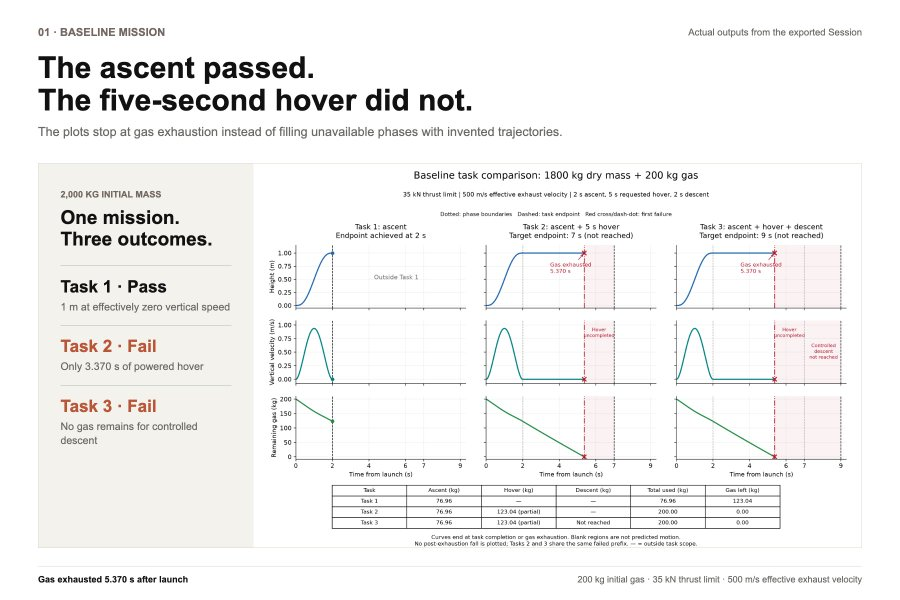
Baseline mission: ascent succeeds, but the requested five-second hover and controlled descent do not.
The failure is an endurance shortfall after successful ideal ascent. A separate unpowered-fall calculation reaches first ground contact at about 4.43 m/s after propellant exhaustion. That calculation is not the prescribed descent and does not model impact, rebound, suspension, structure, or occupant loads.
How do gas load, retained mass, and hover duration change the result?
The five-second result depends directly on retained mass, effective exhaust velocity, thrust capacity, and the amount of trajectory included, because every kilogram of tank, payload, and unexpelled gas must be supported while lower exhaust velocity consumes propellant faster and a limited thrust ceiling can make the chosen path impossible.
The case's gas-load scan (2026) finds both a lower fuel boundary and an upper peak-thrust boundary while holding dry mass fixed. The case's payload comparison (2026) records shorter hover and a higher nine-second gas requirement after adding 200 kg of retained mass.
With the 35 kN cap, the prescribed nine-second airborne path fits a gas-load window of roughly 348–1,340 kg, with zero reserve at the lower edge. The upper edge comes from peak trajectory thrust, not tank capacity. Because the scan adds no tank or installation mass, it does not describe a gas load that can necessarily fit within an existing car.
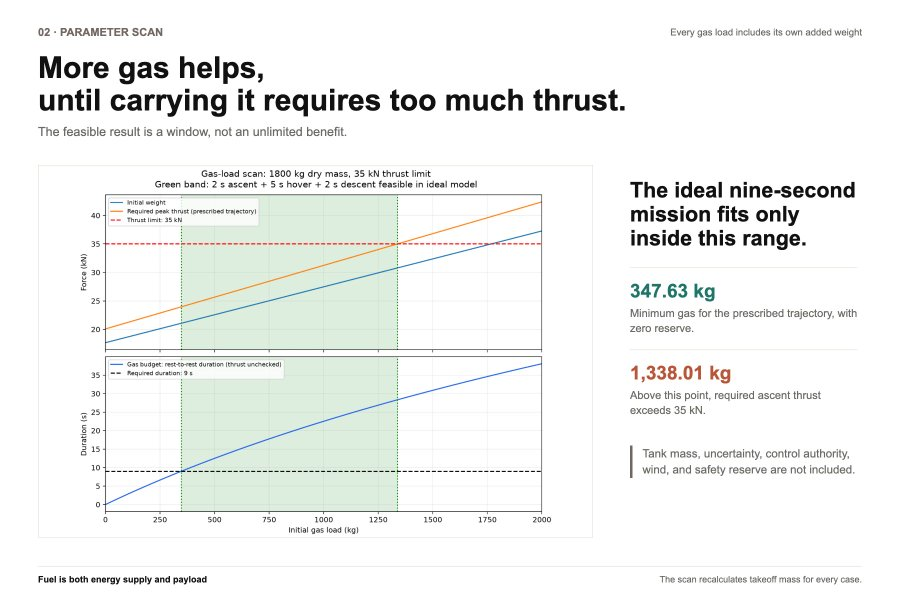
Gas-load scan: more propellant helps only until its added weight exceeds the modeled thrust limit.
The retained-mass comparison keeps initial gas fixed and reports the same quantities in each row:
| Retained mass | Initial gas | Fueled hover after ascent | Hover after reserving descent | Minimum initial gas for nine seconds |
|---|---|---|---|---|
| 1,800 kg | 200 kg | 3.370 s | 1.370 s | 347.634 kg |
| 2,000 kg | 200 kg | 2.858 s | 0.858 s | 386.260 kg |
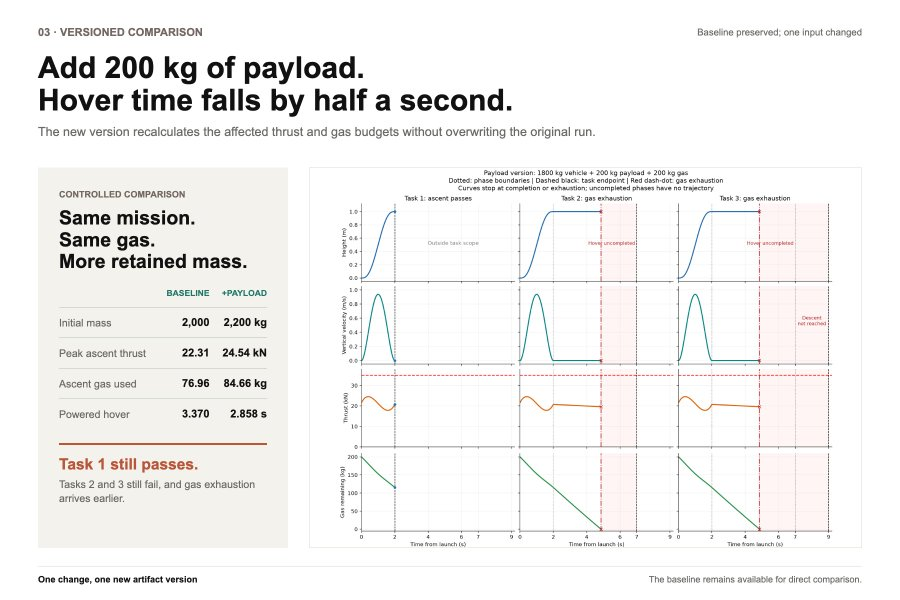
Payload version: the same 200 kg gas load supports less hover when retained mass increases.
Separate failure tests identify the first constraint reached:
| Failure test | Recorded result |
|---|---|
| 100 kg initial gas, other baseline parameters unchanged | Gas exhaustion at 2.756 s after launch |
| 21 kN thrust limit, baseline mass and gas | Prescribed ascent demand exceeded the limit at 0.114 s |
Starting with 100 kg does not change the baseline's roughly 348 kg nine-second fuel boundary; it supplies too little gas to reach it. The 21 kN test shows failure to follow the selected ascent, not failure of every possible slower trajectory.
Trajectory duration changes what the same baseline can complete. The recorded one-second-hover variant reaches a zero-speed touchdown with 13.12 kg remaining, while the five- and ten-second variants terminate at the same gas-exhaustion event.
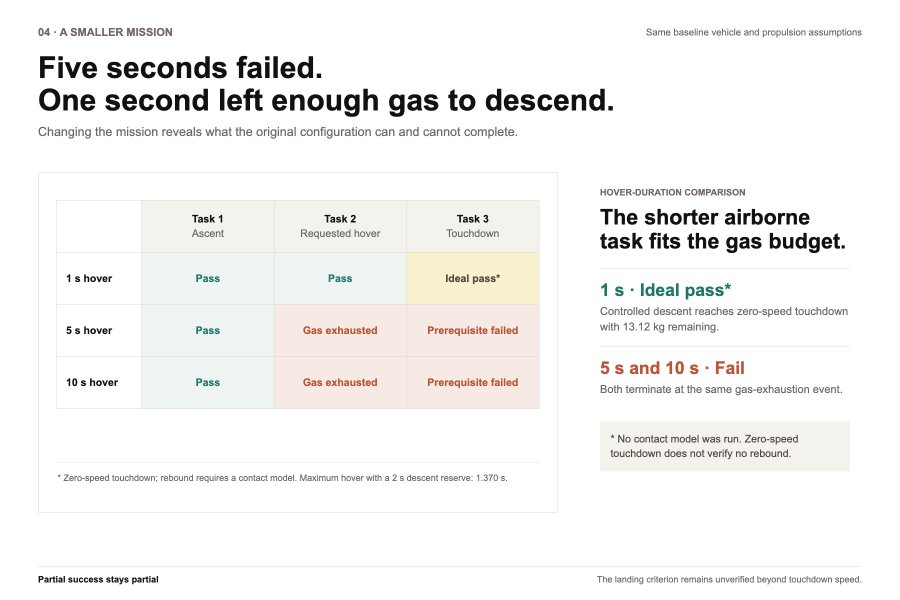
Mission-duration comparison: shortening the hover can fit the modeled gas budget, but touchdown contact remains outside the model.
How can readers inspect the Tesla Roadster hover case in a .science package?
Readers can inspect the AIPOCH Open-Science .science package by tracing the assumptions in final_research_report.md into the saved phase budgets, gas-load scan, failure cases, payload test, and recorded execution evidence, while keeping the imported history separate from any new calculation performed on another computer.
The AIPOCH .science guide (2026) describes packages containing selected conversation branches, files, and recorded evidence, with imported history remaining read-only. The Roadster case's artifact list (2026) identifies the consolidated report, phase budgets, gas scan, failure cases, payload records, and saved figures.
Start with one focused question: Why does 200 kg of gas support only about 3.37 seconds of hover after ascent? Follow the answer through these exact artifacts:
| Artifact | What to inspect |
|---|---|
final_research_report.md | Model assumptions, equations, recorded results, limitations, and interpretation |
baseline_phase_budgets.csv | Ascent consumption and partial-hover budget for the 200 kg baseline |
hover_budgets_v2.csv | One-, five-, and ten-second hover comparisons and descent reserve |
final_gas_scan.csv | Refined lower and upper feasibility boundaries under the 35 kN cap |
final_failure_cases.csv | The 100 kg gas and 21 kN thrust failure examples |
payload200_parameters.json and payload200_budgets.csv | The retained-payload sensitivity case |
baseline_three_tasks_layout_fixed.png | Corrected-layout visual summary; package records say the numerical data were unchanged |

Research record: the useful output is the trace from the question to criteria, code, checks, variants, and preserved artifacts—not one isolated number.
The package guide also defines the boundaries: contents depend on export selection; Side Chat, private reading bookmarks, and their notes are excluded; import does not execute code or restore credentials. Received verification records describe the sender's checks. Use Fork for a separately scoped experiment and report any new calculation as new evidence.
Open the public Roadster hover case, then download its .science package or view the recorded research session. Follow the 200 kg baseline from final_research_report.md into baseline_phase_budgets.csv, then compare the result with final_gas_scan.csv.
Disclaimer. The model is an educational idealization, not a Tesla engineering analysis, vehicle recommendation, safety assessment, or prediction of production performance. Researchers and engineers remain responsible for validating inputs, equations, physical models, hardware constraints, control behavior, and safety margins before applying any result. This article examines the model and recorded results in the case’s .science package; it does not report a new simulation or vehicle test.