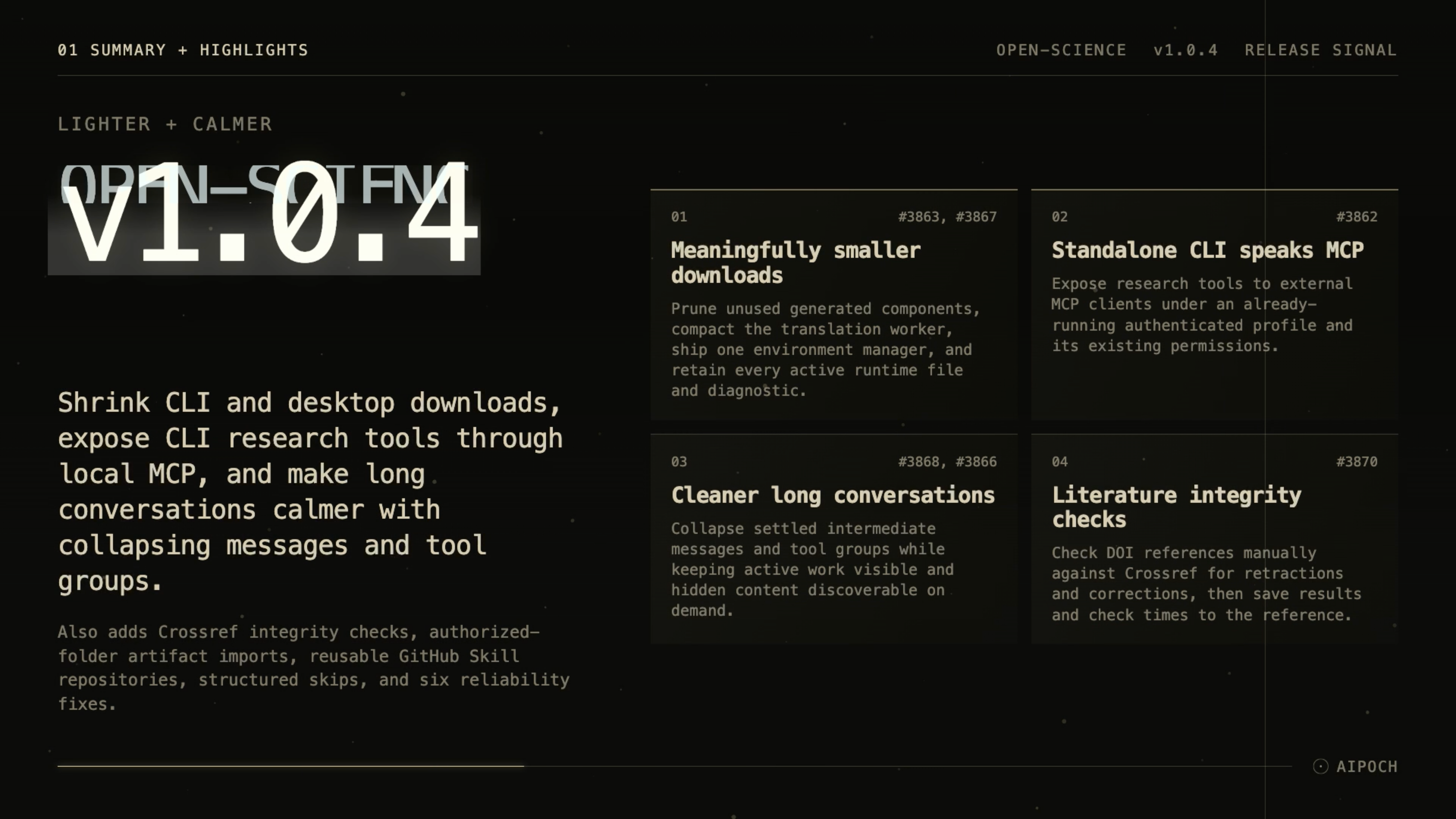
Version 1.0.4 makes the workbench lighter and calmer with smaller downloads, local MCP access, clearer long sessions, and targeted reliability fixes.
AIPOCH Open-Science is AIPOCH's open-source, local-first AI research workbench; its .science packages can carry selected conversation branches, file versions, Notebook records, and verification evidence for review, handoff, and archiving.
What new capabilities help researchers work with external tools and long sessions?
AIPOCH Open-Science v1.0.4 gives researchers a local MCP bridge for the standalone CLI, cleaner transcripts for long-running investigations, and several focused workflow controls, while keeping external clients inside the selected profile's existing permissions rather than presenting MCP as a separate sandbox.
The v1.0.4 GitHub release (AIPOCH, 2026) lists local MCP, transcript collapsing, Crossref checks, authorized-folder imports, saved GitHub repositories, and structured skip actions as implemented.
The versioned MCP CLI documentation (AIPOCH, 2026) requires an already-running authenticated profile service before open-science mcp can serve research tools.
The versioned security guidance (AIPOCH, 2026) says connected MCP clients should be treated as untrusted until reviewed.
Standalone CLI access through local MCP
Researchers often need an external MCP client to continue work without recreating projects, sessions, or artifact records. Version 1.0.4 adds open-science mcp, a local stdio adapter that exposes the standalone CLI's research tools after the selected profile service has been started and authenticated.
The adapter uses the selected profile's current permissions and framework. A connected client can create persistent changes or incur model costs; closing the client does not automatically cancel an accepted research run. The adapter does not provide a remote HTTP MCP endpoint, arbitrary shell access, credential management, or unrestricted file transfer.
Smaller CLI and desktop downloads
Version 1.0.4 removes unused generated components, packages the translation worker against a compact runtime, ships one bundled environment manager, and drops unused alternative distributions. The release retains active runtime files and diagnostics, including the tokenizer lite runtime, so the size reduction is a packaging change rather than a feature-removal claim.
Calmer long conversations and clearer tool activity
Long research sessions can become difficult to scan when settled intermediate messages and repeated tool events dominate the transcript. Version 1.0.4 collapses intermediate messages after a turn settles and groups tool activity into summaries, while keeping running, waiting, interrupted, and failed work visible.
Researchers can expand hidden content, and search, annotations, and native find can reveal the relevant records on demand. Collapsing changes presentation only; it does not delete the underlying transcript or convert unfinished work into a completed state.
Manual Crossref checks in Literature
Literature references with a valid DOI can now be checked manually for known retractions or corrections through Crossref. AIPOCH Open-Science saves the observed result and check time with the reference, giving researchers an inspectable record of what was checked and when.
The check runs only when a researcher requests it and sends the DOI to Crossref. Crossref coverage is incomplete, so a result with no notice does not establish that the paper is unaffected or scientifically valid.
Artifact imports from authorized folders
Version 1.0.4 lets researchers import an existing file from an authorized folder into the current session's managed artifact storage. AIPOCH Open-Science first checks the allowed path and then stores an independent artifact copy; subsequent changes to the source file do not silently rewrite the saved artifact version.
The import does not prove how the external file was originally produced, and it does not grant ongoing access to arbitrary paths outside the authorized roots.
Saved GitHub Skill repositories and structured skips
The GitHub Skills import flow can save a repository and optional ref for later rescanning. Saving a repository creates a reusable source bookmark; it does not install its Skills, freeze upstream content, or certify the repository as safe.
Question cards now support fixed-position Skip and Skip all controls with structured skip states. Submitted decisions survive a continuation failure, while an answer that was not accepted remains editable and visible as failed instead of being recorded as saved.
What else is new in v1.0.4?
Beyond the headline capabilities, v1.0.4 tightens the handoff between interfaces: the release reduces packaged runtime payloads, keeps active diagnostics, preserves the tokenizer lite runtime, and fixes the .science export transition after a researcher chooses a save location, without changing the package's read-only import boundary.
The v1.0.4 release notes (AIPOCH, 2026) describe the download reduction as pruning unused components while retaining active runtime files and diagnostics.
The AIPOCH Open-Science .science package guide (AIPOCH, verified 2026) defines packages as selected research records rather than executable session clones.
The AIPOCH Open-Science product page (AIPOCH, verified 2026) states that imported history is read-only, does not execute code or restore credentials, and includes files according to the export selection.
A .science package can carry selected conversation branches, file versions, Notebook records, and verification evidence. Side Chat conversations and private reading bookmarks are excluded, and received verification records describe the sender's checks rather than proving that the receiving computer reran them. Version 1.0.4 repairs the save-location transition during export; it does not expand those package boundaries.
Which bug fixes affect daily use?
Researchers updating to AIPOCH Open-Science v1.0.4 should expect fixes across Windows Notebook execution, packaged tokenizer support, .science export, folder-access settings, question-card continuation, and Replay event labeling, with each change framed as a repair rather than a new guarantee of scientific correctness.
The v1.0.4 Bug Fixes section (AIPOCH, 2026) names six repairs affecting Notebook, packaging, session export, settings, question cards, and Replay.
The .science handoff guide (AIPOCH, verified 2026) says imported sessions remain read-only and separates recorded handoff evidence from a rerun on the receiving computer.
The AIPOCH Open-Science product FAQ (AIPOCH, verified 2026) keeps researchers responsible for methods, data governance, interpretation, validation, and final decisions.
- Windows Notebook execution: Standard native Notebook execution works again on Windows.
- Packaged tokenizer support: The tokenizer lite runtime is included again in packaged builds.
.scienceexport: Export proceeds to preparation after the researcher selects a save location instead of continuing to wait at that step.- Folder-access settings: The folder-access dialog and its cleanup step no longer race each other.
- Question-card continuation: Ask-user selectors no longer loop after a continuation failure.
- Replay event identity: Automatic results appear as system events instead of ambiguous ordinary messages.
How can readers install or update AIPOCH Open-Science?
AIPOCH Open-Science v1.0.4 can be installed as a desktop application on supported macOS, Windows, and Linux systems or as a standalone command-line package through Homebrew, npm, or versioned archives; researchers should use the v1.0.4 GitHub release for package-specific assets and requirements.
The v1.0.4 Install section (AIPOCH, 2026) supports macOS 12 or later on Apple Silicon or Intel, Windows 10 or 11 x64, and Linux x64 or ARM64.
The same versioned release (AIPOCH, 2026) provides desktop assets, standalone CLI archives, and Linux CLI packages for the stated architectures.
The v1.0.4 CLI instructions (AIPOCH, 2026) document Homebrew installation and npm installation with Node.js 22.13 or later.
| Platform | Version 1.0.4 package path |
|---|---|
| macOS 12+ on Apple Silicon | ARM64 desktop DMG or standalone CLI archive |
| macOS 12+ on Intel | x64 desktop DMG or standalone CLI archive |
| Windows 10/11 x64 | Code-signed desktop installer or standalone CLI zip |
| Linux x64 or ARM64 | AppImage or Debian desktop package; CLI archive, .deb, or .rpm |
Existing desktop installations can use the in-app updater. For a fresh or manual installation, choose the matching asset from the AIPOCH Open-Science v1.0.4 release and verify that the operating system and processor match the package label.
For the standalone CLI, the release documents brew install aipoch/tap/open-science on macOS or Linux, or npm install --global @aipoch/open-science with Node.js 22.13 or later. Versioned standalone archives include a bundled Node runtime for supported macOS, Linux, and Windows architectures.
FAQ
Is the v1.0.4 MCP server a separate sandbox?
No. The local stdio adapter uses the selected authenticated profile's existing permissions and framework. A connected client may create persistent changes or incur model costs, so researchers should review the client and the active profile before connecting them.
Do Literature integrity checks run automatically?
No. Version 1.0.4 enables a manual check only for a reference with a valid DOI. The check sends the DOI to Crossref and stores the observed result and check time; incomplete coverage means that no notice is not proof that a paper is unaffected.
What changed for .science packages in v1.0.4?
Version 1.0.4 fixes an export state that could keep waiting after a save location was selected. The package's safety boundary is unchanged: imported history remains read-only, does not execute code or restore credentials, and carries only the files selected for export.
Which systems can run v1.0.4?
The desktop release supports macOS 12 or later on Apple Silicon or Intel, Windows 10 or 11 x64, and Linux x64 or ARM64. The release also provides command-line installation through Homebrew, npm, and standalone archives for the supported platforms and architectures.
Did smaller downloads remove active features?
The release says no active runtime files or diagnostics were intentionally removed. Version 1.0.4 prunes unused generated components and alternative distributions, compacts the translation worker runtime, ships one environment manager, and restores the tokenizer lite runtime in packaged builds.
What limitations and responsibilities apply?
AIPOCH Open-Science v1.0.4 assists researchers by organizing tools, execution, literature checks, artifacts, and research records, but version 1.0.4 does not turn external clients into a sandbox, make Crossref coverage complete, prove a receiving computer reran a .science package, or replace scientific judgment and peer review.
The v1.0.4 security guidance (AIPOCH, 2026) requires researchers to review MCP servers and understand the permissions granted to connected tools.
The manual publication-check documentation (AIPOCH, 2026) says Crossref observations are incomplete and do not establish that a reference is unaffected.
The AIPOCH Open-Science product page (AIPOCH, verified 2026) states that research methods, data governance, interpretation, validation, and final decisions remain the researcher's responsibility.
Imported .science sessions are inspectable records, not executable replicas. Side Chat conversations, private reading bookmarks, and credentials are excluded; included files depend on export selection; and a received verification record describes the sender's checks rather than a rerun on the recipient's computer.
AIPOCH Open-Science supports reproducible execution and inspectable provenance evidence, but researchers must still assess source quality, permissions, methods, statistics, citations, and outputs. Start with the v1.0.4 release, connect only trusted clients, and review the evidence boundary before continuing or sharing research.