What this research found
How much does battery health decline after two years of smartphone use
Research question
What can selected owner reports say about one model’s battery health after roughly two years?
Summarizes self-reported battery-health observations for a selected phone model after roughly two years. The archive records selection criteria, descriptive statistics, and source discussions.
Data and comparison design
Retain only reports identifying the phone model, an apparent original battery, and the defined use-duration range. Summarize the distribution rather than presenting one impressive or disappointing report as typical.
Recorded findings
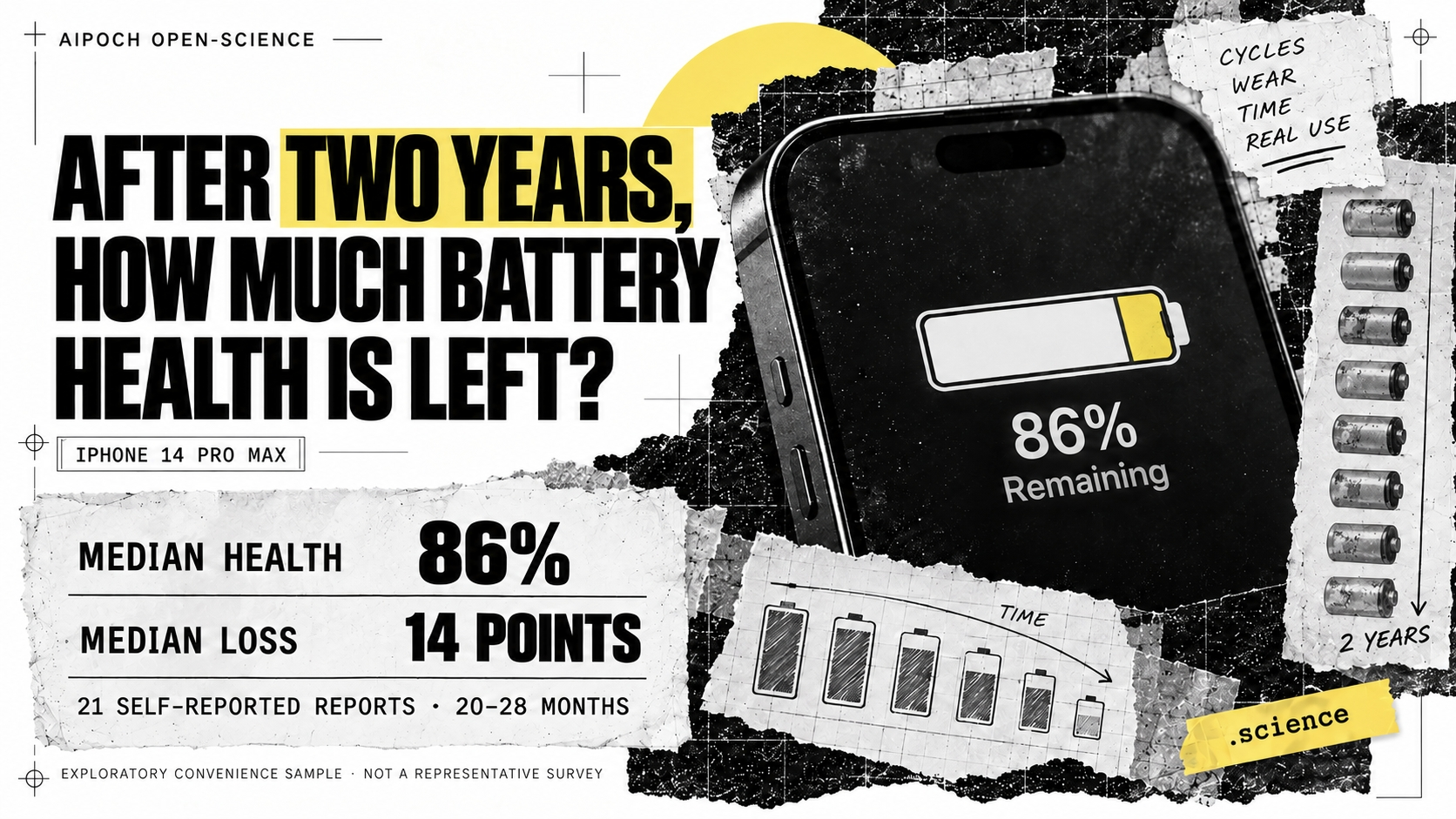
The 21-report convenience sample suggests an iPhone 14 Pro Max typically retains about 87% battery health after roughly two years, equivalent to 13 percentage points of degradation.
| Statistic | Battery health | Degradation |
|---|---|---|
| Mean | 86.8% | 13.2 points |
| Median | 86% | 14 points |
| Interquartile range | 85–88% | 12–15 points |
| Observed range | 81–94% | 6–19 points |
| Standard deviation | 3.7 points | 3.7 points |
Distribution:
- 80–84% health: 4/21 reports (19%)
- 85–89% health: 13/21 (62%)
- 90–94% health: 4/21 (19%)
- Below 80% or above 94%: none
The reports came from relevant Reddit discussions and MacRumors owner threads. Only reports identifying the 14 Pro Max, an apparent original battery, and 18–30 months of use were retained.
This is an exploratory convenience sample, not a representative survey. Battery health was self-reported and not independently tested; ages were sometimes inferred from purchase dates; users with unusually good or bad batteries may be more likely to post; and multiple reports could conceivably come from the same person. Apple’s displayed health is also a rounded software estimate. The defensible conclusion is therefore that mid-to-high 80s appears common after two years, not that 86.8% is a precise population average.
What the comparison shows
The convenience sample is self-reported and may contain selection bias or uncertain ages. Percentage-point loss is not the same as a measured decline in everyday runtime.
Assumptions and limits
These owner reports form a convenience sample, not a representative degradation study. Device history, reporting selection, and the battery-health estimate limit generalization to other phones.
Sources and research materials
The original .science export and matching poster are preserved byte-for-byte from the upstream case. The package contains the conversation, session metadata, and the resources inventoried in its internal manifest. This introduction summarizes the archived record; the research, external sources, and model evaluations were not rerun for this import.
Related research
View all →

Run this kind of analysis on your own question
Start a session and see how an AI co-scientist accelerates your research. Pay-as-you-go, nosubscription required.