AI agents vs agentic AI: an AI agent is a software actor that can use tools to carry out a goal; agentic AI describes goal-directed behavior across one or more steps. The terms overlap. One agent can act agentically, and a larger workflow can coordinate several agents, ordinary software, and human review. The useful question for a researcher is what the system is allowed to do, what evidence it returns, and what still requires human judgment.
A research project makes those boundaries concrete. Finding a paper, checking a sample table, interpreting an assay, and preparing a report are related tasks, but they do not all need the same permissions or evidence. AIPOCH Open-Science provides a useful example through its Specialists: saved research roles that can receive bounded tasks while the Main Agent coordinates the conversation. This article explains the concepts first, then examines one published Specialist example. AIPOCH publishes this article and has an interest in the product described below.
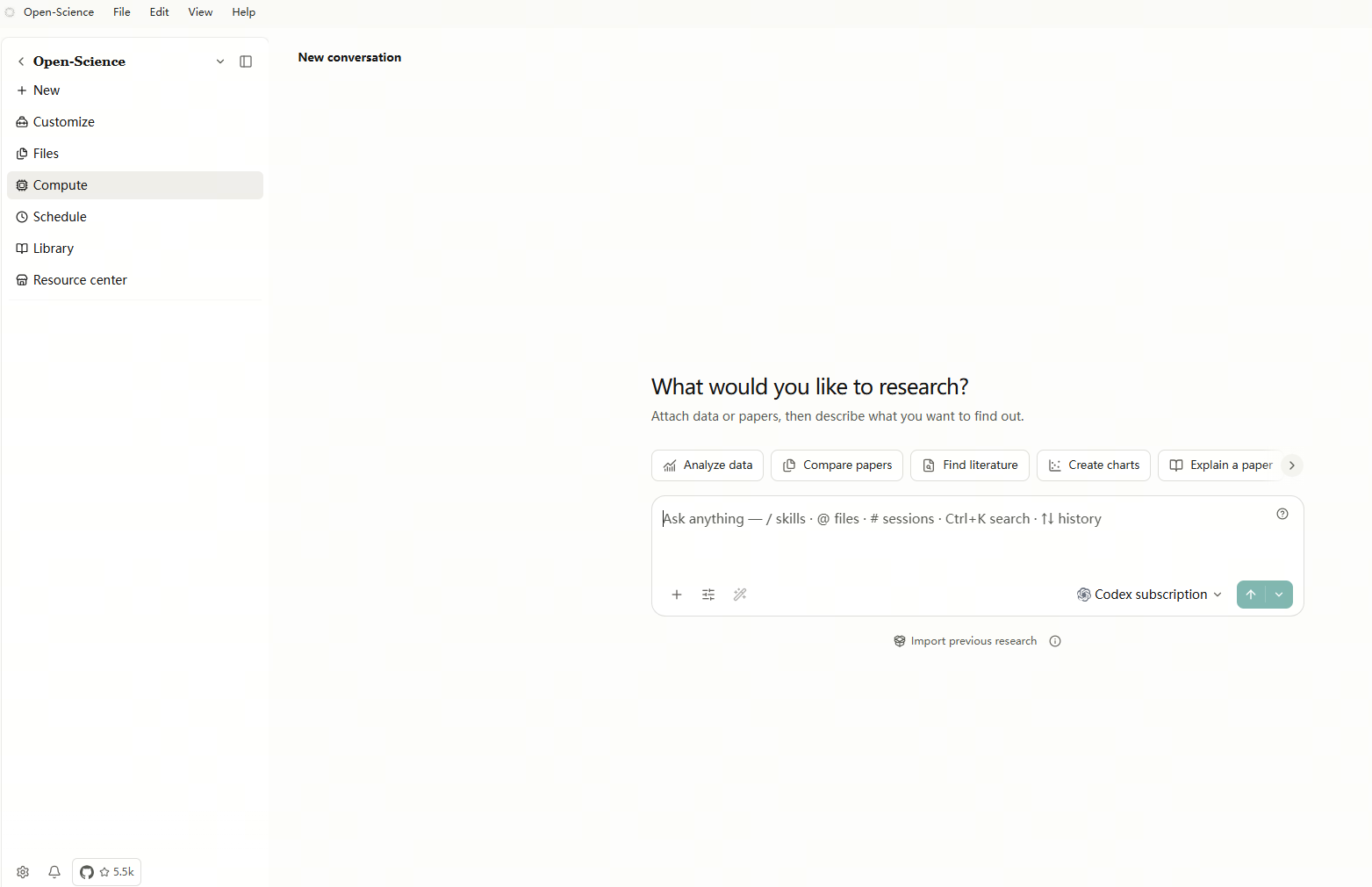
AIPOCH Open-Science main workspace. This interface screenshot shows where a researcher starts; the Specialist example below comes from the public documentation.
What is the difference between an AI agent and agentic AI?
An AI agent is an acting software component that receives a goal, uses permitted tools, and responds to results, while agentic AI describes goal-directed behavior across a process; the terms overlap because one agent can act agentically and a wider workflow can combine agents, ordinary software, and human review without requiring a particular number of agents.
Microsoft's agentic AI explanation (verified 2026) distinguishes the system's behavior from the agents that carry it out. Anthropic's agent architecture guide (published 2024; verified 2026) distinguishes fixed paths from agents that dynamically direct their process and tool use.
| Question | AI agent | Agentic AI |
|---|---|---|
| What does the term name? | An acting software component or role | Goal-directed behavior or system design |
| Who decides the next action? | The agent, within its assigned scope | The system may coordinate choices across a wider task |
| Must there be multiple agents? | No | No |
| Where do people remain involved? | Set boundaries and inspect a task result | Set the goal, permissions, checkpoints, and acceptance criteria |
The distinction is not a capability score. A single well-equipped agent may plan and adapt through a long task. A multi-agent arrangement may still follow a mostly fixed sequence. Count agents only after the research task and its review points are clear.
When does a research task benefit from a Specialist?
A Specialist helps when a research subtask has a stable scope, specific inputs, permitted tools, and an output a person can check; the researcher can give a saved role a data-quality check while keeping interpretation and final decisions in the main conversation, because a role's name alone establishes neither expertise nor independent verification of the underlying science.
AIPOCH's Specialists overview (updated 2026) defines a Specialist as a saved role with identity, instructions, and permitted Skills or Connectors. The delegation guide (verified 2026) distinguishes selecting a Specialist to speak in the main conversation from assigning a separate child task.
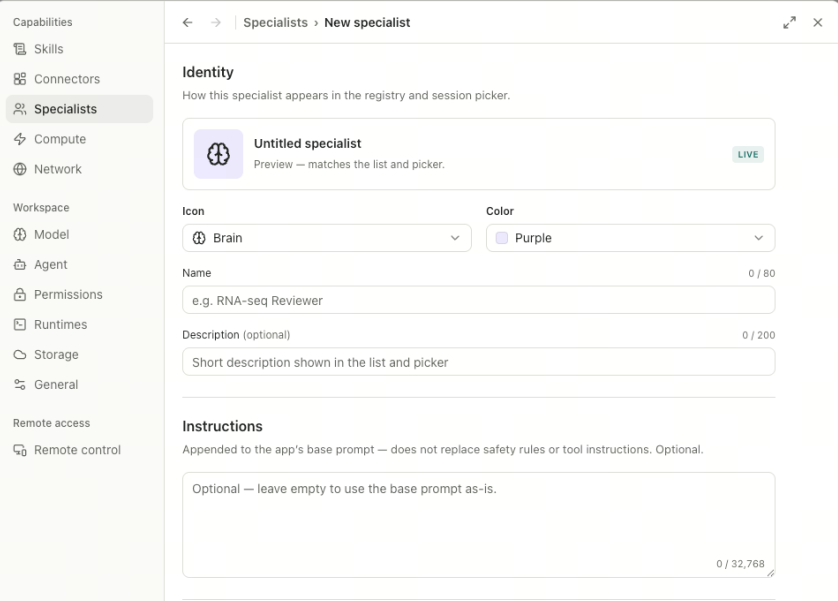
The New specialist screen shows the fields that define a role: how it appears in the registry and session picker, its name and description, and optional instructions appended to the base prompt. The empty fields are placeholders; the screen alone does not establish that a research check has been run.
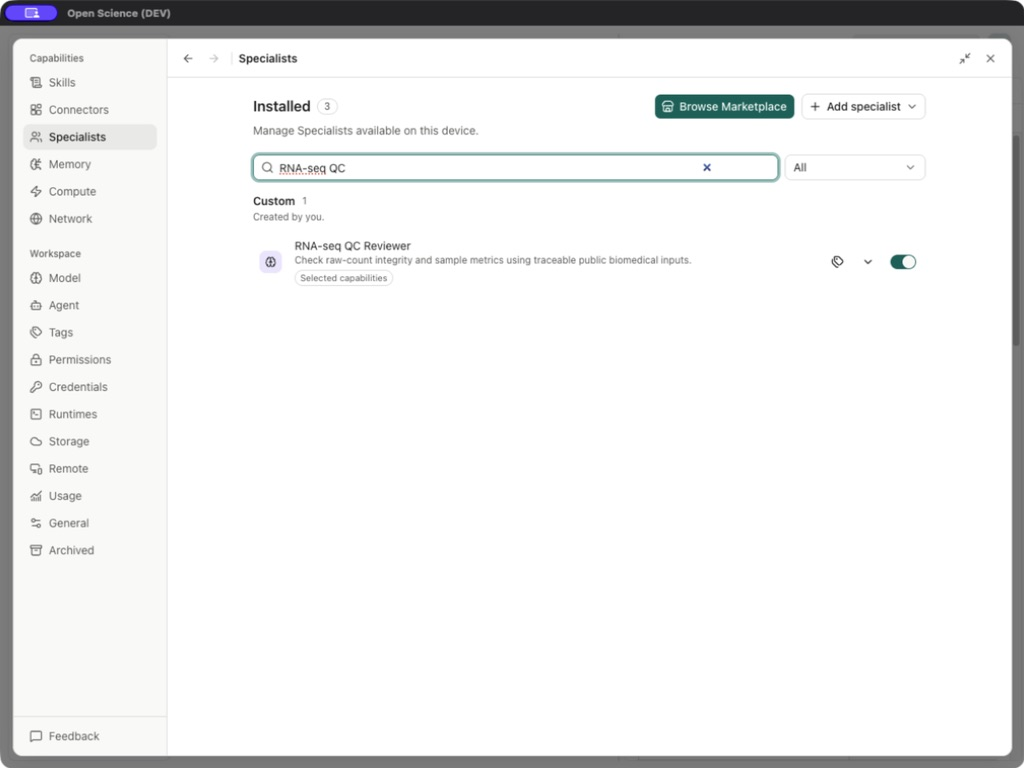
The published Open-Science documentation shows an installed RNA-seq QC Reviewer. The screenshot illustrates the role interface; it does not show that every possible research check has been performed or validated.
For the writer of a protocol, the practical choice is straightforward: describe the subtask before selecting the role. Name the source file or table, the exact check, the expected deliverable, and what the Specialist must not infer. A role can be reused, but each new dataset still needs its own input and result review.
Creating that role can itself be a guided step. In the setup conversation below, the assistant first inventories the existing specialists, the available skills, and the connectors catalog, then asks about the specialist's purpose, name, system prompt, capability scope, and optional icon and color before defining it.
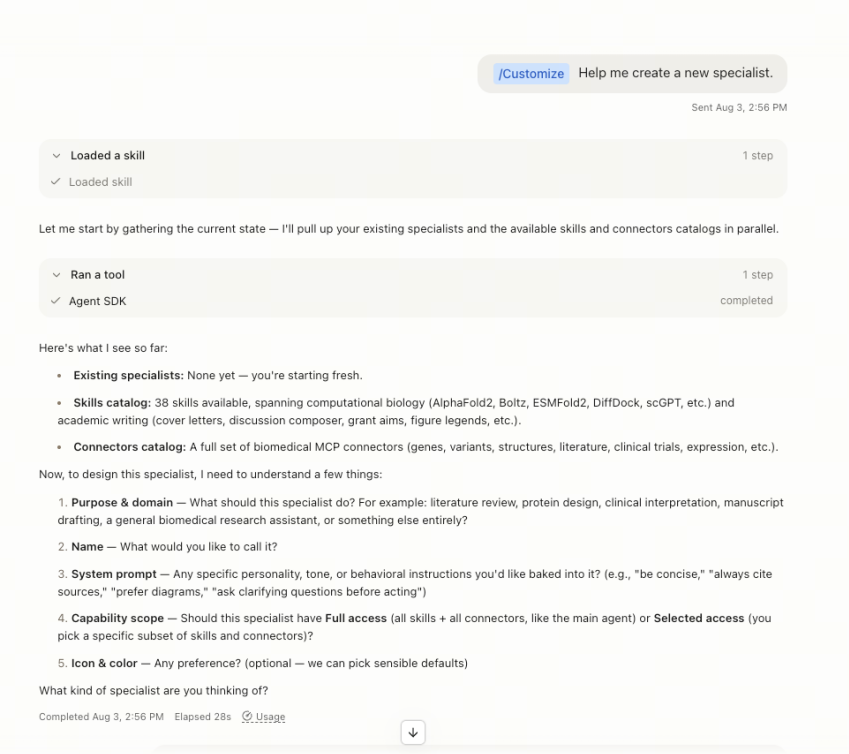
The setup conversation gathers the role's scope before creation. It is a configuration dialogue, not evidence that any delegated research check has run; the skill-loading and tool steps shown here belong to setup, not to a reviewed task result.
How does a Specialist fit into an agentic research workflow?
A Specialist can complete one bounded part of a larger research goal while the Main Agent coordinates the conversation and the researcher checks the evidence; the arrangement is useful when a later decision depends on an intermediate check with its own input and output, and delegation creates a separate task record while leaving scientific judgment with the researcher.
The AIPOCH roles guide (updated 2026) says the Main Agent can coordinate delegated work. The documented delegation procedure (verified 2026) tells users to inspect the child's transcript, tool results, and terminal status before accepting its output.
The public example is a deliberately narrow RNA-seq quality-control check. The researcher supplies a 12-row sample summary, asks an RNA-seq QC Reviewer to verify unique sample identifiers and a per-row arithmetic identity, and receives a table of the checks. The documentation reports that the requested arithmetic checks passed. The result verifies consistency within the supplied summary; it does not recalculate values from the original count matrix or establish biological quality thresholds. That limit is precisely why the task boundary matters.
In a longer project, the researcher could use the checked summary to decide what analysis to run next. That continuation is an illustrative workflow, not an additional run established by the published example. The distinction between a recorded check and a proposed next step keeps the article's evidence traceable.
What should a researcher inspect before trusting a delegated result?
Researchers should inspect a delegated task's actual execution, input version, tool activity, and saved output against acceptance checks stated before the run; a fluent Main Agent reply cannot establish that a Specialist ran or that a scientific conclusion is valid, so the review should identify what the supplied data and calculation could not establish.
AIPOCH's delegation guide (verified 2026) directs users to open the child record rather than rely on a progress message. The public worked example (verified 2026) limits its successful 12-row arithmetic result to the supplied summary and excludes independent validation of the original matrix.
For a real research handoff, check four items:
- Input: Was the intended file or complete table passed to the child, with the correct version?
- Execution: Did the Specialist run the named calculation or retrieval tool? A task label is not a tool record.
- Output: Do row count, identifiers, calculations, and saved files meet the stated acceptance criteria?
- Boundary: Does the conclusion stay within what the input can support?
If a child cannot read the file or waits for permission, resolve that state before treating the task as complete. If the result is uncertain, revise the task scope or inspect the source data manually.
When should a researcher use one agent instead of delegation?
Use one agent when a researcher can inspect the input, actions, and result without losing track of the evidence; add delegation when a distinct subtask needs separate instructions, tools, or an independently reviewable record, because each additional handoff creates work and the research question and acceptance checks should determine the architecture.
Anthropic's agent architecture guide (published 2024; verified 2026) recommends starting with the simplest workable design and notes the cost and latency of added complexity. AIPOCH's Specialists overview (updated 2026) identifies recurring responsibilities and separate subtasks as uses for a Specialist.
For example, a researcher asking one focused question about a paper may simply use the main conversation and inspect the cited passage. A lab checking the same sample-summary rule across projects may benefit from a saved QC role and a visible child record. Neither choice guarantees a correct scientific answer; the relevant test is whether another researcher can inspect the evidence and reproduce the check.
What is the practical takeaway for research teams?
The practical distinction is between an agent that acts and the goal-directed behavior of the wider research process; a useful deployment makes inputs, permissions, outputs, and review points explicit, then judges each delegated result within the evidence actually supplied rather than treating a completed child task as proof of the whole scientific conclusion.
Microsoft's agentic AI explanation (verified 2026) identifies agents as the actors and agentic AI as the goal-directed behavior. AIPOCH's Specialist delegation guide (verified 2026) requires checking the child's record and limits its published arithmetic example to the supplied summary.
Conclusion. AIPOCH Open-Science Specialists show how one bounded check can be delegated and inspected within a larger project. Explore AIPOCH Open-Science or follow the Specialist delegation guide to examine the workflow.
What other questions arise when applying agentic AI to research?
Researchers commonly ask whether an agentic system requires multiple agents, how a saved Specialist differs from the Main Agent, and what a completed child task proves; the answers depend on workflow design and evidence scope, because a single agent can act agentically, delegation creates a separate task, and completion alone does not validate scientific conclusions.
Microsoft's agentic AI explanation (verified 2026) distinguishes goal-directed behavior from the agents that perform it. AIPOCH's roles and delegation documentation (verified 2026) distinguishes the Main Agent's coordination from a Specialist's separate child task.
FAQ
Does agentic AI require multiple AI agents?
No. A single agent can make goal-directed decisions and use tools across several steps. Multiple agents are an architectural choice, not part of the definition.
Is an AIPOCH Specialist the same as the Main Agent?
No. A Specialist is a saved research role. The Main Agent handles the conversation and can delegate a separate task to that role. Selecting a Specialist to speak in the main conversation is a different action.
Does a completed Specialist task prove a scientific conclusion?
No. The public RNA-seq example checks arithmetic consistency in a supplied summary. Claims about the original data or biological interpretation require separate evidence and review.
What should I read next?
For choosing a research workspace rather than defining an agent workflow, see AIPOCH's AI agent workspace comparison.