Science moves forward through exploration, and through people building on one another’s work. A research contribution has more to offer than its final figures and conclusions: the questions that shaped it, the choices behind its methods, and the attempts that changed its direction can help someone else take the next step.
We want those paths to be easier to understand, learn from, and continue. That hope is the starting point for AIPOCH Open-Science 1.0, now available as v1.0.0, released on October 14, 2026.
The open-source AI research workbench brings research materials, executable tools, and reviewable outputs into one environment. At its center is a practical way to share the work behind a result: a .science package carrying selected conversation branches, file versions, Notebook records, and verification evidence.
Built by AIPOCH, AIPOCH Open-Science is local-first and model-agnostic. Researchers can work with AI agents to explore a question, inspect files and literature, run computational tasks, and prepare reports, tables, and figures. The context behind that work can stay available for review, handoff, and archiving across projects or computers.
The accompanying AIPOCH Open-Science preprint describes the workbench and its .science package approach, with coauthors from medical centers, universities, and industry. Beyond AIPOCH, the paper lists 76 affiliation entries for coauthors based at medical centers, universities, and companies worldwide. These entries describe the coauthors’ professional backgrounds. For the broader product announcement, see our launch announcement distributed through PR Newswire.
The coauthors contributed through practical use and evaluation. As documented in the paper's author contributions, authors beyond AIPOCH used the workbench, offered feedback and revision suggestions, and supported supplementary product validation. Their individual contributions helped test and refine AIPOCH Open-Science alongside AIPOCH's engineering work. The paper’s reported checks should be read within their stated version and experimental scope, rather than as comprehensive validation of the final v1.0.0 release.
For us, making research more open starts with a practical question: what would help the next person understand this work well enough to question it, learn from it, or carry it forward? The capabilities below are our way of working toward that goal.
At a glance
- Bring literature, data, code execution, and research artifacts into a persistent workspace.
- Export selected research context as a
.sciencepackage for another researcher or computer. - Choose compatible models and agent backends, with permissions that govern tool use and external access.
- Inspect available provenance and review evidence before deciding what a result supports.
Watch the AIPOCH Open-Science introduction on YouTube:
Pass the research process on with the result
When researchers share a result, we hope they can also share enough of the path behind it for someone else to understand how they got there and find a starting point for their own exploration.
A .science package gives a collaborator a structured record of how a piece of AI-assisted research developed. Alongside selected outputs, it can carry the conversation branches, input and artifact versions, Notebook records, and available verification evidence associated with the work.
That context matters at ordinary research handoffs. A colleague reviewing a figure may need the input table, the code that produced it, the branch where an assumption changed, and the record of the checks already performed. For a student learning a method, seeing how a question became an executable analysis can make the reasoning easier to follow and give them a place to begin their own work. Moving to another computer raises the same questions about materials and dependencies.
With AIPOCH Open-Science research packages, the sender chooses what to include and the recipient imports the package into another project or computer. The exported selection determines which file contents travel. Side Chat conversations and private reading bookmarks are excluded, so essential handoff notes belong in the recorded conversation or a report included with the package.
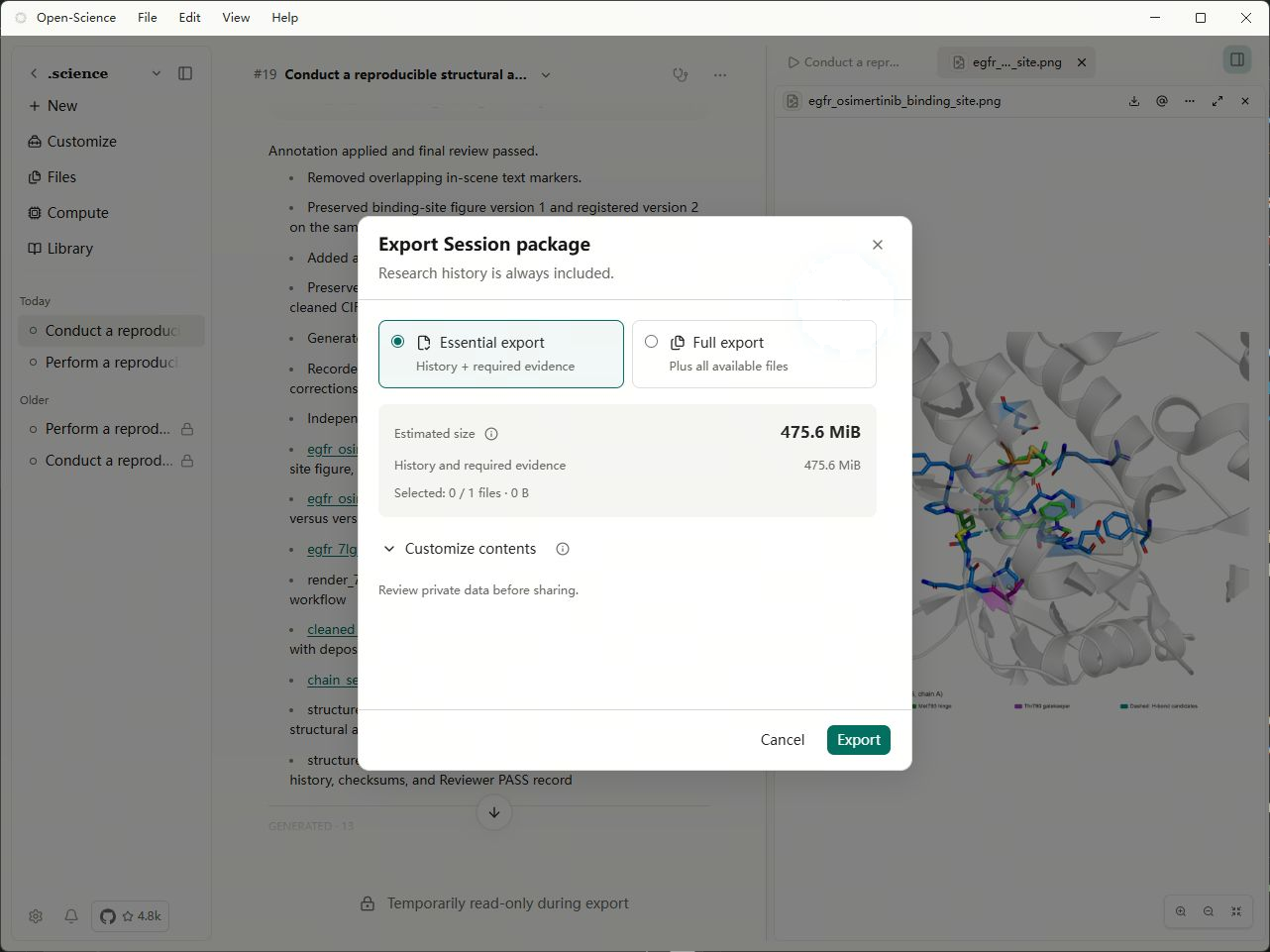
Figure 1. The .science package export dialog in AIPOCH Open-Science. Essential export, Full export, and Customize contents control the handoff selection. The displayed size belongs to this existing session; it is not a package-size limit. Captured locally for this article.
Imported sessions remain read-only. Opening the record does not execute code, restore credentials, or transfer the sender’s service authorizations. Researchers can create a writable copy to continue the work after checking the required inputs, dependencies, runtime, and permissions.
Verification evidence keeps its original scope, too: a received record describes the sender’s checks. It does not establish that the receiving computer reran the analysis or that the underlying scientific conclusion is correct. These boundaries make the package useful as an inspectable handoff while leaving scientific assessment with the researcher.
For the export and import workflow, see the AIPOCH Open-Science .science handoff guide.
One workspace from question to reviewable output
AIPOCH Open-Science connects the reasoning conversation with the files and tools needed to carry out a research task. Projects retain working context, while the agent can use permitted sources, scientific connectors, and computational tools to produce materials for researcher review.
A representative workflow starts with a specific request: inspect an input dataset, apply a stated analysis method, produce a figure and summary table, and record the assumptions and limitations. The researcher supplies the materials and acceptance criteria, reviews the proposed work, and inspects the resulting artifacts.
Within that workflow, researchers can:
- Define the task. Provide the question, source materials, relevant files, expected outputs, and review criteria.
- Execute the analysis. Use permitted tools and run Python, R, or shell workflows in the working environment.
- Inspect the result. Review reports, figures, tables, and Notebook records together with available execution and provenance evidence.
- Prepare the handoff. Select the relevant branches, file versions, and records for a
.sciencepackage, with a clear note about what the recipient should review next.
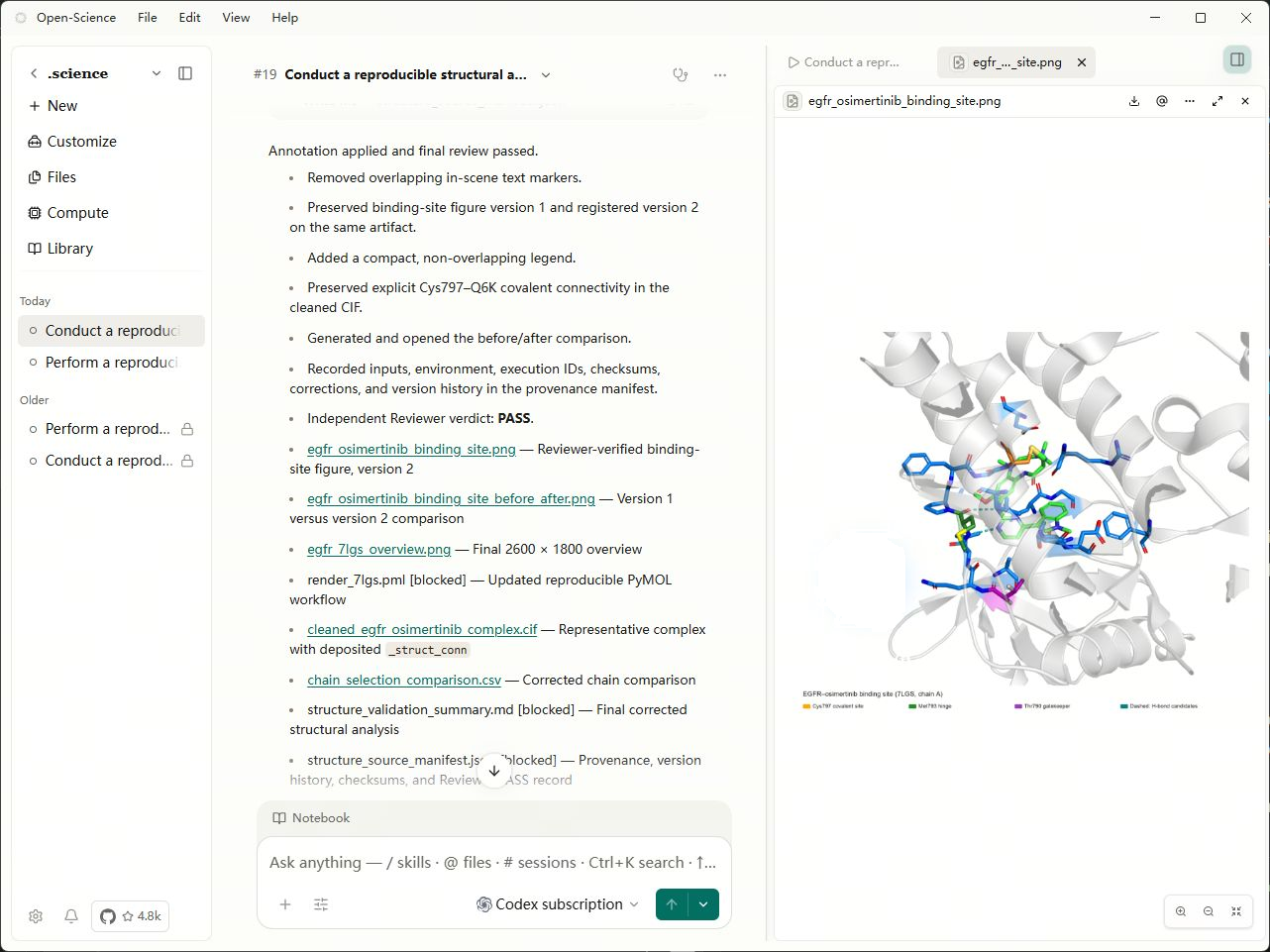
Figure 2. An existing molecular-structure workflow in AIPOCH Open-Science, with the recorded conversation beside an artifact preview. This local capture illustrates the workspace and an earlier session's outputs; it does not report a newly executed or independently validated scientific result.
Local and remote computing serve different needs. Supported remote workflows can connect to registered SSH hosts or submit jobs through Slurm. A remote run still requires reachable infrastructure, valid authentication, suitable software and dependencies, sufficient resources, and permission to perform the task.
This workflow supports computational research across fields. A literature review, a statistical analysis, and a bioinformatics investigation may use different methods, but each benefits from explicit inputs, recorded execution, and outputs that remain available for inspection. We want a colleague joining later to have a way into the work, even if they were not present when the first question was asked.
Build a focused literature workflow
The Literature Library helps researchers keep references and PDFs connected to their projects. Researchers can organize materials, use agents to search and read library sources, and generate formatted citations and bibliographies. BibTeX and RIS import and export support existing reference workflows.
Smart Collections can optionally use a configured classification model to screen references against researcher-defined inclusion and exclusion criteria. The screening results remain material for human review: researchers still decide whether a paper belongs in the reading set and whether its evidence supports a claim.
Keeping literature beside the analysis also makes follow-up questions more concrete. A researcher can ask which source informed a methodological choice, compare a passage with the working interpretation, or return to a figure in the original paper while reviewing an output. Keeping that connection visible is one way to help the next reader understand whose ideas informed the work and how those ideas were used.
Choose the models and capabilities your work needs
AIPOCH Open-Science supports multiple model providers, compatible custom gateways, locally deployed models, and four agent backends: Claude Code, OpenCode, Codex, and CodeBuddy. The selected backend, model, API protocol, and account determine which combinations and capabilities are available.
The workbench’s reusable capabilities serve distinct roles:
| Resource | Role in a research workflow | Launch reference inventory |
|---|---|---|
| Built-in Skills | Reusable instructions and methods available with the workbench | 23 Skills |
| Skills Marketplace | Additional Skills that researchers can discover and install | 525 published Skills |
| Built-in Connectors | Permissioned access to scientific resources and tools | 36 Connectors |
| Specialist Marketplace | Installable profiles combining instructions, Skills, and data tools for scoped work | 10 Specialists |
Built-in counts refer to v1.0.0; marketplace counts reflect the official catalogs checked on October 14, 2026, rather than permanent totals. Marketplace resources require separate installation, and marketplace and built-in inventories may overlap. A local import does not publish a resource; marketplace contributions go through review before publication.
Model choice also lets teams connect compatible internal or local deployments to the research environment. Compatibility needs to be checked for the actual endpoint, protocol, model, and agent backend. Connecting a model does not grant it unrestricted access to files, tools, or computing resources.
Inspect the evidence behind an artifact
AIPOCH Open-Science preserves reports, tables, figures, and notebooks as versioned artifacts with available provenance. Depending on what was captured, a version can be connected to inputs, producer code, execution history, environment details, its conversation branch, and review evidence.
The practical benefit is a more precise review question. Instead of asking only whether a figure looks plausible, a researcher can inspect which input version and recorded computation produced that figure. Missing evidence remains a limitation of the record and needs to be resolved before making stronger claims.
An optional Reviewer can inspect a completed agent turn in a separate context, using the responses, execution records, and related file evidence available for that turn. Findings can prompt corrections and a bounded cycle of re-review. Reviewer checks support inspection; they do not replace peer review or independently validate an experiment.
In the desktop app, researchers can re-execute eligible artifact versions when the required recipe, captured inputs, and runtime are available, then compare outputs and export verification records. Viewing recorded session steps does not execute code, and verification does not establish scientific validity. See the v1.0.0 release notes for the supported scope.
Reproducing a result requires its own assessment of methods, inputs, dependencies, runtime, and output comparisons. Provenance and verification records help researchers conduct that assessment.
Local-first research with explicit external access
AIPOCH Open-Science stores project data locally by default and gives researchers control over configured models, tools, and computing environments. This makes the local workspace a durable place for research materials and records.
External calls still matter. A configured cloud model receives the prompt and context needed for its request. Searches, remote connectors, and remote compute communicate with their respective services. Researchers should consider the destination, permissions, and service requirements before sharing sensitive material through those calls.
The software is available under the Apache License 2.0. External models, services, and computing resources may have separate charges and terms.
Start with a research question worth handing over
Begin with one bounded task and a clear expected output. Choose the model and tools appropriate to the work, supply the relevant materials, and review the resulting files and evidence. Then prepare a .science package with enough context for a colleague to understand the result and its unresolved questions.
Download AIPOCH Open-Science 1.0 from the official v1.0.0 release, with desktop packages for macOS on Apple Silicon and Intel, Windows x64, and Linux x64 and ARM64 in AppImage and Debian formats. Choose the installer for your platform and verify it against the release’s SHA256SUMS.txt. Back up your profile before upgrading.
Visit the AIPOCH Open-Science product page for the workbench overview, or explore the source repository to inspect and contribute to the project.
Version 1.0 is a beginning. With AIPOCH Open-Science, we hope more people can take part in research, more of the process can be seen and understood, and more valuable work can become a starting point for someone else. Each question, selected material, recorded analysis, and piece of evidence that researchers choose to share can help make that possible.
Science, Open to All.
Frequently asked questions
What is AIPOCH Open-Science 1.0?
AIPOCH Open-Science 1.0 is an open-source, local-first, model-agnostic AI research workbench. It brings research materials, executable tools, literature workflows, and traceable artifacts together, with .science packages for selected research records.
What can a .science package contain?
A .science package can carry selected conversation branches, file versions, Notebook records, and verification evidence for review, handoff, and archiving. Included files depend on the export selection; Side Chat conversations and private reading bookmarks are excluded.
Can a recipient continue research from a .science package?
Yes, by creating a writable copy for further work. The imported original stays read-only, and a new execution requires the necessary files, dependencies, runtime, model configuration, and permissions.
Does local-first mean research data never leaves the computer?
No. Project data is stored locally by default, but configured model providers, web searches, remote connectors, and compute services can receive data needed for their requests. Review the selected services and permissions for each workflow.
Does AIPOCH Open-Science certify research results?
No. Provenance, Reviewer findings, and verification records provide evidence for inspection. Researchers remain responsible for methods, interpretation, independent checks, and scientific conclusions.
Disclaimer
AIPOCH Open-Science supports research workflows, computational analysis, and research record sharing. It does not replace scientific judgment or peer review. Researchers remain responsible for evaluating data, methods, outputs, and the scope of any recorded checks.