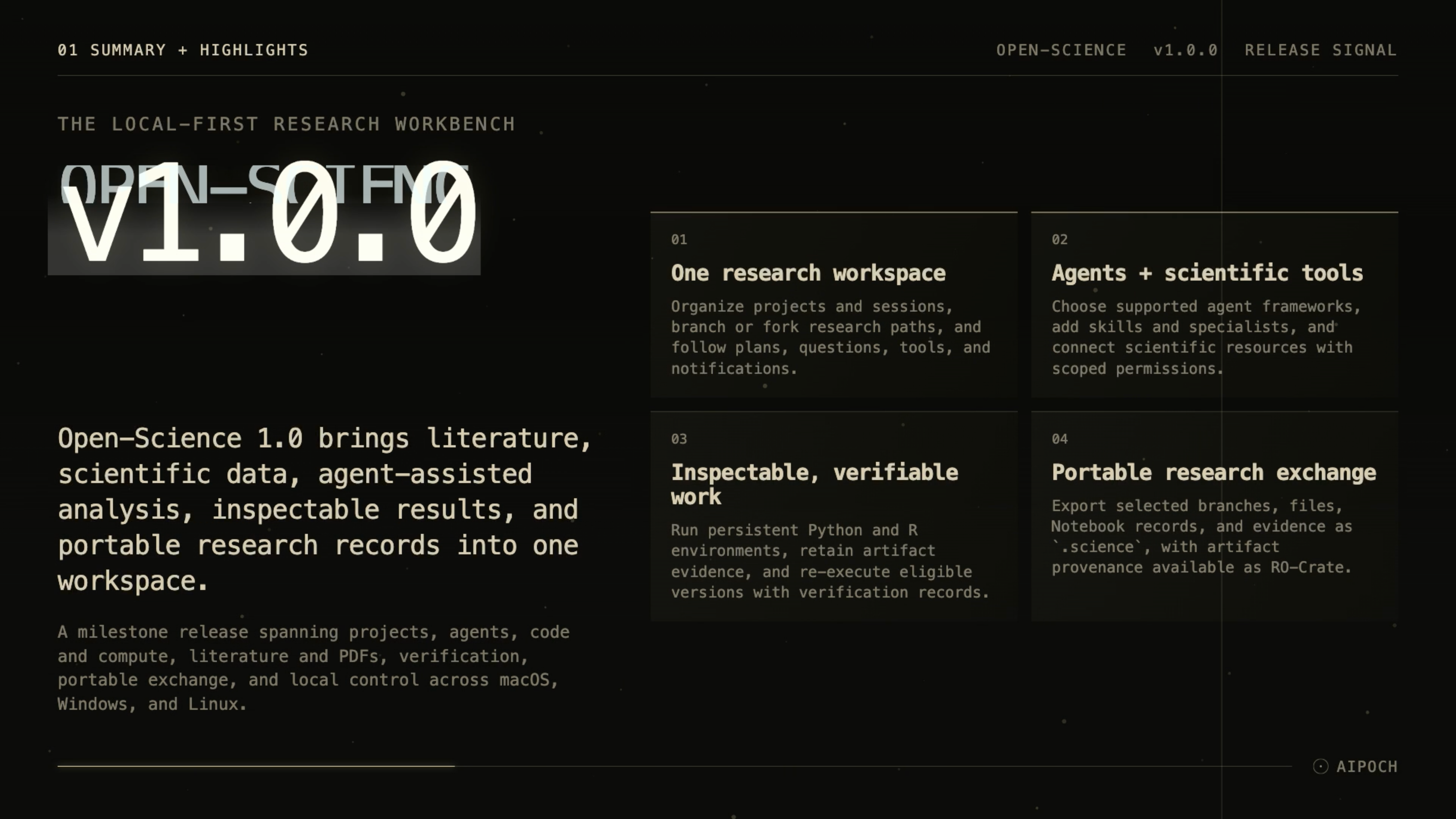
AIPOCH Open-Science v1.0.0 is available for macOS, Windows, and Linux, with desktop installers, .science research packages, and documented upgrade precautions.
Developed by AIPOCH, AIPOCH Open-Science is an open-source, local-first AI research workbench. The v1.0.0 GitHub release, published October 14, 2026, is the source for the shipped capabilities and package links below.
What research capabilities ship with v1.0.0?
Version 1.0.0 packages research sessions, code execution, literature work, and inspectable outputs in the desktop release. The release notes describe what is available in 1.0; they do not assign a first-available version to every capability.
Portable .science research packages
A result can be difficult to review when the conversation, input versions, and execution records live in separate places. In v1.0.0, a .science export can carry selected conversation branches, file versions, Notebook records, and verification evidence for review, handoff, or archiving in another project or computer. Researchers choose which files to include. See the research package guide for the export and import workflow.
An imported package opens as a read-only record; it does not execute code or restore credentials. Side Chat conversations and private reading bookmarks are excluded. A received verification record reports checks made by the sender; it does not show that the receiving computer reran them. A researcher can create a writable copy for follow-up work after checking local inputs, dependencies, and permissions.
Execution and artifact inspection
Open-Science v1.0.0 includes persistent Python and R Notebook environments, package management, execution history, variables, and .ipynb export. It can run background work locally or use configured SSH hosts and Slurm clusters. The desktop app retains immutable artifact versions with available code, inputs, execution history, and environment evidence.
Eligible artifact versions can be re-executed and compared in the desktop app when a complete recipe, captured inputs, and a usable runtime are available. This supports inspection of a recorded step; it does not establish scientific validity or guarantee identical output across environments.
Literature and research resources
Open-Science v1.0.0 lets researchers organize references, collections, tags, notes, and duplicates; look for available open-access full text; screen papers against research criteria; annotate PDFs; and export BibTeX or RIS. The release also supports scientific connectors and custom MCP servers with scoped permissions. Upstream source coverage and configured access determine which records and services are available for a particular project.
What else matters in v1.0.0?
The v1.0.0 release provides four agent-framework choices—Claude Code, OpenCode, Codex, and CodeBuddy—alongside compatible model providers, custom endpoints, and supported subscription logins. Protocol features depend on the selected framework. Desktop, browser, and CLI surfaces have different capabilities, and WSL2 Bash remains an opt-in preview on Windows x64.
For installations moving to 1.0, the release states that historical-data upgrade and import paths remain available and that this version introduces no new data format or migration. Its 1.x compatibility policy defines the supported public interfaces. Managed cloud-GPU submission, a local GPU compute backend, and real-time multi-user editing are outside the 1.0 release scope.
Bug fixes that affect daily use
The v1.0.0 GitHub release does not enumerate individual bug fixes. For a named fix or regression, consult the tagged changelog and earlier version notes rather than treating this release's capability summary as a fix list.
Install or update
Download the package matching your operating system and processor from the v1.0.0 release assets: macOS Apple Silicon or Intel DMG; Windows x64 installer; or Linux x64/ARM64 AppImage and Debian packages. The GitHub release also provides SHA256SUMS.txt for checking downloaded files.
Back up your profile before upgrading. Downgrading the application does not roll back its data, and an older binary may not read data written by a newer version. The release publication includes desktop packages; standalone CLI archives and Linux CLI .deb/.rpm packages are not part of these v1.0.0 assets. Check the release page for the current download and channel status before updating another installation.
Resources
- AIPOCH Open-Science v1.0.0 release notes and downloads
- AIPOCH Open-Science product page
- AIPOCH
- AIPOCH Open-Science
.scienceresearch handoff guide - AIPOCH Open-Science v0.36.0 release notes
FAQ
Is AIPOCH Open-Science v1.0.0 available on Windows, macOS, and Linux?
Yes. The v1.0.0 GitHub release lists desktop packages for Windows x64, macOS Apple Silicon and Intel, and Linux x64 and ARM64. Choose the installer that matches your system and check its published checksum.
What can a .science package carry in v1.0.0?
A v1.0.0 .science export can carry selected conversation branches, file versions, Notebook records, and verification evidence. Included files depend on the export selection; Side Chat conversations and private reading bookmarks are excluded.
Does importing a .science package rerun its analysis?
No. A v1.0.0 import is read-only and does not execute code or restore credentials. Verification records describe the sender's checks; any new execution on the receiving computer requires suitable inputs and a compatible environment.
Do existing installations need a data migration for v1.0.0?
The v1.0.0 release says this transition introduces no new data format or migration and retains existing historical-data upgrade and import paths. Back up the profile first, because downgrading a binary does not reverse data changes.
Disclaimer
AIPOCH Open-Science assists researchers with research workflows but does not replace scientific judgment or peer review. Model outputs, literature screening, execution records, and verification evidence require independent review of sources, methods, inputs, and results.