AIPOCH Open-Science v1.3.4 adds opt-in Agent tracing to a receiver you control, removes a Windows update stall, and keeps long Notebook histories fast.
AIPOCH Open-Science is the open-source, local-first research workbench from AIPOCH, and this release focuses on reliability and observability rather than new research methods.
What new capabilities help researchers understand and run the built-in Agent?
AIPOCH Open-Science v1.3.4 gives researchers a practical way to inspect built-in Agent behavior and keep the desktop app current, because new opt-in tracing, reasoning-effort discovery, and an updated model catalog make Agent runs more transparent and predictable across supported models and platforms. The v1.3.4 GitHub Release, published in 2026, records opt-in Agent tracing that exports correlated OTLP/HTTP spans to a receiver you host. The v1.3.4 GitHub Release, published in 2026, lists CodeBuddy reasoning-effort discovery and the addition of GLM-5.4 to the Zhipu model catalog.
Opt-in Agent tracing to a receiver you control
Projects can turn on Agent tracing and export correlated OTLP/HTTP JSON spans for turns, model requests, and MCP tool executions to a generic collector or Langfuse endpoint that you host. Four capture-detail switches control what is recorded, and a local upload-status switch reports delivery health. Tracing is off by default; a project must enable it, or a CLI run must pass --otel-traces. Spans go only to the OTLP/HTTP endpoint set in the app's launch configuration, never to an AIPOCH-operated service. This lets a research group inspect turn structure and tool use on infrastructure it already governs, after reviewing the capture switches on shared machines.
Reasoning efforts matched to the selected model
CodeBuddy connections now discover the reasoning efforts each model supports during sign-in and catalog refresh. The effort picker then offers only the levels the selected model actually supports, so a researcher does not have to guess which settings will apply. The Zhipu model catalog also adds GLM-5.4, available directly on Zhipu connections.
What else is new in v1.3.4?
AIPOCH Open-Science v1.3.4 improves long-history responsiveness and aligns system memory reporting with each operating system, so researchers revisiting long-running Notebooks and comparing the Compute summary with their operating system monitor see consistent numbers and lower overhead during routine interactions. The v1.3.4 GitHub Release, published in 2026, describes a bounded history view that replaces repeated full reads when starting Runs, selecting results, or opening previews. The v1.3.4 GitHub Release, published in 2026, records Compute memory accounting that excludes cached memory on macOS and shows committed memory against its limit on Windows.
Long Notebook histories cost less to work with. Eligible Run transitions are written to durable per-lane slots that fold into checkpoints, so a Notebook with hundreds of Runs no longer re-reads its whole history for routine interactions.
The Compute system summary now follows each platform's native accounting. On macOS, usage matches Activity Monitor by excluding cached memory; on Windows, the summary shows committed memory against its limit alongside physical memory, with tuned default thresholds.
Which bug fixes affect daily use?
AIPOCH Open-Science v1.3.4 fixes several stalled or silent paths in update delivery and everyday Agent work, so Windows updates continue while the Agent is active, denied tool actions explain themselves, and image and film generation flows remain visible to the researcher throughout each session. The v1.3.4 GitHub Release, published in 2026, lists a fix that recognizes the built-in Agent and image helper as the app's own installation helpers. The v1.3.4 GitHub Release, published in 2026, restores compact Windows installer deltas and surfaces explicit upstream HTTP statuses such as a 402 with an actionable billing explanation.
- Windows updates no longer stall when the Agent runs. The updater recognizes the built-in Agent and image helper as its own processes, and helper registration is enforced so a new helper cannot be missed.
- Compact Windows update deltas are back. Stable releases again publish the compact delta used for delta updates, and a missing delta for an already-published release can be repaired without re-shipping the version.
- Denied tool actions explain themselves. A denied action now ends the turn with a durable explanation, and denial counts stay separate from completed work.
- Billing statuses surface as provider facts. An explicit upstream 402 now shows an actionable billing explanation while preserving the status and safe provider details.
- Research-film and image flows stay visible. Blocked film dialogs can open the owning conversation, and generated edit-image versions open reliably in the full preview while publishing.
How can readers install or update AIPOCH Open-Science?
AIPOCH Open-Science v1.3.4 installs across macOS 12 or later, Linux x64 or ARM64, and Windows 10 or 11 x64 through signed desktop packages, Homebrew, npm, or standalone archives with a bundled runtime, so readers can choose the installation path that matches their platform and update method. The v1.3.4 GitHub Release, published in 2026, lists desktop packages for every supported platform in its Assets. The official download page, updated by AIPOCH in 2026, provides the signed installers referenced by that release.
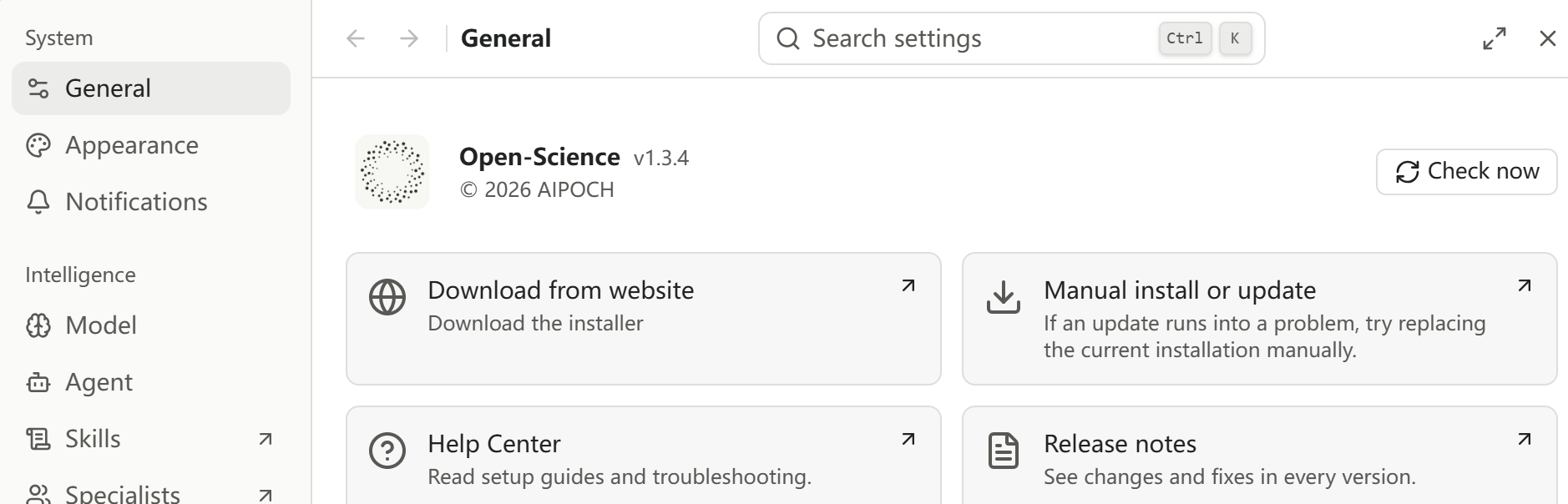
- Desktop client. Download the signed installer from the official download page or the release Assets. The app updates itself in place; on macOS, eligible updates can also install automatically when the app quits.
- Homebrew on macOS and Linux. Run
brew install aipoch/tap/open-science, thenopen-science start --no-openandopen-science url. The macOS desktop app is also available throughbrew install --cask open-science. - npm. With Node.js 22.13 or later, run
npm install --global @aipoch/open-science, thenopen-science --help. - Standalone archives. The release Assets include standalone CLI archives for all supported platforms with a bundled Node runtime, plus
.deband.rpminstallers on Linux.
Verify that any package comes from the official release page before installing it.
Where can readers verify the release and learn more?
AIPOCH Open-Science v1.3.4 can be verified against public first-party pages, with the GitHub Release serving as the authoritative record of what shipped and related AIPOCH pages providing context on the workbench, earlier versions, and agent workflows for researchers who want to confirm the details. The v1.3.4 GitHub Release, published in 2026, lists every implemented change, fix, and known limitation. The Open-Science product page, maintained by AIPOCH in 2026, describes the workbench and its research workflows.
- The data recipients documentation explains where tracing spans are sent and how to review capture switches.
- The AIPOCH blog and the v1.3.3 release article provide context for earlier updates.
- The AI agent workflow guide explains how agents fit into research projects.
FAQ
Is Agent tracing on by default in v1.3.4?
No. Project tracing is off until a project enables it, and a single CLI run requires an explicit --otel-traces opt-in. Captured spans go only to the OTLP/HTTP endpoint configured in the app's launch configuration, not to an AIPOCH-operated service.
Which receivers work with Agent tracing?
The release supports generic OTLP/HTTP collectors and Langfuse. Four capture-detail switches control which turns, model requests, and tool executions are recorded, and a local status switch reports delivery health.
Does v1.3.4 fix the Windows update stall?
Yes. The updater now recognizes the built-in Agent and image helper as the app's own processes instead of failing closed, and helper registration is enforced automatically. Stable Windows updates also publish a compact installer delta again.
Why do memory numbers look different in v1.3.4?
The Compute summary now matches each platform's native accounting. macOS excludes cached memory to match Activity Monitor, and Windows shows committed memory against its limit alongside physical memory.
Which platforms does v1.3.4 support?
Desktop builds cover macOS 12 or later on Apple Silicon and Intel, Linux x64 and ARM64, and Windows 10 or 11 x64. CLI and standalone archive options are available from the release Assets and package managers.
What limitations and responsibilities apply?
AIPOCH Open-Science v1.3.4 assists researchers but does not replace scientific judgment or peer review, and its replay and AI-assisted outputs carry explicit boundaries that readers should weigh before relying on results, especially where citation, unit, statistic, or method validation matters. The v1.3.4 GitHub Release, published in 2026, states that replay reproduces recorded steps rather than re-executing them and that solver-exact equivalence remains open. The v1.3.4 GitHub Release, published in 2026, notes that AI-assisted outputs reflect the configured model and the record they cover. Review tracing capture switches on shared machines, and treat AI-assisted results as aids, not validation of citations, units, statistics, or methods.