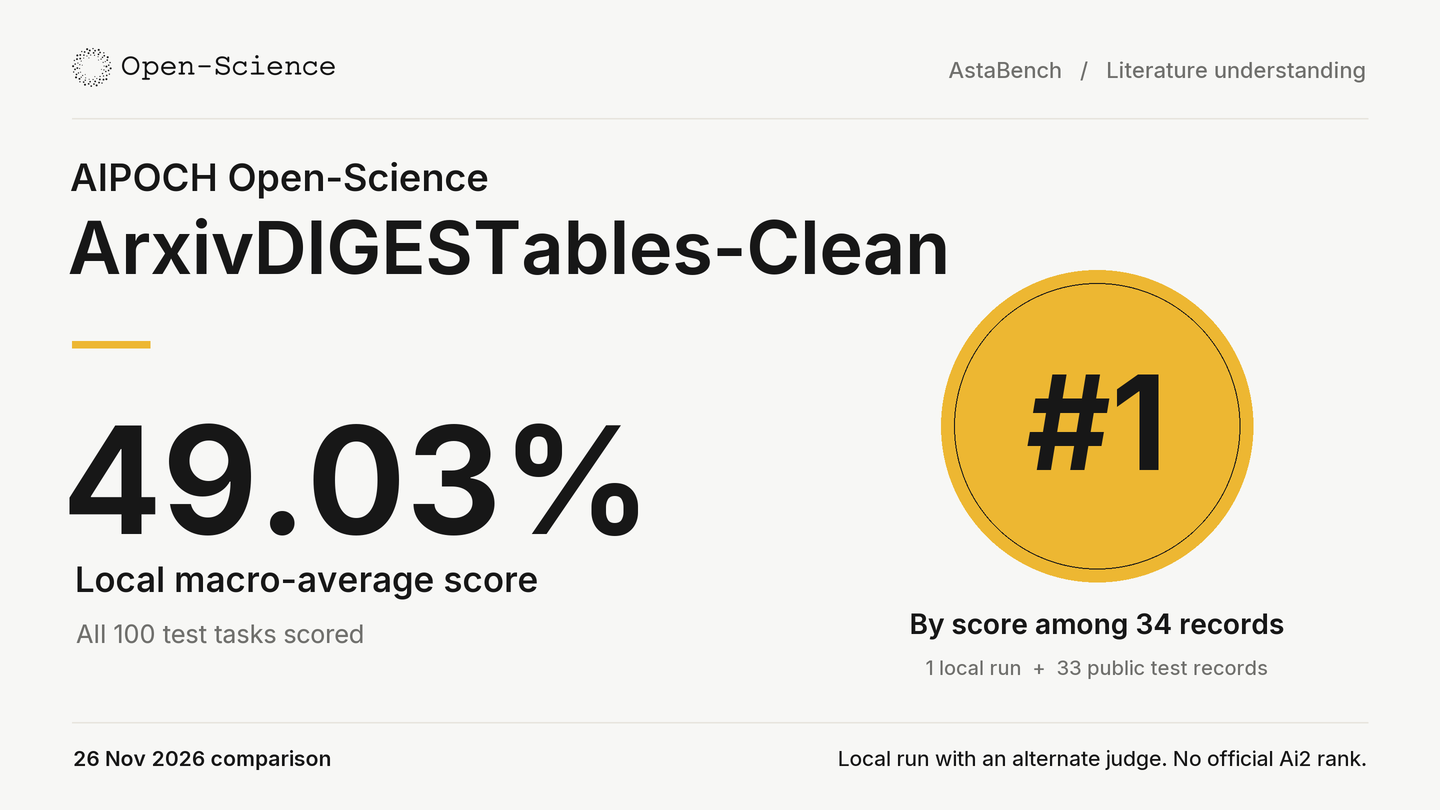
AIPOCH Open-Science scored 49.03% on the full 100-task ArxivDIGESTables-Clean test split in a local evaluation. Its score is 6.09 percentage points above the highest of 33 public test records available on November 26, 2026. This is a comparison of numerical scores, not an official leaderboard placement. The local run used an alternate judge, included revisions and retests, and has not been submitted to Ai2. Ai2 public test records
What does ArxivDIGESTables-Clean ask an agent to do?
A literature review table can look simple until a researcher checks each cell. Which paper used which dataset? What method did it compare against? Does the reported result apply under the same conditions as the result in the next row?
Ai2's ArxivDIGESTables-Clean benchmark turns this work into a measurable task. Given a set of related papers and a caption describing the intended table, an agent must fill rows for papers and columns for comparison aspects. The reference tables come from arXiv papers. The “Clean” subset excludes tables that are trivial or cannot be reconstructed from the available full text.
In AIPOCH's evaluation, Open-Science searched snippets only within the paper IDs supplied for each task. This matters because a plausible cell is not enough. A useful table should connect each comparison back to the paper that supports it.
This task sits after retrieval in a literature workflow. Our earlier LitQA2-FullText-Search evaluation examined whether Open-Science could find a target paper among its first 30 results. ArxivDIGESTables-Clean asks whether an agent can turn a specified set of papers into a structured comparison.
How was the 49.03% calculated?
Open-Science used GPT-6 Astra at high effort to answer all 100 test tasks. All 100 answers passed the team's output checks and received a score. The evaluation retained Ai2's score_tables algorithm and original reference statements. Codex CLI 0.162.0 with GPT-6.1 Sol at high effort was used to expand tables and judge whether statements were supported.
The primary metric, score_tables/mean, averages the scores across the 100 tasks with equal weight per task. AIPOCH's local result was 49.034494%, rounded to 49.03%. Across all tasks, the judge marked 2,019 of 4,004 reference statements as supported, or 50.42%. The two percentages use different weighting: one averages tasks, while the other counts statements.
How does it compare with public test records?
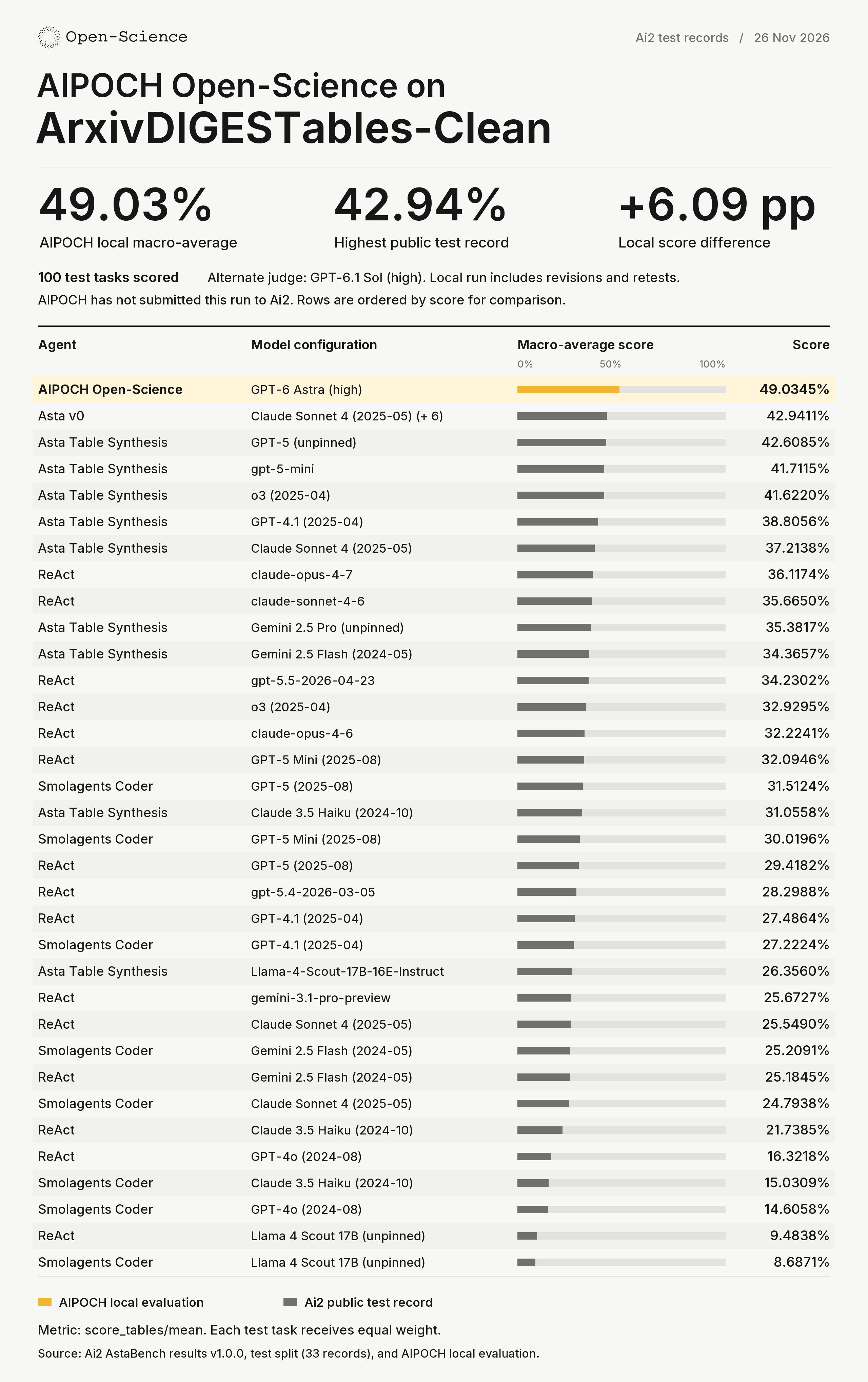
As of November 26, 2026, the highest public score_tables/mean result for this test subset was 42.9411%. AIPOCH's 49.0345% local result is 6.0934 percentage points higher when calculated from the unrounded scores. If placed beside the 33 public entries and sorted by score, the local entry appears first among 34 records. Separate records can represent different configurations of the same agent. Ai2 public test records
The scoring model differed from the official setup, and the local run included revisions and retests. Whether Ai2 would accept this configuration and its run history is unresolved. An official placement requires an accepted submission.
For a broader picture of research work, see AIPOCH Open-Science's CORE-Bench-Hard local evaluation, which tests computational reproduction, and its SUPER-Expert local evaluation, which tests work in research codebases. Each benchmark has its own tasks, metric, model configuration, and evaluation conditions. The Open-Science benchmark overview brings these results together.
What should a research team take from this result?
The result concerns one concrete deliverable: a comparison table built from specified papers. When using an agent for a real review, inspect the cells that affect a decision, follow them back to the relevant papers, and correct any missing qualifications. A benchmark score provides a starting point for that review, while the underlying papers remain the evidence for the research claim.
Explore AIPOCH Open-Science to work with literature, files, and analysis in one project. For review and handoff, a .science package can carry selected conversation branches, file versions, Notebook records, and verification evidence. The receiving researcher can inspect that record in a read-only imported session and decide what to check again.