On November 24, OpenAI announced on X that small proteins based on shapes proposed by GPT-6.2 had attached to their intended targets in a lab. The team had picked five targets. Its research partner, Onava, found at least one protein that attached to each. That sounds like five successes in five tries. The lab actually tested 322 proteins.
What did GPT-6 contribute to the lab test?
The idea behind the GPT-6 protein design study was to see whether a general-purpose language model could take a request about a particular target, work out a shape for a small protein that might attach to it, and give researchers something worth making and testing.
The November 2026 preprint describes how a prerelease version of GPT-6.2 proposed the shapes of these small proteins, called minibinders. The AIPOCH case study traces the next steps to specialist software that suggested amino acid sequences and helped select candidates, and to Onava, which made the proteins and measured binding.
Why involve specialist software if GPT-6.2 could already draw the shape? A lab needs the order of the amino acids, the building blocks that form a protein. The shape was a proposal for what the finished molecule might look like. Choosing a sequence gave Onava a particular protein to make.
A proposed shape can look like a good fit on screen. For a design to register as a hit here, a physical protein had to show a signal when tested against its target. A hit gave the researchers a candidate to investigate. Finding out whether it changes anything inside a cell would take another experiment.
The researchers also gave the model a different job. They took three shapes that GPT-6.2 had proposed earlier and for which a binding protein had already been found. This time GPT-6.2 proposed new amino acid sequences for those shapes. In the second experiment, 14 of the 107 proteins made from the new sequences showed binding. That result answers a question the first screen leaves open: a GPT-designed sequence could also yield a protein that attached, given a shape with prior evidence of binding.
How could all five targets have a hit if only one in nine proteins bound?
The AIPOCH case puts the published results side by side. Start with panel A on the left. Each target has its own row showing how many proteins bound and how many were tested for that target.
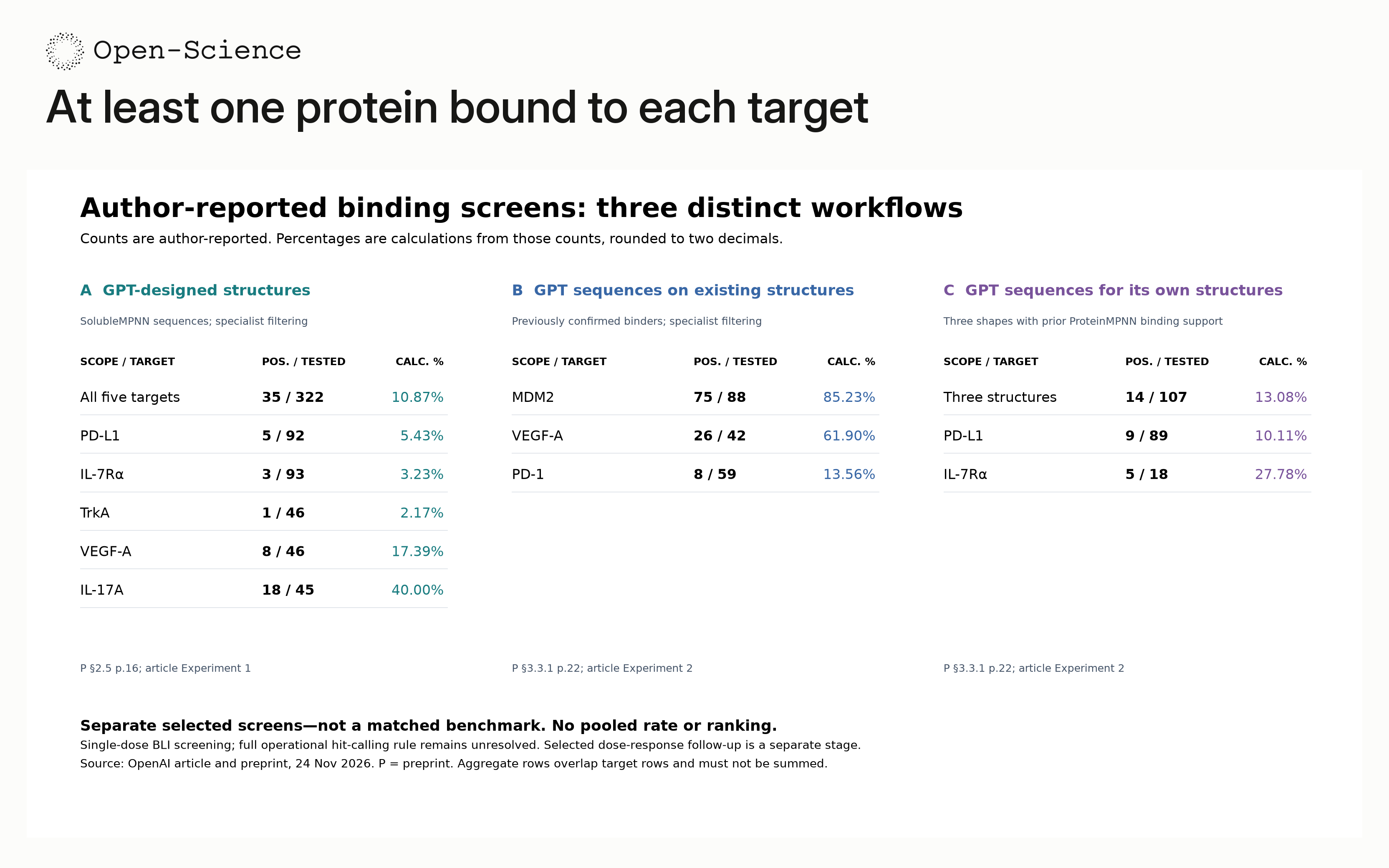
Panel A starts with a total. Cover the “All five targets” row and you can reconstruct it from the five rows below.
We tried that with the two columns of counts. The positives added up to 35 (5 + 3 + 1 + 8 + 18). The tested proteins added up to 322 (92 + 93 + 46 + 46 + 45). Every target contributed at least one hit, yet only about one in nine tested proteins attached. Writing the unit beside each number settled it for us. Five of five targets had a hit, and 35 of 322 proteins showed binding. Naming what a percentage counts also helps when reading chemical purity and enantiomeric excess.
One detail was easier to miss. Find VEGF-A in panel A, then find the same name in panel B. Why did 8 of 46 proteins bind in the first group and 26 of 42 in the second? We went back to the description of the second experiment. Panel A began with newly proposed shapes. Panel B began with shapes from proteins already known to bind, and GPT-6.2 proposed new sequences for those shapes. Knowing that changed our caption for panel B. 26 of 42 tested variants showed binding when the team started from known binders.
How did we build the case in AIPOCH Open-Science?
We used AIPOCH Open-Science to trace the headline back to individual experiments, beginning with the numbers a reader could find in the announcement and bringing in the paper wherever the announcement left us without enough information to calculate a rate or attribute a result.
The case’s input inventory identifies the starting table, published_aggregate_counts.csv, as ten rows transcribed from the announcement. The first screen on page 16 of the preprint supplies five numbers that the initial table lacked: how many proteins were tested against each target.
Take the five hits reported for PD-L1. We left the rate blank in the announcement-only calculation. Dividing five by 322 would have mixed the hits for one target with the tests for all five. Once the paper supplied the right denominator, the row read 5 of 92, or 5.43%. The case records where the additional numbers came from, so a reader can retrace that change.
Next came a choice about the figure. We kept one panel for newly proposed shapes, one for new sequences on existing binders, and one for new sequences on three earlier GPT-designed shapes. The recorded analysis rebuilt the numerical tables using both the announcement-only inputs and the fuller set that included the paper. The saved counts could be checked against each version, and the final three-panel figure could travel with the report in the .science package.
The conclusion we would cite
GPT-6.2 contributed designs that produced measurable binding in the lab. The clearest evidence for its contribution to shape design is the first screen: Onava found hits for all five targets among 322 selected proteins made with help from specialist tools. The 14 hits in the separate 107-protein screen support a second, narrower claim about designing sequences for previously supported shapes. Together, the results give researchers a reason to test more model-designed candidates. Estimating the chances for an arbitrary proposal, or showing that attachment produces a useful biological effect, would take additional evidence.
How can you watch the case as a Research Film?
For a lab meeting, you can turn a completed research branch into a narrated Research Film in the AIPOCH Open-Science desktop app, giving colleagues a way to follow the question and the figure before opening the underlying counts for a closer look.
AIPOCH’s Research Film walkthrough shows the workflow in the desktop app. To start from a shareable .science package, drop it onto the project’s New conversation page and confirm the import. Open the completed branch you want to present and select Session actions → Generate research film. The Research Film guide, offers Research explanation for a presentation of the question, method and findings, and Operation replay for walking through the recorded work.
For this case, choose Research explanation on a branch prepared for sharing. When Research film ready appears, select Play research film. One useful place to pause is the first panel: ask viewers what the “five” counts before revealing what the “322” counts. Check the narration against the figure, then use Export MP4 in the preview if you want a video file for the meeting. The narration is generated in English.
Frequently asked questions
Did the model propose only 322 designs?
The 322 were candidates selected for the first lab screen. Other proposals could be filtered out before testing. Dividing 35 by 322 gives the share of tested proteins that showed binding. The success rate across everything the model proposed would require a different denominator.
How strongly did the 35 hits bind?
The first screen recorded which candidates showed a binding signal under the test conditions. The researchers made follow-up measurements on selected hits. As the case’s guide to the lab measurements explains, the count of 35 alone tells us neither how tightly each protein bound nor whether binding changed anything in a cell.
What can I check for myself in the AIPOCH case?
Open the published results table, pick VEGF-A and divide the positive count by the tested count in each experiment. You should get 17.39% for 8/46 and 61.90% for 26/42. That reproduces the calculation from the published counts. Independently confirming binding would require new lab measurements.