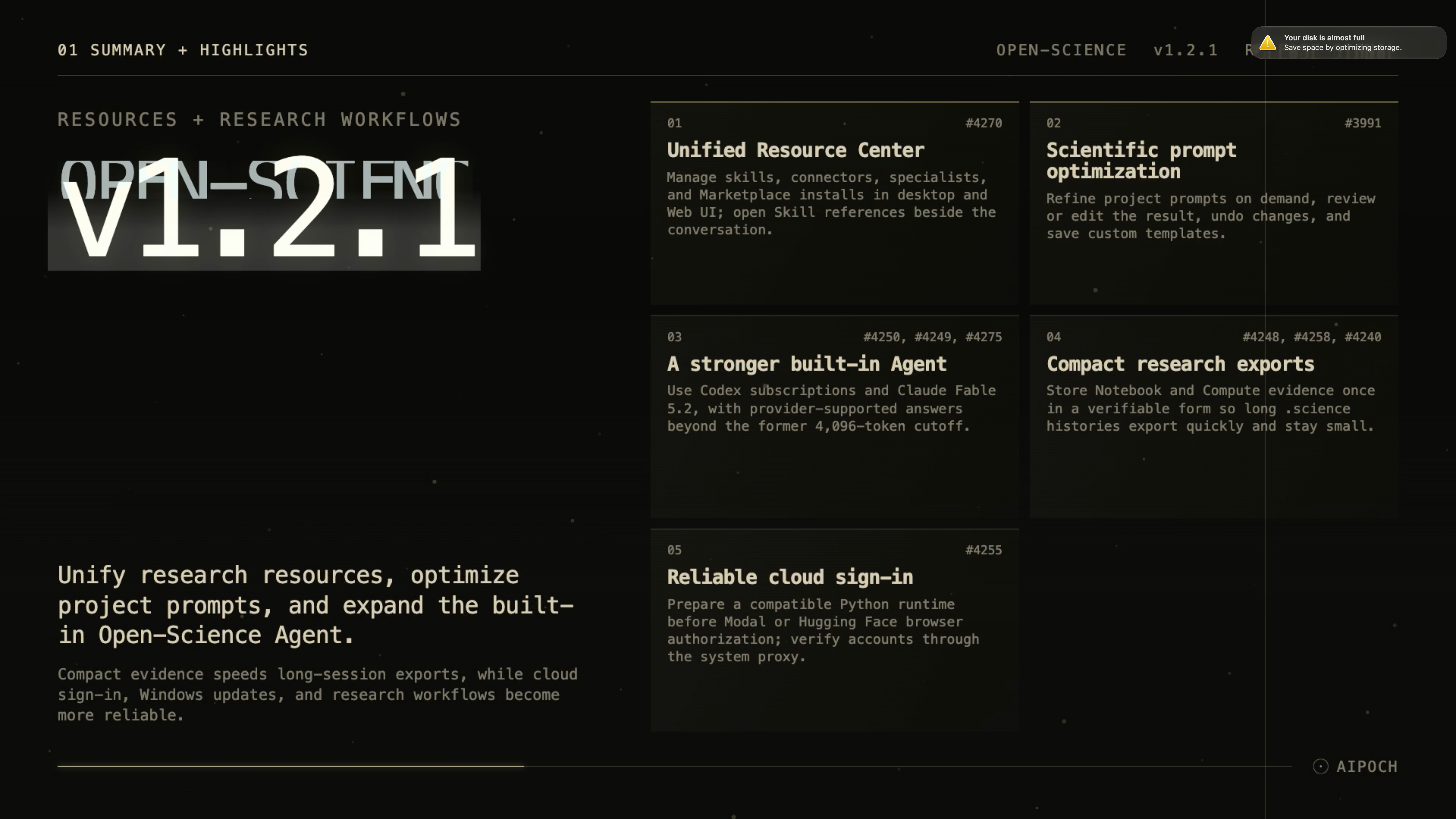
Version 1.2.1 brings research resources together, adds manual prompt refinement, expands the built-in Agent, and makes long-session exports more compact.
AIPOCH Open-Science is AIPOCH's open-source, local-first research workbench for macOS, Windows, and Linux. The v1.2.1 release notes, published on November 11, 2026, are the source for the changes below.
What new capabilities help researchers in v1.2.1?
AIPOCH Open-Science v1.2.1 brings resource management, project prompt refinement, and more Agent account choices into existing research workflows, letting researchers find Skills, Connectors, and Specialists in one Resource Center, review prompt changes before applying them, and use supported Codex subscription accounts with the built-in Agent, subject to configured access and provider support.
The AIPOCH Open-Science v1.2.1 release notes (2026) list the unified Resource Center and manual project prompt optimization as implemented features. The same v1.2.1 release notes (2026) state that Codex subscription accounts can be used for the main Agent and subagents.
Unified Resource Center
Skills, Connectors, Specialists, and Marketplace installations previously lived in separate places. In v1.2.1, the Resource Center puts them together with shared catalog cards, filters, bulk selection, and detail drawers. Marketplace installation also works in the Web interface, and Skill references can open beside a conversation without disturbing the current draft. Researchers can inspect and manage available resources while staying in the same project context. (v1.2.1 release notes, 2026)
Scientific Prompt Optimization
When a project prompt needs refining, v1.2.1 lets a researcher invoke optimization from the composer. The result can be reviewed and edited before it replaces the draft; Undo restores the earlier text and removed pasted attachments. Custom templates live in Project settings. Optimization runs through the configured provider only when the researcher invokes it, so the feature is a manual editing aid rather than automatic scientific validation. (v1.2.1 release notes, 2026)
Built-in Agent Account and Model Options
The built-in Open-Science Agent in v1.2.1 accepts imported or app-owned Codex subscription accounts for its main agent and subagents, reusing existing connection flows for sign-in and refresh. The bundled Anthropic model list adds Claude Fable 5.2 with a stated one-million-token context window. Provider-supported long answers are no longer capped at the former 4,096-token output limit; actual availability and limits still depend on the configured provider and model. (v1.2.1 release notes, 2026)
Compact Evidence for Long Sessions
Long Notebook and Compute histories can repeat the same evidence across many runs. Version 1.2.1 stores unique evidence content once with verified digests, and the first export backfills historical evidence. The release describes smaller, faster .science exports for long histories; a compact package still needs review of its selected contents before sharing. (v1.2.1 release notes, 2026)
What else is new in v1.2.1?
AIPOCH Open-Science v1.2.1 also adds bibliography CSV export and improves workflows around the main research session, covering account authorization for connected compute services, long Agent responses, research-film generation, and idle runtime cleanup, so researchers have more control over exported records and encounter fewer interruptions during ordinary desktop use.
The v1.2.1 release notes (2026) describe a 16-column bibliography CSV export for selected references, projects, or collections. The same release notes (2026) describe Python-runtime preparation and system-proxy account verification for Modal and Hugging Face targets.
- Bibliography CSV: Export selected references across pages, with exclusions, or a whole project or collection; missing metadata stays blank.
- Cloud compute sign-in: Modal and Hugging Face prepare a compatible Python runtime before browser authorization and verify accounts through the system proxy. These targets still require user-provisioned accounts and permissions.
- Longer supported Agent output: The built-in Agent follows the model's configured or advertised output limit, with a documented fallback.
- Research films and idle runtimes: Film generation continues across session switches; idle Python, R, REPL, and Shell interpreters are reclaimed after 15 minutes without session activity.
Which bug fixes affect daily use?
AIPOCH Open-Science v1.2.1 fixes interruptions in file preview, Windows updates, conversation continuation, and several import and document paths, helping researchers return to attachments, install an update, or continue work after an Agent question without an avoidable workflow stall while keeping the underlying scientific analysis subject to ordinary review.
The v1.2.1 release notes (2026) say Notebook files attached in chat open a preview again. The v1.2.1 release notes (2026) also describe restored signed Windows update packaging and clearer recovery information about files or processes blocking installation.
- Windows updates: Signed packaging is restored, and recovery identifies blocking files and processes while pruning closed startup logs.
- Notebook and file links: Chat attachments open previews again, and local file links open their corresponding files.
- Agent continuation: Answered Agent questions no longer wait on a deferred persistence flush before work continues.
- Literature and PDFs: Identifier routing and DOI letter case are preserved; damaged external PDFs are handled more defensively.
- Session reliability: Terminal conversation events are acknowledged reliably, and authorized local CLI imports work again in session packages.
How can readers install or update AIPOCH Open-Science?
AIPOCH Open-Science v1.2.1 is available through official release assets and the download page for supported desktop platforms, so researchers can choose an installer for their operating system and architecture, use the application's in-place update path when already installed, or select a documented standalone CLI option with its specific runtime requirements.
The v1.2.1 release notes (2026) list macOS 12 or later, Linux x64 or ARM64, and Windows 10 or 11 x64 for the desktop client. The official AIPOCH download page (verified 2026) provides platform-specific downloads and installation guidance.
Choose a macOS ARM64 or x64 DMG, a Linux x64 or ARM64 AppImage or Debian package, or the Windows x64 signed installer from the v1.2.1 assets. On macOS, Homebrew can install the desktop app with brew install --cask open-science. The release also documents a standalone CLI through the AIPOCH Homebrew tap, npm with Node.js 22.13 or later, and archives with a bundled Node runtime. Check the release page for the package that matches the machine before installing.
Where can readers verify the release and learn more?
The AIPOCH Open-Science v1.2.1 GitHub release is the authoritative record for shipped changes, installation options, and known limitations, while the public product and download pages explain the broader workbench and current packages and related AIPOCH articles provide context for the preceding release and earlier literature-workflow changes.
The v1.2.1 GitHub release (2026) separates implemented work from partial capabilities and roadmap items. The AIPOCH Open-Science product page (verified 2026) describes the workbench's local-first scope and researcher responsibilities.
- AIPOCH Open-Science v1.2.1 release notes
- AIPOCH Open-Science product page and AIPOCH home
- AIPOCH Open-Science downloads
- Open-Science v1.2.0: approved remote jobs and a built-in Agent
- Open-Science v1.0.8: settings, literature import, and study snapshots
What questions do readers ask about v1.2.1?
Readers considering AIPOCH Open-Science v1.2.1 need to know which changes require deliberate action and how research records remain reviewable, because the version adds manual project-prompt refinement and broader resource access while leaving account provisioning, export selection, scientific interpretation, and validation with the researcher and configured external services.
The v1.2.1 release notes (2026) say prompt optimization runs only when invoked through the configured provider. The v1.2.1 release notes (2026) say remote compute targets still require user-provisioned accounts, software, and permissions.
Does v1.2.1 optimize project prompts automatically? No. A researcher manually invokes the v1.2.1 composer action, reviews or edits the proposed text, and can undo the change. The configured provider handles an invoked optimization. (v1.2.1 release notes, 2026)
Can the built-in Agent use a Codex subscription? Yes. In v1.2.1, imported or app-owned Codex subscription accounts are supported for the main built-in Agent and subagents, using the existing connection flows. (v1.2.1 release notes, 2026)
Does compact evidence change what a .science package means? No. Version 1.2.1 stores repeated Notebook and Compute evidence once with verified digests to reduce export size; researchers still choose and inspect the records they share. (v1.2.1 release notes, 2026)
Do Modal and Hugging Face work without an account? No. Version 1.2.1 improves runtime preparation and proxy-aware sign-in, but remote targets still need user-provisioned accounts, resources, software, and permissions. (v1.2.1 release notes, 2026)
What limitations and responsibilities apply?
AIPOCH Open-Science v1.2.1 assists researchers with organizing resources, running configured tools, and keeping available evidence inspectable, but it does not replace scientific judgment or peer review, and researchers remain responsible for data governance, source checking, methods, interpretation, and validation when workflows require external accounts, local components, explicit permission, or possible costs.
The v1.2.1 release notes (2026) say replay reproduces recorded steps rather than re-executing them, with solver-exact equivalence still open. The AIPOCH Open-Science product page (verified 2026) says researchers remain responsible for methods, data governance, interpretation, validation, and final decisions.