When a camera turns back toward a doorway, the new view can look convincing even if the camera missed its intended position. In the AIPOCH Open-Science Lyra 2.0 case, one model variant earns a higher WorldScore Subjective Quality score while following the camera less accurately. The .science package lets you trace that result to two rows of the published ablation table. Explore the case.
Watch the AIPOCH Open-Science case walkthrough on YouTube
Removing self-augmentation helps two of seven metrics
Across the five configurations reported for Tanks and Temples, the Lyra model trained without self-augmentation earns the highest Subjective Quality score and the lowest reprojection error, even though its style consistency, camera control and three other image metrics all worsen relative to the full model.
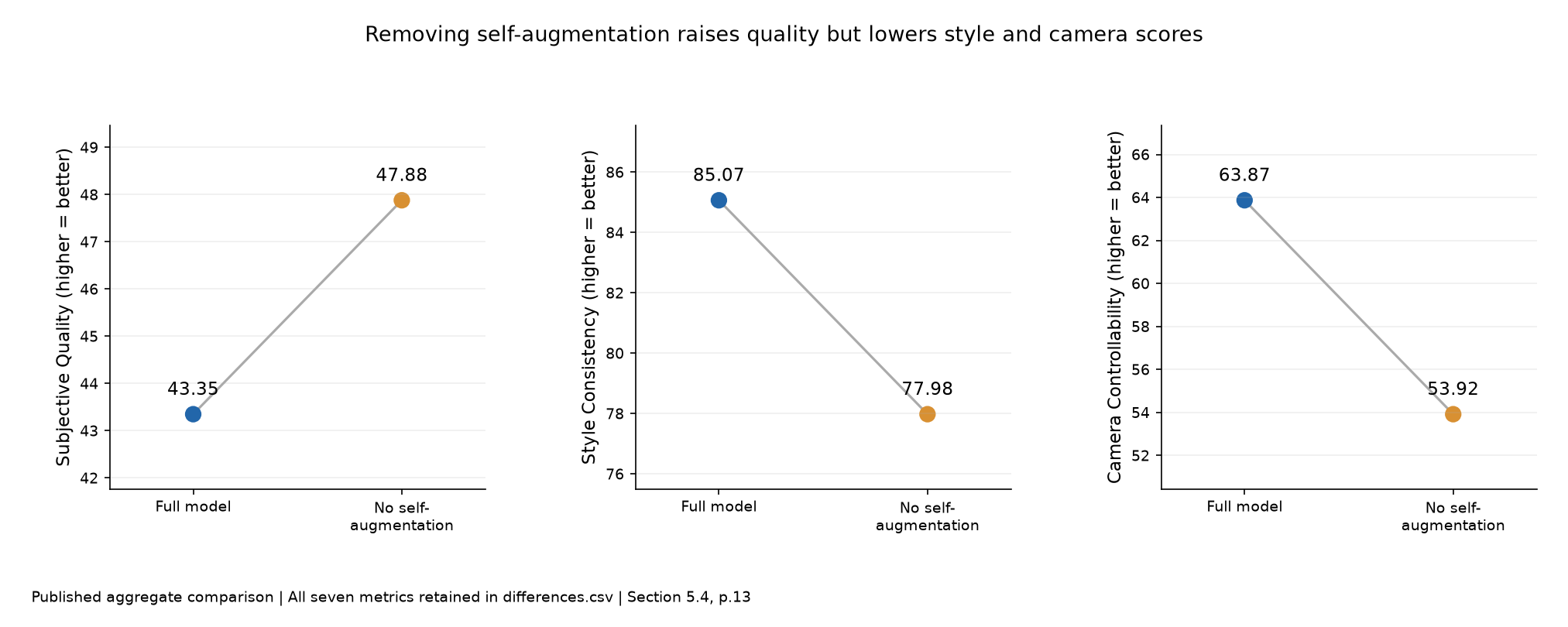
Subjective Quality rises from 43.35 to 47.88, a gain of 4.53 score units on the WorldScore measure used in the paper (Table 3 and Section 5.2, 2026). Style Consistency falls by 7.09 points and Camera Controllability by 9.95 points in the same comparison (AIPOCH case analysis, 2026).
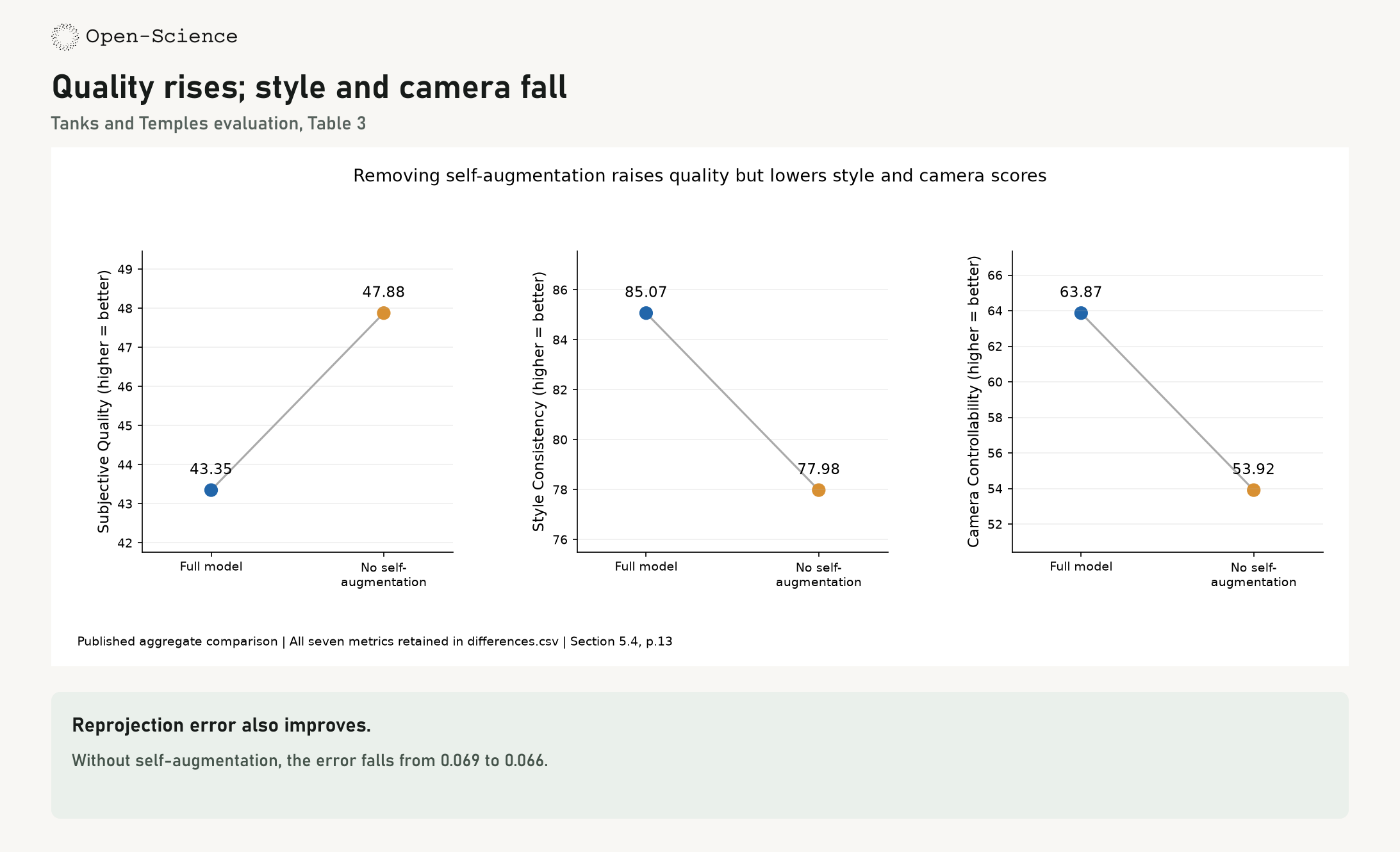
Figure 1. Blue marks the full model and orange the variant without self-augmentation. Each panel has its own scale. Outside these three panels, reprojection error falls from 0.069 to 0.066, a favorable change because lower is better. Full-size chart.
“Better pictures” has a narrow meaning here. The gain belongs to Subjective Quality alone among the image-quality scores. SSIM drops by 0.021, LPIPS rises by 0.016 and FID rises by 3.82. All three changes go in the unfavorable direction.
The authors attribute the decline in style and camera scores to the model encountering imperfect earlier frames at inference time without having learned to handle them during training. Section 5.4 leaves the favorable reprojection result unexplained. The five aggregate rows give no measure of how much those differences vary across scenes or repeated runs. Lyra 2.0, Section 5.4.
One metric changes the comparison between two configurations
Explicit Correspondence Fusion scores better than Global Point Cloud on quality, style and camera control, but extending the comparison to all seven metrics removes its advantage under a rule that requires one configuration to match or beat the other on every metric and improve on at least one.
Across the five configurations, only this pair satisfies the rule using the three selected scores (case comparison, 2026). Of the four added metrics, SSIM, LPIPS and FID also favor Explicit Correspondence Fusion, while reprojection error favors Global Point Cloud at 0.067 versus 0.071 (Table 3, 2026).
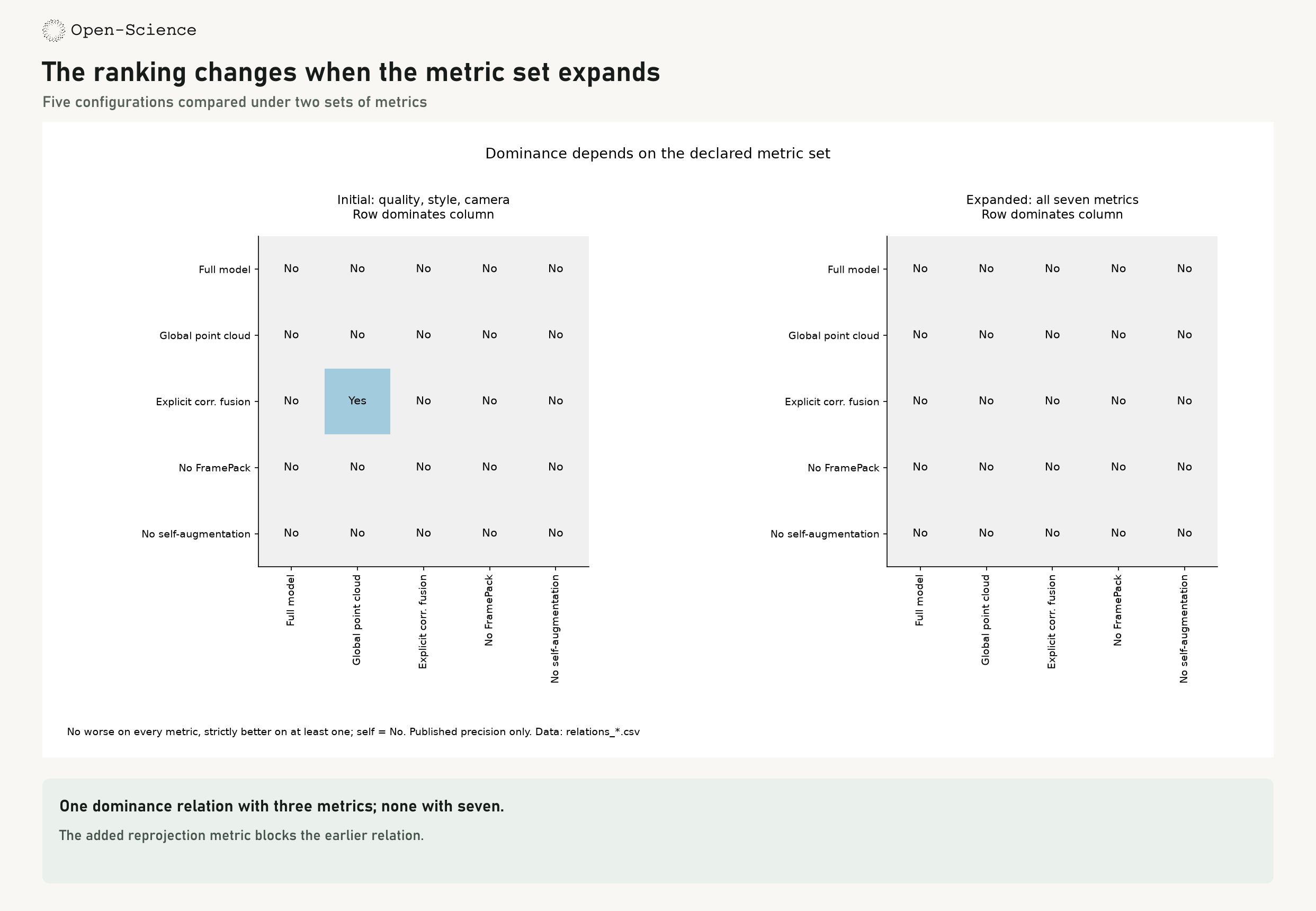
Figure 2. Read each row against each column. The single “Yes” on the left disappears on the right when reprojection error enters the comparison. Full-size matrices.
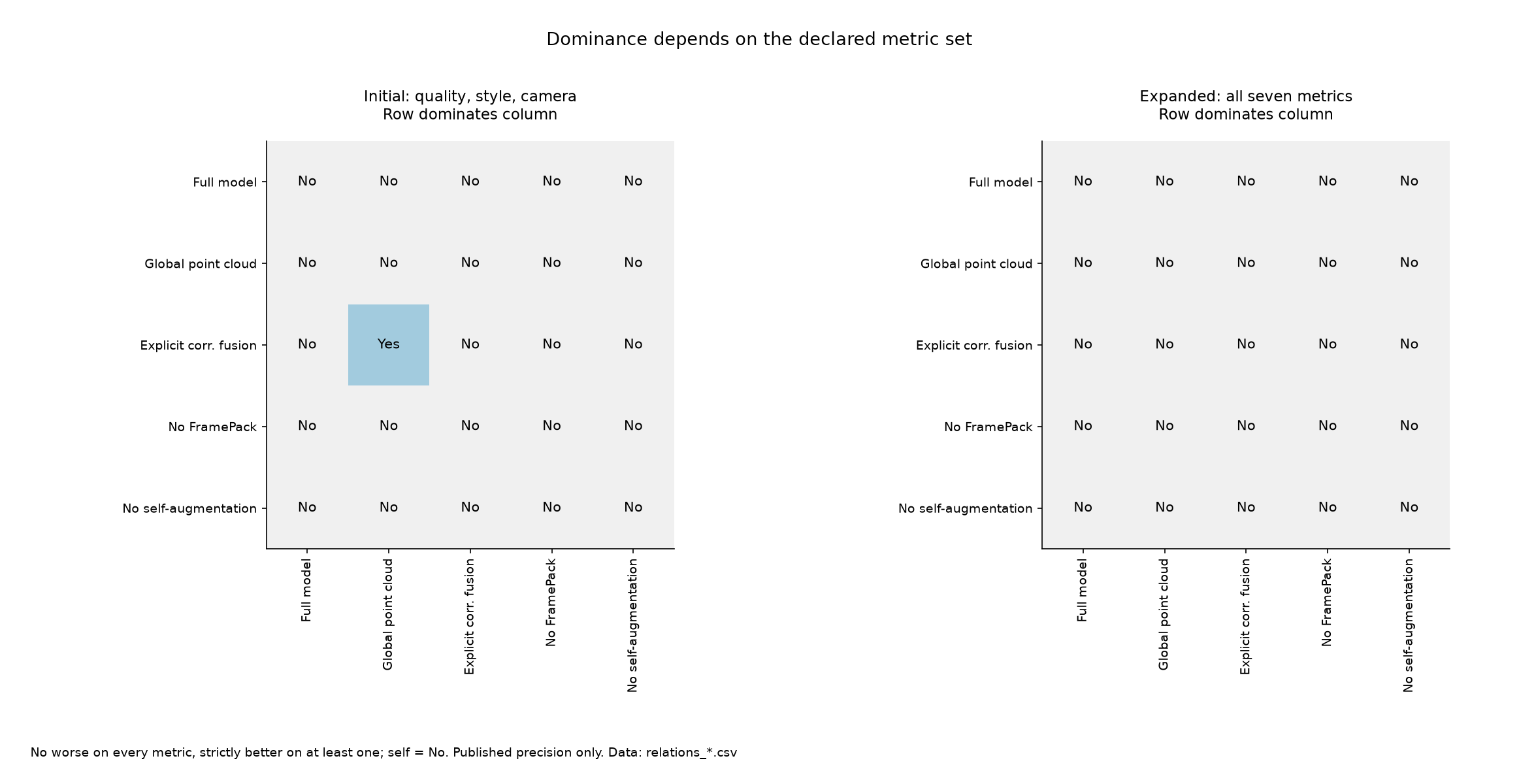
The seven-metric comparison leaves zero qualifying pairs. To choose between the two configurations, a researcher would have to decide how much reprojection error matters for the intended walkthrough. The table supplies the scores and leaves that decision open.
Trace the result in AIPOCH Open-Science
The shortest route through the Lyra case is to open the report in the final ZIP, follow the two self-augmentation rows back to the paper, then inspect the saved comparison that identifies exactly which metric disqualifies Explicit Correspondence Fusion when the analysis expands to seven metrics.
The 2026 case includes lyra_verified_package.zip with the report and numerical outputs. Import opens a read-only session, and Fork to continue creates a writable copy for a new analysis in the desktop app (AIPOCH Open-Science package guide, 2026).
- Download the
.sciencepackage from the case page and import it into an Open-Science project. Openlyra_verified_package.zip, extract it, and start withreport.md. - Compare
lyra_table3_published.csvwith Table 3. Inself_augmentation_all_metrics.csv, read each difference as variant minus full model. The broader variant comparisons are indifferences.csv. - Find the Explicit Correspondence Fusion row and Global Point Cloud column in
relations_initial.csvandrelations_expanded.csv. Openchanged_pair_witnesses.csvto see the two reprojection values responsible for the change.
Questions about the case
Is 47.88 the percentage of viewers who preferred the pictures?
It is a WorldScore Subjective Quality score. The case records no new viewer preference test.
Does a lower reprojection error mean the camera followed its path more accurately?
The paper measures those properties separately. Its reprojection metric uses estimated per-frame depth, while Camera Controllability measures pose accuracy.
Does opening the package rerun Lyra?
Import lets you inspect the sender's saved calculations and verification records. New computation requires a separate run. Package guide.