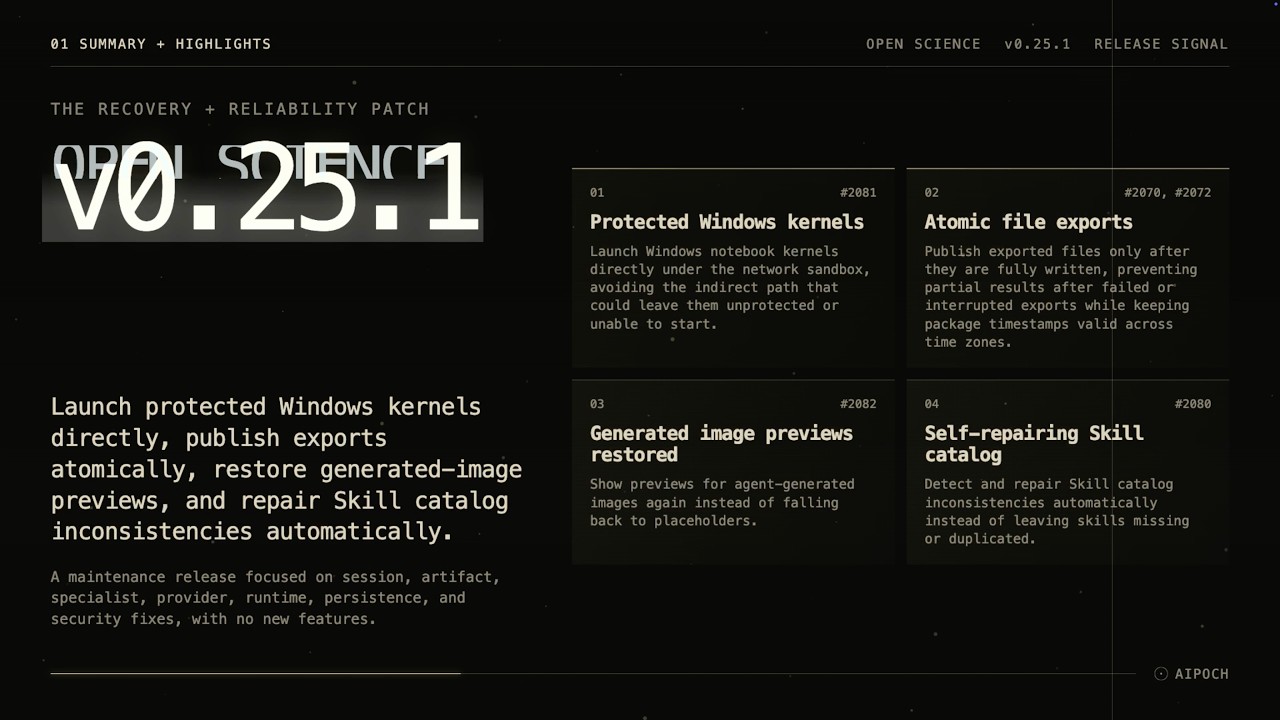
Open Science v0.25.1 is a maintenance release focused on safer runtime startup, dependable exports, restored previews, and recovery across everyday research workflows.
Open Science is an open-source, local-first, model-agnostic, self-hosted AI research workbench for reproducible scientific discovery. It is developed by AIPOCH.
What new capabilities help researchers work more reliably?
Protected Windows notebook kernels
Windows notebook kernels previously depended on an indirect launch path that could leave them unprotected or unable to start. v0.25.1 launches them directly under the network sandbox, so Windows users can start notebook work within the intended runtime boundary described in the Open Science documentation and source repository.
Atomic, time-zone-safe file exports
Interrupted exports could leave partial files behind, while package timestamps could become invalid across time zones. Exports now publish only after the file is fully written, and package timestamps remain valid when shared across environments.
Restored generated-image previews
Agent-generated images now render their previews again instead of falling back to placeholders. This makes visual outputs easier to inspect from the research session.
Self-repairing Skill catalog
Catalog inconsistencies can make Skills appear missing or duplicated. Settings now detects and repairs those inconsistencies automatically, helping the local catalog return to a usable state.
What else is new in v0.25.1?
This patch release adds no new features. It concentrates on recovery and reliability across sessions, artifacts, specialists, providers, persistence, and workspace lifecycle handling. For broader capability context, see the Open Science product overview.
Bug fixes that affect daily use
Notebook and compute: Session concurrency limits persist across restarts; failed artifact finalization can be retried; and stale runtime-selection contracts no longer block kernel startup.
Files and artifacts: PDF reading context keeps the logical file identity when an underlying file is replaced, and session detail edits no longer overwrite one another with stale data.
Sessions and persistence: Stale session-recovery combinations normalize on startup, queued Task turns are admitted before persistence, and cleanup can recover after a deletion failure.
Agents and providers: Finalized Claude model-call usage is recovered into usage statistics, CodeBuddy preserves empty command arguments on Windows, and interrupted Specialist packages recover with clear source guidance.
Workspace and settings: Renderer lifecycle listeners are cleaned up over long sessions, alongside the Skill catalog repair described above.
Install or update
Open Science v0.25.1 supports macOS 12+ on Apple Silicon or Intel, Linux x64, and Windows 10/11 x64. Download the appropriate installer from the official v0.25.1 release page. Existing installations can update in place.
Resources
- Open Science v0.25.1 release notes
- Open Science product page
- AIPOCH
- Open Science source repository
- Open Science v0.24.0: Network Boundaries, Shared Credentials, and Faster Project Switching
- Open Science v0.23.0: PDF Evidence, Live Notebook Variables, and Safer Storage
- How to Organize a Research Project in Open Science
FAQ
What is Open Science v0.25.1?
It is a patch and maintenance release with no new features, focused on runtime protection, export integrity, preview rendering, and recovery fixes.
Which platforms are supported?
The release supports macOS 12+ (Apple Silicon or Intel), Linux x64, and Windows 10/11 x64.
What changed for Windows notebook users?
Windows kernels now launch directly under the network sandbox, avoiding the previous indirect path that could fail or leave the kernel outside the intended protection boundary.
Are interrupted exports safe to retry?
Yes. Files are published atomically only after they are fully written, so an interrupted export does not leave a partial result at the published path.
Does the Skill catalog sync to a hosted public service?
No. Skills remain local in v0.25.1; the fix repairs local catalog inconsistencies by detecting missing or duplicated entries.
Disclaimer
Open Science assists researchers with AI-supported workflows and computation. It does not replace scientific judgment, domain expertise, or peer review.