OpenAI Prism vs. AIPOCH Open-Science: Scientific Writing Workspace or Research Workbench?
Compare OpenAI Prism and AIPOCH Open-Science across scientific writing, research execution, model choice, data handling, provenance, collaboration, and team fit.
Introduction
OpenAI Prism and AIPOCH Open-Science solve adjacent research problems, so the right choice depends on where your work is most constrained. OpenAI Prism is a cloud, AI-native workspace built around scientific writing, LaTeX documents, citations, equations, figures, and collaboration. AIPOCH Open-Science is an open-source, local-first, model-agnostic AI research workbench for connecting literature, files, models, code execution, scientific data, artifacts, and review.
That distinction matters because “AI for science” is not one product category. A manuscript editor can make writing and collaboration easier without becoming a computational research environment. A research workbench can make analysis and provenance easier without replacing a collaborative LaTeX editor. Treating the two products as interchangeable leads to the wrong evaluation criteria.
This comparison uses public product documentation and release notes checked on September 18, 2026. It is a research-based comparison, not a claim of hands-on testing inside a Prism account. The goal is to help a researcher or team choose an operating model, then show where AIPOCH Open-Science fits when the work extends beyond the manuscript.
Key Takeaways
- Choose OpenAI Prism when the manuscript, LaTeX project, and real-time collaboration are the center of the work.
- Choose AIPOCH Open-Science when the center of gravity is research execution: files, code, scientific data, model choice, artifacts, and inspectable provenance.
- AIPOCH Open-Science is a broader workbench and a possible Prism alternative for execution-heavy research, but it is not a one-to-one replacement for Prism’s collaborative LaTeX experience.
- A team can use both as separate layers, with an explicit handoff from verified research outputs to manuscript production.
OpenAI Prism and AIPOCH Open-Science at a glance
| Decision area | OpenAI Prism | AIPOCH Open-Science |
|---|---|---|
| Primary job | Scientific writing and collaboration | Reproducible research execution and inspection |
| Main work object | A shared LaTeX manuscript and its related files | A research project containing inputs, execution, artifacts, and review records |
| AI interaction | Editor-native assistance inside the document | Scientific agents operating across files, tools, code, and data sources |
| Model approach | OpenAI models integrated into the Prism experience | Model-agnostic routes, subject to the selected framework and provider compatibility |
| Literature context | Search and incorporate literature in the manuscript workflow | Literature Library, references, PDFs, collections, project links, and research analysis |
| Code and data execution | Not the product’s stated center of gravity | Python and R execution, notebooks, connectors, and research artifacts |
| Provenance | Document and collaboration context | Inspectable project records, replayable verification, artifacts, and review scope |
| Collaboration | Built around shared projects and collaborators | No multi-user real-time collaboration in the current release; collaborative workflows remain a roadmap area |
| Deployment posture | Cloud workspace | Local-first desktop workbench for macOS, Windows, and Linux |
| Best fit | Writing, revising, equations, citations, figures, and team manuscript work | Evidence-heavy, computational, multi-step, model-flexible research workflows |
The table is a decision aid, not a feature-count contest. OpenAI’s official launch post describes Prism as a free, AI-native workspace for scientists to write and collaborate on research, built on a cloud-based LaTeX foundation. The current Help Center describes an editor-native assistant that works with document context and is available to eligible personal ChatGPT accounts (OpenAI, Introducing Prism; OpenAI Help Center, Troubleshooting and Getting Help in Prism).
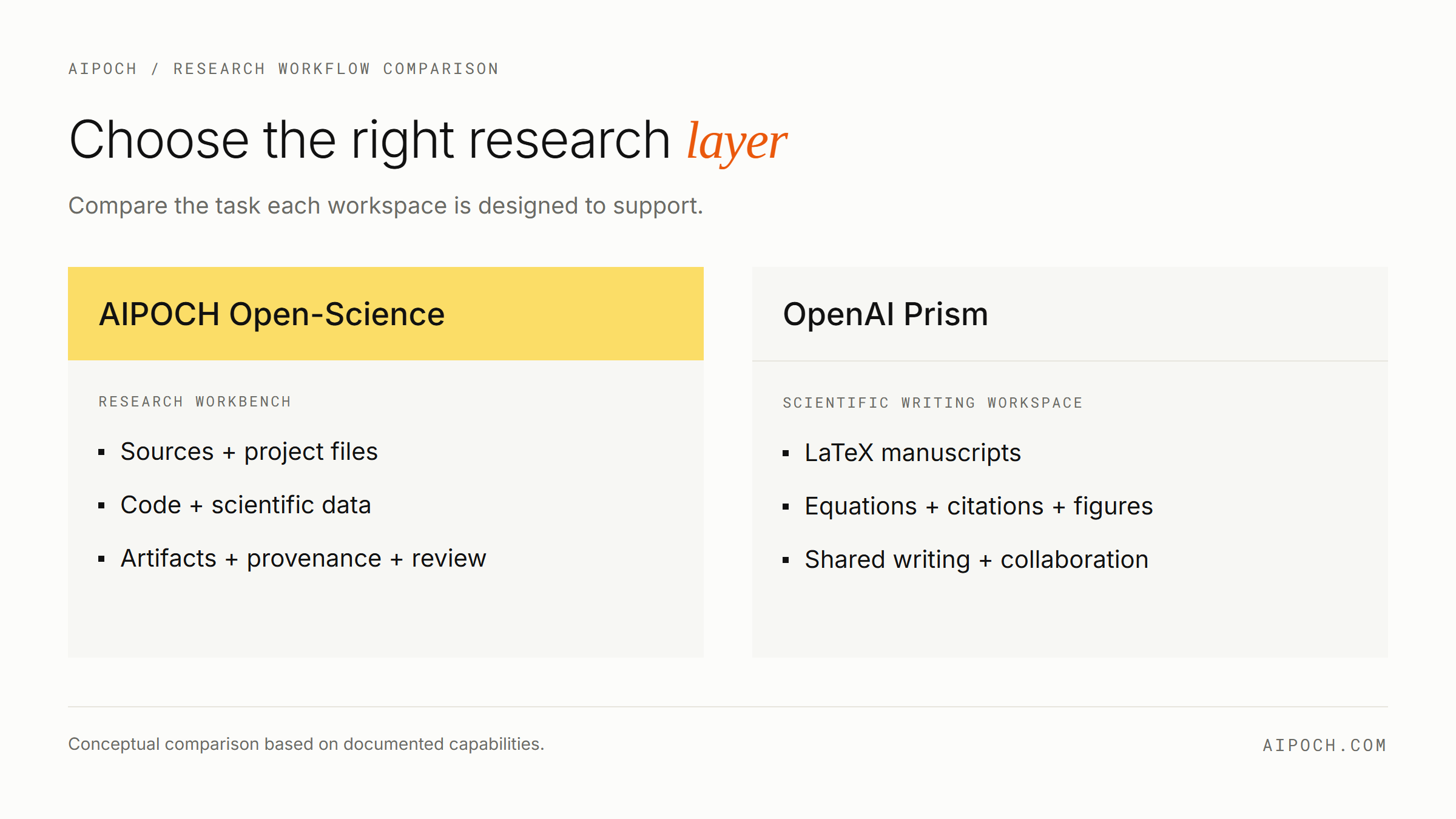
Conceptual comparison of documented product scopes; this is not a product screenshot or a performance test.
The AIPOCH Open-Science v0.30.2 release describes the product as an open-source, local-first, model-agnostic AI research workbench with scientific agents, Python and R execution, connectors, and cross-platform support. Its documented limitations include the absence of multi-user real-time collaboration and the fact that provider choice remains constrained by the selected framework.
What is OpenAI Prism, and what is it best at?
OpenAI Prism is an AI-assisted LaTeX workspace for scientific writing and collaboration. Its manuscript context includes text, equations, citations, and figures. The editor-native assistant helps with revisions and LaTeX errors.
If you arrived through a search for “ChatGPT Prism” or “Prism OpenAI,” the product covered here is OpenAI's Prism workspace. OpenAI's current access guidance describes eligible ChatGPT accounts; those search phrases should not be read as separate product tiers.
That makes Prism a natural fit when researchers already have their analysis outputs and need to develop a shared manuscript. This comparison focuses on a further decision: whether the team also needs AIPOCH Open-Science to organize the inputs, execution, and research artifacts behind that paper. It does not evaluate general LaTeX editors or claim that a workbench replaces collaborative typesetting.
What AIPOCH Open-Science adds beyond the manuscript
AIPOCH Open-Science is strongest when the research process itself must remain inspectable. A project can bring together references, uploaded files, scientific data sources, model routes, agent work, Python or R execution, generated tables and figures, and review records. The manuscript may be one output, but it is not the only object that matters.
The current AIPOCH Open-Science release supports a local-first workflow across macOS, Windows, and Linux. The official repository describes scientific agents that can read files, search the web, run code, query scientific data sources, and produce reports, tables, and figures with traceable provenance. The release notes also document replay behavior for notebook turns, record-scoped review, literature retraction checks, and connector-specific validation.
This architecture changes the evaluation question. Instead of asking only, “Can the AI improve this paragraph?”, a research team can ask:
- Which source files and references were available when the result was produced?
- Which model route and tools were used?
- Can the code and artifacts be inspected by another researcher?
- Can the team re-run a bounded step and verify what changed?
- Can sensitive work remain in a local-first environment while external calls are controlled?
These are the questions that make AIPOCH Open-Science a broader OpenAI Prism alternative for execution-heavy research. They also explain why it should not be marketed as a like-for-like replacement for Prism’s collaborative LaTeX editor.
Which product fits computational and data-intensive research?
AIPOCH Open-Science has the clearer fit when analysis, code, and scientific data are part of the daily workflow. Its workbench model connects the research question to executable steps and durable outputs. Python and R execution, literature tools, scientific connectors, and artifact records belong to the same project context.
OpenAI Prism can still be useful in this setting as the place where a team turns validated findings into a paper. The distinction is operational: Prism keeps the manuscript coherent, while AIPOCH Open-Science keeps the research path that produced the manuscript inspectable.
For example, a genomics team may need to import a reference set, query a database, run an analysis, compare intermediate tables, review a figure, and retain the reasoning that led to a result. In AIPOCH Open-Science, those steps can be organized as a project workflow with explicit inputs and artifacts. The final figure and methods text can then move into a Prism manuscript when the team needs collaborative LaTeX editing. That handoff should be treated as a deliberate boundary; the products do not automatically share project state or provenance.
Model choice and platform control
AIPOCH Open-Science offers more control over the model and execution layer, while Prism offers a more integrated OpenAI experience. AIPOCH describes itself as model-agnostic, but its current release notes qualify that claim: provider choice depends on the active framework’s endpoint compatibility, and the product does not yet provide a unified model gateway. A team should verify the provider, protocol, credentials, and environment required for the intended workflow.
Prism’s advantage is consistency. The AI assistant is built into the writing environment, so a researcher does not need to decide which backend to configure before asking for a revision or a LaTeX diagnosis. The trade-off is that the team accepts the product’s cloud operating model and the models available through that experience.
This difference is especially important for organizations with procurement, data residency, or model governance requirements. “Model-agnostic” does not mean every model is available in every configuration, and “cloud workspace” does not by itself explain every data boundary. The decision should follow a documented data-flow review rather than a generic privacy label.
Data handling, provenance, and review
The two products make different trust assumptions. OpenAI’s Prism Help Center states that Prism does not currently use the Zero Data Retention API option and keeps logs for a period after requests to improve the product. Teams working with unpublished or regulated material should read the current OpenAI documentation and apply their own data approval process before using the service.
AIPOCH Open-Science’s local-first design gives a team more control over where the desktop workbench, files, notebooks, and artifacts are maintained. That does not mean every operation is automatically local or that the whole computer becomes isolated. The current release notes distinguish the app’s notebook and compute sandbox from the wider system, require HTTPS for remote endpoints, and describe reviewer and replay guarantees as bounded rather than full-session equivalence.
The practical question is not which product has a universal privacy winner. It is which data-flow and provenance model matches the work. Prism can be the right choice for collaborative manuscript content that an organization has approved for its cloud workspace. AIPOCH Open-Science can be the right choice when a team needs local-first project control, explicit execution records, and a path to inspect or verify research artifacts.
AIPOCH Open-Science workflow for a Prism-oriented team
Teams that like Prism’s writing experience do not need to force one product to do every job. A bounded workflow can separate research execution from manuscript collaboration:
- Define the research question in an AIPOCH Open-Science project. State the scope, expected output, and review criteria before asking an agent to act.
- Attach references and research files. Record the sources, versions, and permissions that the analysis is allowed to use.
- Select a supported model route and execution environment. Check provider compatibility, credentials, Python or R requirements, and any remote compute boundary.
- Run the analysis and inspect the artifacts. Review tables, figures, logs, and generated files instead of treating a narrative answer as the final result.
- Use replay or review where the task requires it. AIPOCH Open-Science v0.30.2 supports bounded notebook replay and opt-in, record-scoped review; these controls do not replace domain validation.
- Move verified outputs into the manuscript layer. Export the approved figures, tables, citations, and methods notes into Prism or another writing environment. Keep the research project as the provenance record.
This workflow keeps the roles clear. Prism owns the collaborative manuscript experience. AIPOCH Open-Science owns the execution path and the evidence needed to review it. If a team requires automatic, bidirectional synchronization between the two products, it should treat that as an integration project rather than an existing feature.
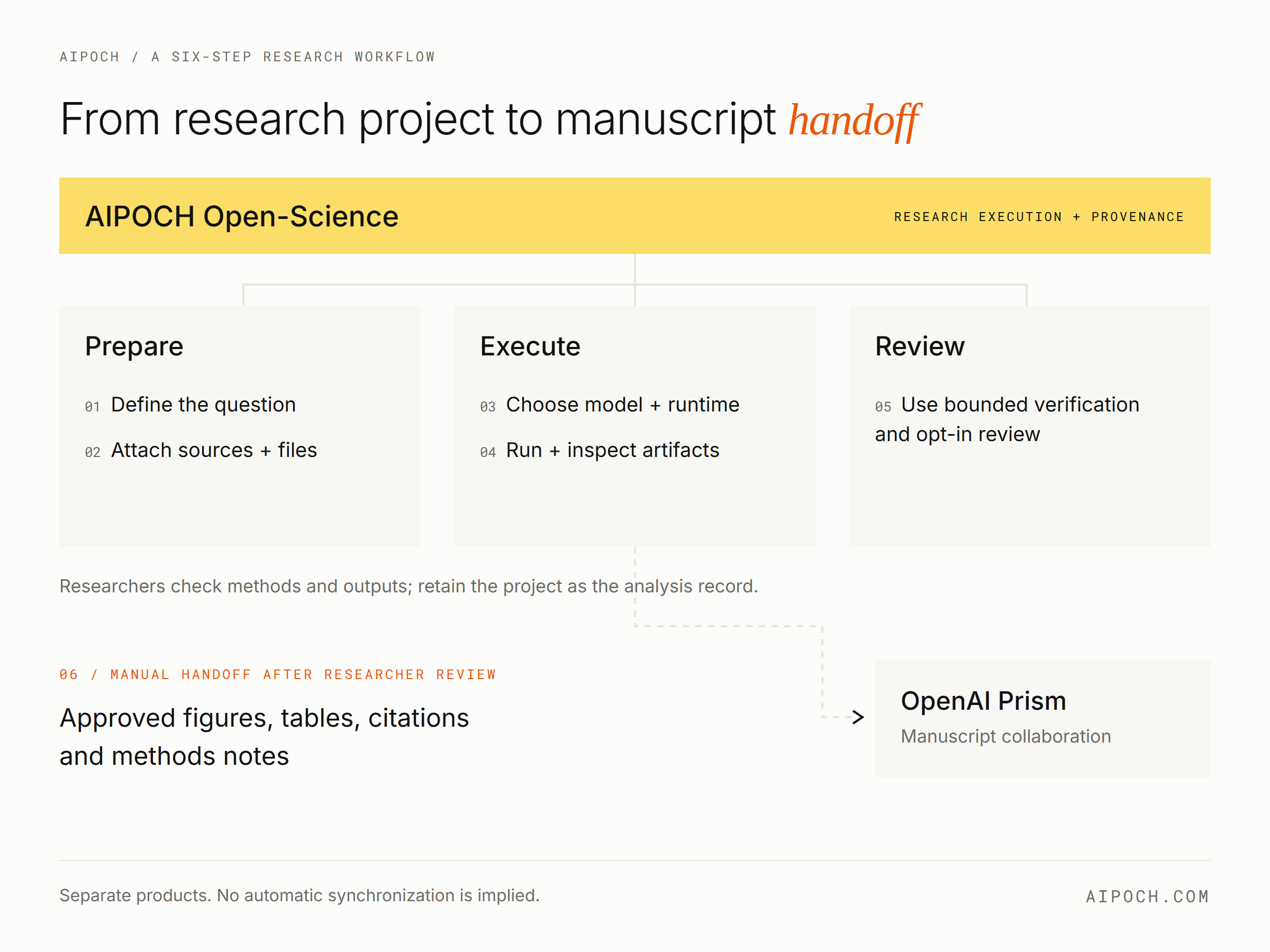
Illustrative workflow: researchers manually transfer approved outputs to the writing workspace. This does not imply a native integration or automatic synchronization.
Who should choose which?
Choose OpenAI Prism when:
- The immediate goal is to draft, revise, compile, and co-edit a scientific paper.
- The team already has its analysis environment and mainly needs a shared LaTeX workspace.
- An integrated OpenAI writing assistant is more valuable than switching between model providers.
Choose AIPOCH Open-Science when:
- The research involves code, data sources, literature, agents, and multiple intermediate artifacts.
- The team needs local-first project control and a model-flexible execution layer.
- Reproducibility, provenance, bounded replay, and review records are part of the research requirement.
Use both when:
- One group needs a durable research execution record and another group needs collaborative manuscript production.
- The team can define a clear handoff: verified artifacts and citations move into the manuscript, while the original project remains the source of truth for analysis.
Neither product should be selected because it has the longer feature list. Select the layer that matches the main failure mode in the current research process.
Frequently asked questions
Is AIPOCH Open-Science an OpenAI Prism alternative?
Yes, for teams looking for a broader AIPOCH Open-Science research workbench, especially when execution, data, model choice, artifacts, and provenance matter. It is not a one-to-one replacement for Prism’s cloud LaTeX collaboration experience. The two products overlap around AI-assisted research, but they organize the work around different primary objects.
Which is better for writing a scientific paper?
OpenAI Prism is the more direct fit when the paper and its LaTeX project are the center of the work. AIPOCH Open-Science is the stronger fit when the paper depends on a multi-step analysis that must remain inspectable. A team may use AIPOCH Open-Science for evidence and execution, then use Prism for collaborative manuscript production.
Can OpenAI Prism and AIPOCH Open-Science be used together?
Yes, as separate layers with an explicit handoff. AIPOCH Open-Science can produce reviewed artifacts, tables, figures, and provenance records; Prism can incorporate the approved outputs into a collaborative manuscript. This article does not claim a native Prism connector or automatic synchronization between the products.
Is OpenAI Prism local-first?
No. OpenAI describes Prism as a cloud-based LaTeX platform, and its Help Center documents cloud service behavior and log retention. A team with strict local-first or controlled-network requirements should evaluate AIPOCH Open-Science’s deployment and provider configuration instead.
Is AIPOCH Open-Science fully reproducible by itself?
It provides inspectable artifacts, bounded replay, and review controls, but AIPOCH Open-Science does not claim full-session replay or solver-exact equivalence in the current release. Researchers still need to validate methods, citations, units, statistics, and scientific conclusions.
Conclusion: compare the research layer, not just the brand
OpenAI Prism is a strong choice for manuscript-centered scientific writing and collaboration. AIPOCH Open-Science is a broader research workbench for teams that need to connect sources, models, code, scientific data, execution, artifacts, provenance, and review.
The best decision rule is simple: use Prism when collaborative LaTeX writing is the bottleneck; use AIPOCH Open-Science when the research process that produces the manuscript is the bottleneck. When both problems are real, define a clean handoff and let each product do the job it is built to do.
For a broader comparison of research workbench operating models, see Claude Science vs. AIPOCH Open-Science. To evaluate the current AIPOCH Open-Science release and platform requirements, start with the AIPOCH Open-Science repository.
Disclaimer
This article is intended for informational purposes only and does not constitute medical advice, clinical guidance, diagnostic recommendations, treatment decisions, or validated scientific conclusions. The product descriptions and workflow examples are based on public documentation; they do not represent a validated research finding or a guarantee of any particular result.
AIPOCH Open-Science is a research workflow tool. It does not replace researcher judgment, and researchers remain responsible for evaluating the accuracy, completeness, and appropriateness of any outputs generated. All outputs require independent verification and expert interpretation before use in research.
References and external links in this article are provided for informational purposes. AIPOCH does not endorse and is not responsible for the content of third-party sources.