Open Science v0.30.2: Dependable Windows R, Faithful Notebook Replay, and Cleaner Evidence
AIPOCH Open-Science v0.30.2 restores dependable Windows R runtimes, replays notebook inputs faithfully, keeps reviewer correction context, cleans up PubMed and Crossref literature evidence, tightens Ensembl, VEP, Reactome, OLS, CellGuide, UCSC, and gnomAD connectors, and adds DeepSeek V4.1 Flash to the model catalog.
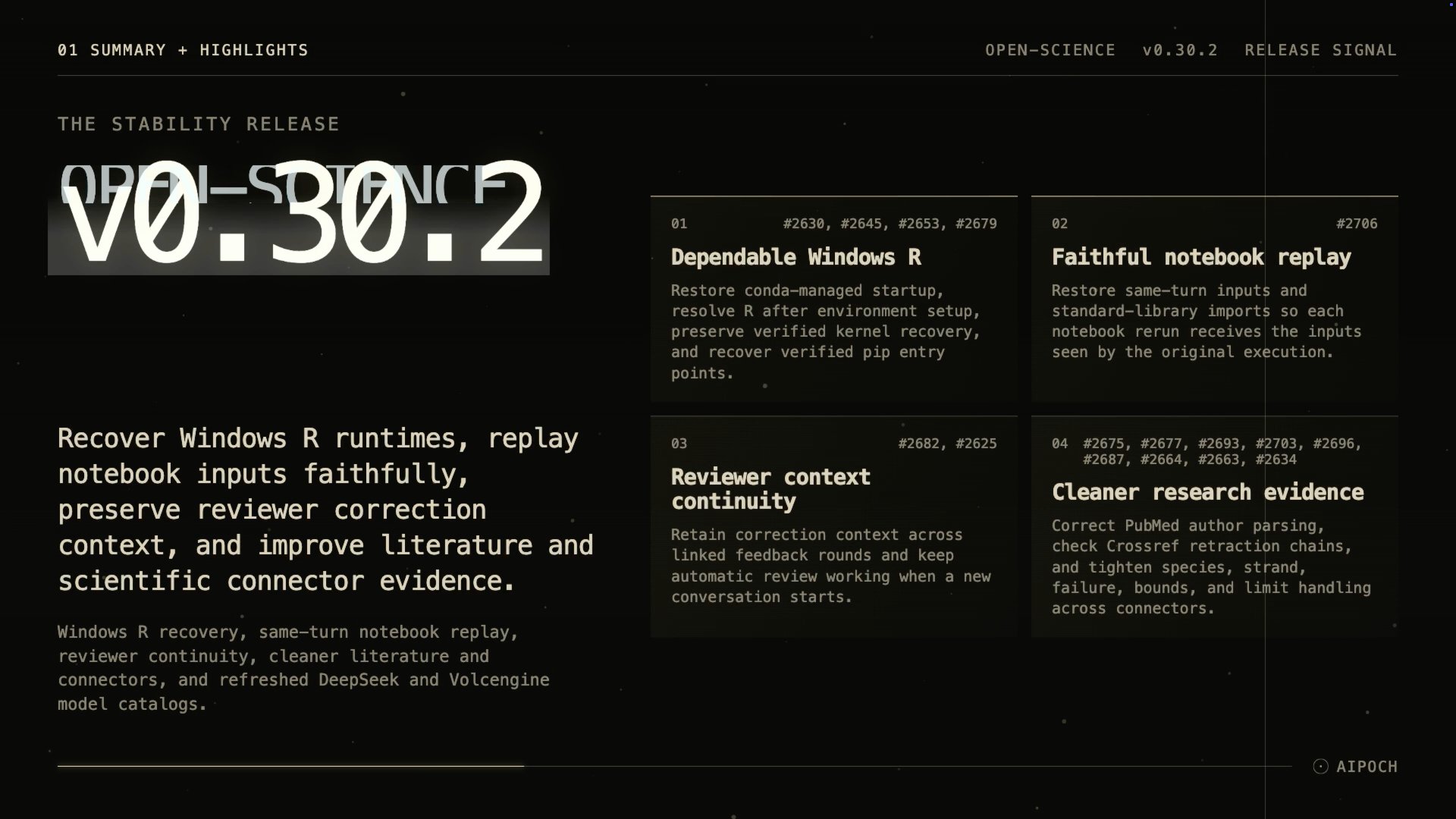
Open Science v0.30.2 is a stability release: Windows R recovers, notebook replay restores same-turn inputs, reviewer corrections keep context, and DeepSeek V4.1 Flash joins the catalog.
AIPOCH Open-Science is an open-source, local-first, model-agnostic AI research workbench developed by AIPOCH. It supports reproducible, inspectable research across models with scientific AI agents, Python and R execution, scientific data connectors, and cross-platform support for macOS, Windows, and Linux.
What new capabilities help researchers run Windows R, replay notebooks, and keep review context?
Version 0.30.2 does not add a new surface area. It hardens work that already ships, in four places where a small failure costs a researcher a long rerun or a lost correction.
Recover a working Windows R runtime
On Windows, a conda-managed R environment could start in a state where the interpreter was not resolved after environment materialization, and a verification check could not find the pip entry points it needed. Both failure modes surfaced as an environment that looked installed but would not run.
The v0.30.2 release restores conda-managed R startup on Windows with sandbox failures traced rather than silently discarded, resolves the R executable again after environment materialization, preserves execution and verified kernel recovery, and recovers verified Windows pip entry points for reproducibility checks.
For a Windows researcher, this means an R kernel that was set up once can be started again, and an environment that reports a failure now reports where the failure occurred. The workbench remains honest about its sandbox boundary: on Windows, network sandboxing applies to the notebook and compute runtimes only after the sandbox's one-time administrator setup.
Replay notebook turns with the inputs the original run saw
When a notebook turn was replayed, same-turn inputs and standard-library imports were not always restored, so a rerun could execute against a different set of names than the original run. That undermines the point of a rerun, which is to check the same computation.
Version 0.30.2 restores same-turn inputs and standard-library imports on replay, so a rerun receives exactly the inputs the original execution saw.
This supports reproducible execution rather than proving it. Verification in Open-Science checks a captured version of a run, not a whole session: full-fidelity session replay and solver-exact equivalence guarantees remain open, and starting a check from the web client currently requires the desktop app. Replayable per-version verification is the deterministic check; LLM-assisted code reconstruction is a separate, non-deterministic aid.
Keep reviewer correction context across linked feedback
Correction threads can span rounds. When a linked feedback thread lost its correction context between rounds, a reviewer had to restate what was already established before the next item could be assessed. Automatic review also stopped when a new conversation started, so continuity depended on the researcher remembering to carry it forward.
In version 0.30.2, linked feedback threads retain correction context between rounds, and automatic review survives starting a new conversation. Review is still opt-in and record-scoped, and it does not replace domain-specific validation of citations, units, statistics, or methods.
Read cleaner literature evidence from PubMed and Crossref
Author-string handling affected the reliability of imported records. PubMed imports now separate author surnames from initials, and author suffixes such as "Jr." are no longer read as initials. The release also checks retraction relationships recorded through Crossref's updated-by relationships, so a retraction update is inspected rather than dropped.
These are parsing and lookup corrections, not a claim about the scientific reliability of any record. Imported literature remains source material to verify, and a Crossref retraction chain surfaces a signal that still requires the researcher's reading.
Query Ensembl, VEP, Reactome, OLS, CellGuide, UCSC, and gnomAD more precisely
Connector results depend on whether the request was interpreted the way the researcher wrote it. Version 0.30.2 makes several of those interpretations explicit and validated: Ensembl lookups report the resolved species, VEP region queries are normalized to the forward strand, the requested Reactome species is honored and validated, OLS failures are preserved and relation pagination is validated, CellGuide data fetch failures surface correctly, and UCSC bounds are validated with gnomAD limits tightened.
The practical benefit is that a wrong species, a strand mismatch, or an empty result that should have been an error becomes visible instead of being read as a real answer. Returned records still require review in their research context.
What else is new in v0.30.2?
- DeepSeek V4.1 Flash joins the model catalog, and legacy session models are preserved across the update, so an existing session keeps working with the model it was recorded against. The Volcengine Ark lineup is refreshed alongside it. Available provider connections still depend on the active agent framework's endpoint compatibility, and remote endpoints must use HTTPS.
- Tab selection indicators animate smoothly, and literature tool cards are unified with expanded literature details.
- Side chats keep their application mount and no longer wait for main-turn readiness before being admitted, and delegated OpenCode subagents run in isolated runtimes.
- Queued CLI conversation snapshots reconcile, and no writes happen during passive conversation hydration.
- Specialist-bound runtime skills prepare correctly, the marketplace shows its source when authors are missing, and provisioned OpenCode skill references are readable.
- Native web search approval is remembered per conversation, Go session identity is included in provider probes, original image detail is normalized in the responses bridge, and Settings stays open when mobile navigation is dismissed.
Bug fixes that affect daily use
Notebook and compute. Windows conda R starts again with sandbox failures traced; the R executable resolves after environment materialization; execution and verified kernel recovery are preserved; same-turn inputs and standard-library imports replay; verified Windows pip entry points recover for reproducibility checks. Session bookkeeping is also reconciled: queued CLI conversation snapshots match again, and passive conversation hydration performs no writes.
Literature. PubMed author surnames and initials are separated, author suffixes are no longer treated as initials, and Crossref updated-by retraction relationships are checked.
Connectors. Ensembl lookups report the resolved species; VEP region queries are normalized to the forward strand; the requested Reactome species is honored and validated; OLS failures are preserved and relation pagination validated; CellGuide data fetch failures surface correctly; UCSC bounds are validated and gnomAD limits tightened.
Sessions and side chats. Side chats keep their application mount and admit independently of the main turn; delegated OpenCode subagents run in isolated runtimes.
Skills and marketplace. Specialist-bound runtime skills prepare correctly, the marketplace identifies its source when author information is missing, and provisioned OpenCode skill references are readable.
Permissions and settings. Native web search approval is remembered for the conversation; Settings stays open when dismissing mobile navigation; Go session identity is included in provider probes; original image detail is normalized in the responses bridge; undo stays above the settings panel; and contextual inline message layouts are restored.
Install or update
Open Science v0.30.2 supports macOS 12 or later on Apple Silicon and Intel, Linux x64, and Windows 10/11 x64. Download the matching DMG, AppImage, Debian package, or Windows installer from the release's Assets section. On first run, the onboarding wizard checks the environment and can install and configure an app-managed agent runtime. Once installed, the app can update itself in place.
Official macOS builds are Developer ID signed and notarized, so they open like other trusted applications; a locally built copy is not notarized. Windows builds are unsigned, so SmartScreen shows a bypassable "unrecognized app" prompt on first launch. Confirm that the package came from the official release page before continuing.
If you already run an R notebook on Windows, the useful test is to restart that kernel and rerun a turn to confirm the replay inputs match. For update-scope decisions, v0.30.0 added private bookmarks and agent access to extracted PDF elements, and v0.28.0 introduced replayable artifact verification.
Resources
- Open Science v0.30.2 release notes and downloads
- AIPOCH Open-Science source repository
- AIPOCH Open-Science product page
- AIPOCH
- AIPOCH Open-Science PDF reading and source-linked evidence
- How to extract figures and tables from research PDFs with AIPOCH Open-Science
- AIPOCH Open-Science v0.30.0: private bookmarks and extracted PDF elements
- AIPOCH Open-Science v0.29.0: carry research sessions between machines
FAQ
What is new in AIPOCH Open-Science v0.30.2?
Version 0.30.2 is a stability release. It restores dependable Windows R runtimes across startup, interpreter resolution, verified kernel recovery, and Windows pip entry points for reproducibility checks; restores same-turn inputs and standard-library imports on notebook replay; keeps reviewer correction context across linked feedback and across new conversations; corrects PubMed author parsing and adds Crossref retraction-chain checks; tightens Ensembl, VEP, Reactome, OLS, CellGuide, UCSC, and gnomAD connector behavior; and adds DeepSeek V4.1 Flash to the model catalog. See the official release notes for the complete list.
Does v0.30.2 fix R on Windows?
It addresses the failures that stopped a conda-managed R environment from running: conda-managed R starts again on Windows with sandbox failures traced, the R executable resolves after environment materialization, execution and verified kernel recovery are preserved, and verified Windows pip entry points recover for reproducibility checks. The workbench still distinguishes what it can verify: sandboxing covers the app's notebook and compute runtimes, and on Windows that boundary applies only after the sandbox's one-time administrator setup.
Does notebook replay now reproduce an entire session exactly?
No. Version 0.30.2 restores same-turn inputs and standard-library imports on replay, so a rerun receives the inputs the original execution saw. Verification in Open-Science checks a captured version rather than a whole session: full-fidelity session replay and solver-exact equivalence guarantees remain open, and starting a verification check from the web client currently requires the desktop app.
Which model changes ship in v0.30.2?
DeepSeek V4.1 Flash joins the model catalog, legacy session models are preserved across the update, and the Volcengine Ark lineup is refreshed. Provider choice remains per framework rather than one unified gateway: the available protocol depends on the selected agent backend, and remote endpoints must use HTTPS.
Which platforms support AIPOCH Open-Science v0.30.2?
The release supports macOS 12 or later on Apple Silicon and Intel, Linux x64, and Windows 10/11 x64. Installers are available from the v0.30.2 download page. Official macOS builds are signed and notarized; Windows builds remain unsigned, so SmartScreen may show a bypassable prompt on first launch.
Disclaimer
This article is intended for informational purposes only and does not constitute medical advice, clinical guidance, diagnostic recommendations, treatment decisions, or validated scientific conclusions.
AIPOCH Open-Science assists researchers with reading, organizing, executing, and inspecting research materials. It does not replace scientific judgment or peer review. Researchers remain responsible for checking original sources, literature records, extraction quality, methods, and the accuracy and appropriateness of any generated outputs.
References and external links are provided for informational purposes. AIPOCH does not endorse and is not responsible for the content of third-party sources.