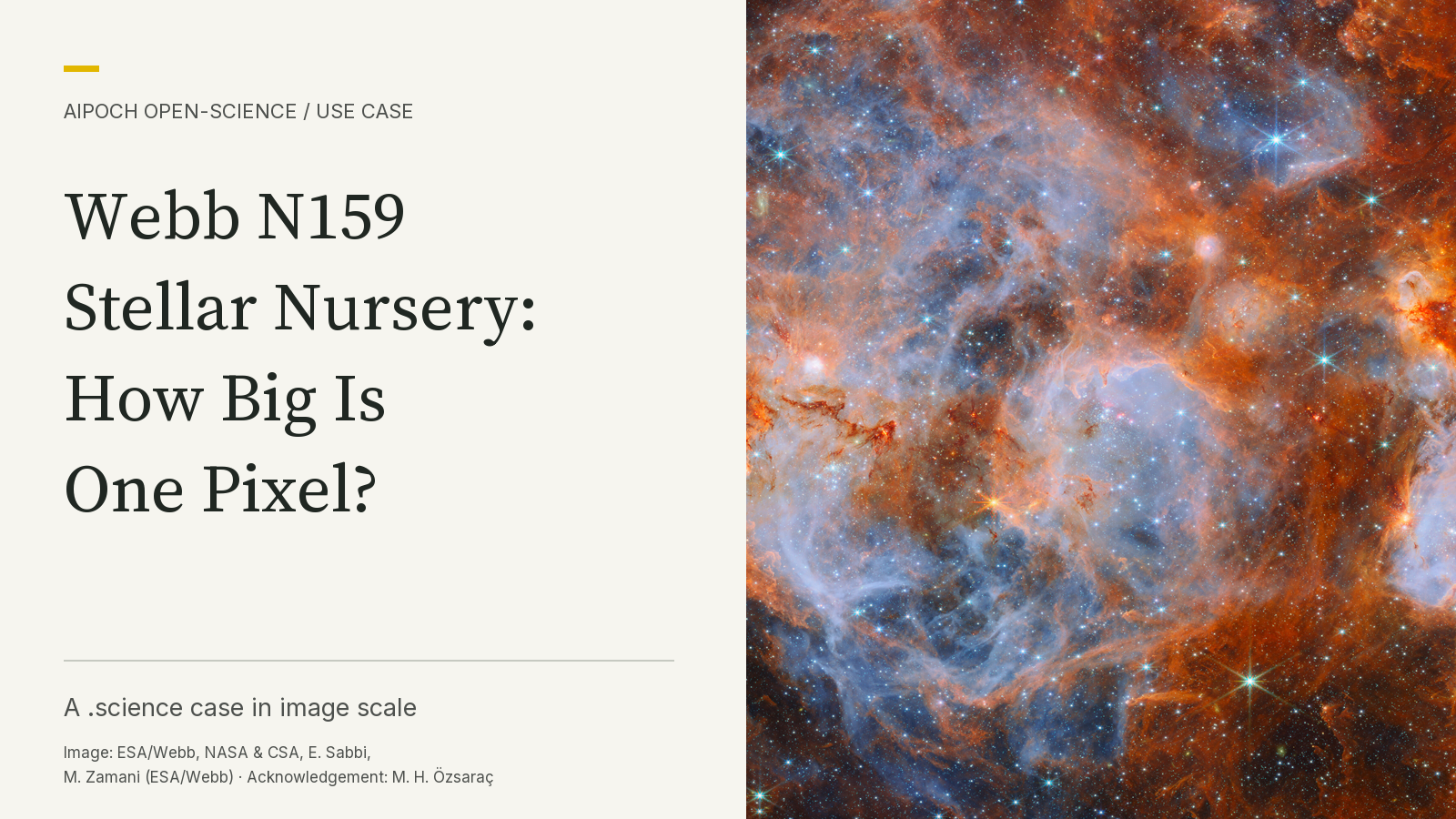
How much space does a single pixel in the Webb N159 stellar nursery image represent? The N159 case in AIPOCH Open-Science follows that question from image dimensions and sky coverage to a calculated physical scale. Its .science package brings together the inputs, calculations, figures, and recorded checks, so readers can trace the result and examine its assumptions.
The N159 image-scale result
One pixel in the N159 case's 4,000 × 2,667 JPEG represents about 0.0756 arcseconds or 0.0590 projected light-years along the horizontal axis, assuming the JPEG retains the complete released field and the adopted distance of approximately 161,000 light-years is appropriate.
The ESA/Webb N159 release (2026) lists a 5.04 × 3.36 arcminute field and an approximate distance of 161,000 light-years. The N159 case (2026) applies those inputs to the analyzed JPEG's 4,000-pixel width.
The calculation is 2 × 161,000 × tan(5.04 arcminutes / 2), with the angle converted to radians: about 236 light-years across. Dividing by 4,000 gives about 0.0590 light-years per pixel, or 21.55 light-days. The source description gives an approximate width of 230 light-years. The calculated value is about 2.6% larger; the record retains both estimates without assigning an unsupported cause to the difference.
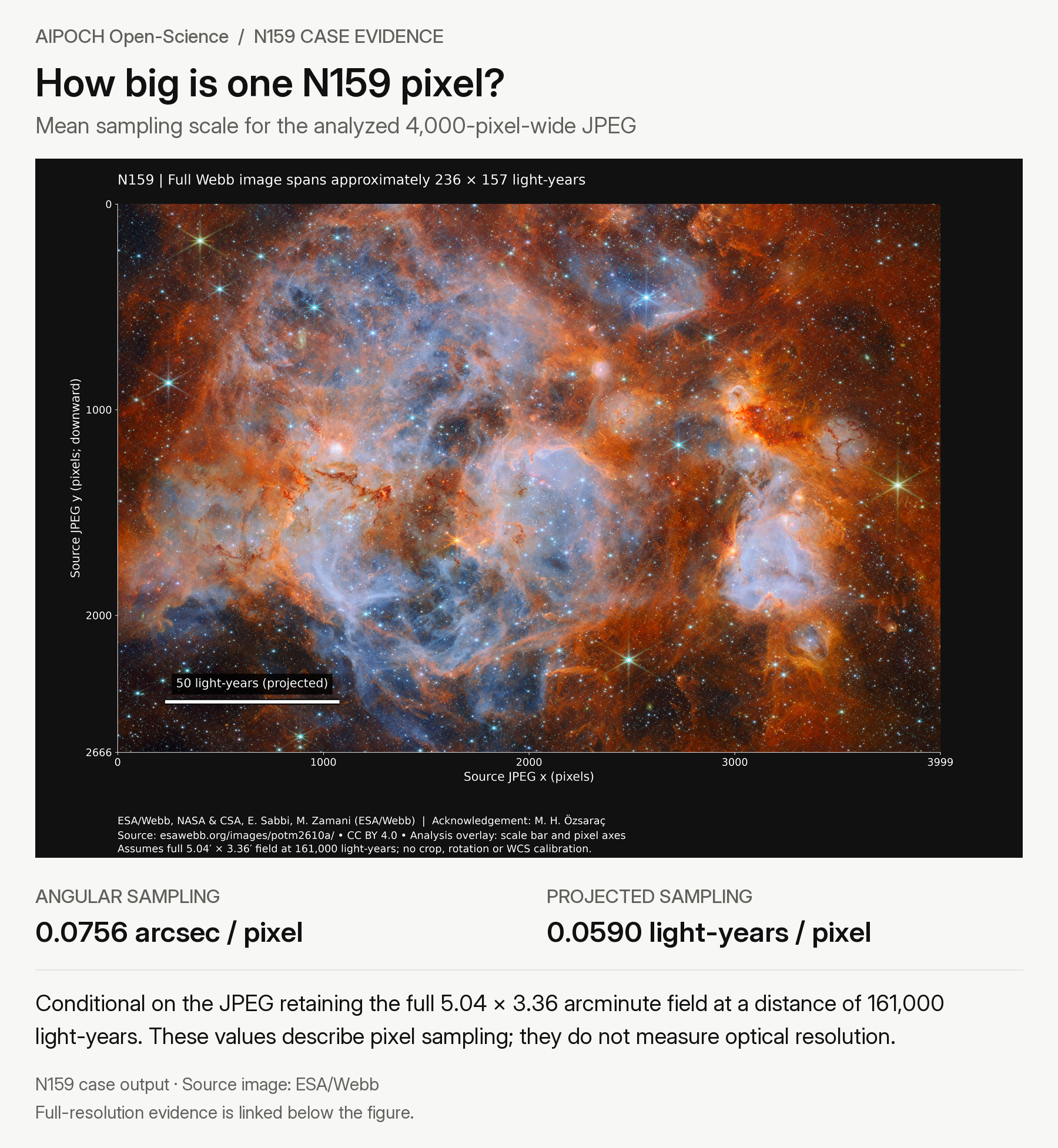
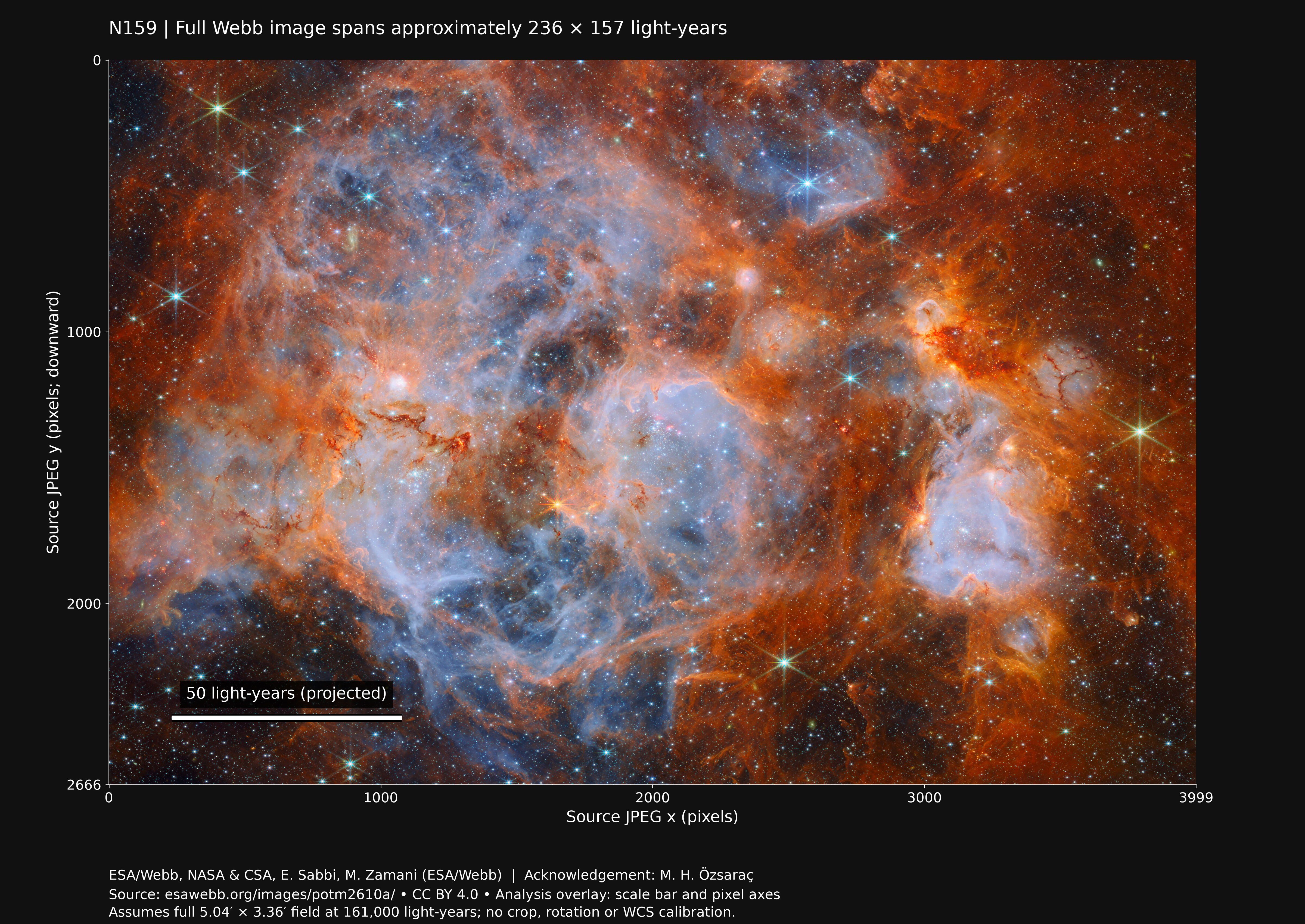
The case's full-image figure places a 50-light-year scale bar against the JPEG's pixel grid. The scale depends on the stated field and distance assumptions. Source image: ESA/Webb N159. View the original figure at full resolution.
The image dimensions matter because the metadata describes a 9,694 × 6,463 file, while the analysis uses a 4,000 × 2,667 JPEG. Different raster sizes do not by themselves show a calculation error or changed field of view. Establishing that the smaller copy retains the same complete field requires provenance beyond its dimensions. The final report keeps that condition explicit.
Sampling is not optical resolution
The N159 case compares the angular width assigned to a JPEG pixel with selected instrument point-spread-function widths to show why image sampling alone cannot establish the size of a star or which structures are resolved in the processed N159 composite.
The N159 analysis (2026) uses ten selected empirical full-width-at-half-maximum values from STScI's NIRCam PSF table. The case's recorded comparison (2026) expresses those reference widths as roughly 0.53–2.12 pixels on the analyzed JPEG grid.
To obtain that range, the case divides each reference angular width by 0.0756 arcseconds per horizontal JPEG pixel. The ratio compares an instrument reference with a sampling interval. It is not a fitted stellar diameter or a strict threshold for separating two stars. Combining observations, resampling and image processing can also affect apparent widths in the released composite.
What resizing can and cannot reveal
The N159 resizing comparison follows one crop from the analyzed JPEG through reduction and enlargement, showing how interpolation can smooth the displayed image without recovering detail discarded when blocks of the original JPEG samples were averaged into fewer stored pixels.
The ESA/Webb N159 release (2026) is the source image for the crop comparison. The recorded resizing workflow (2026) reduces a 400 × 264 crop to 100 × 66 using BOX averaging, then enlarges it back with bicubic interpolation.
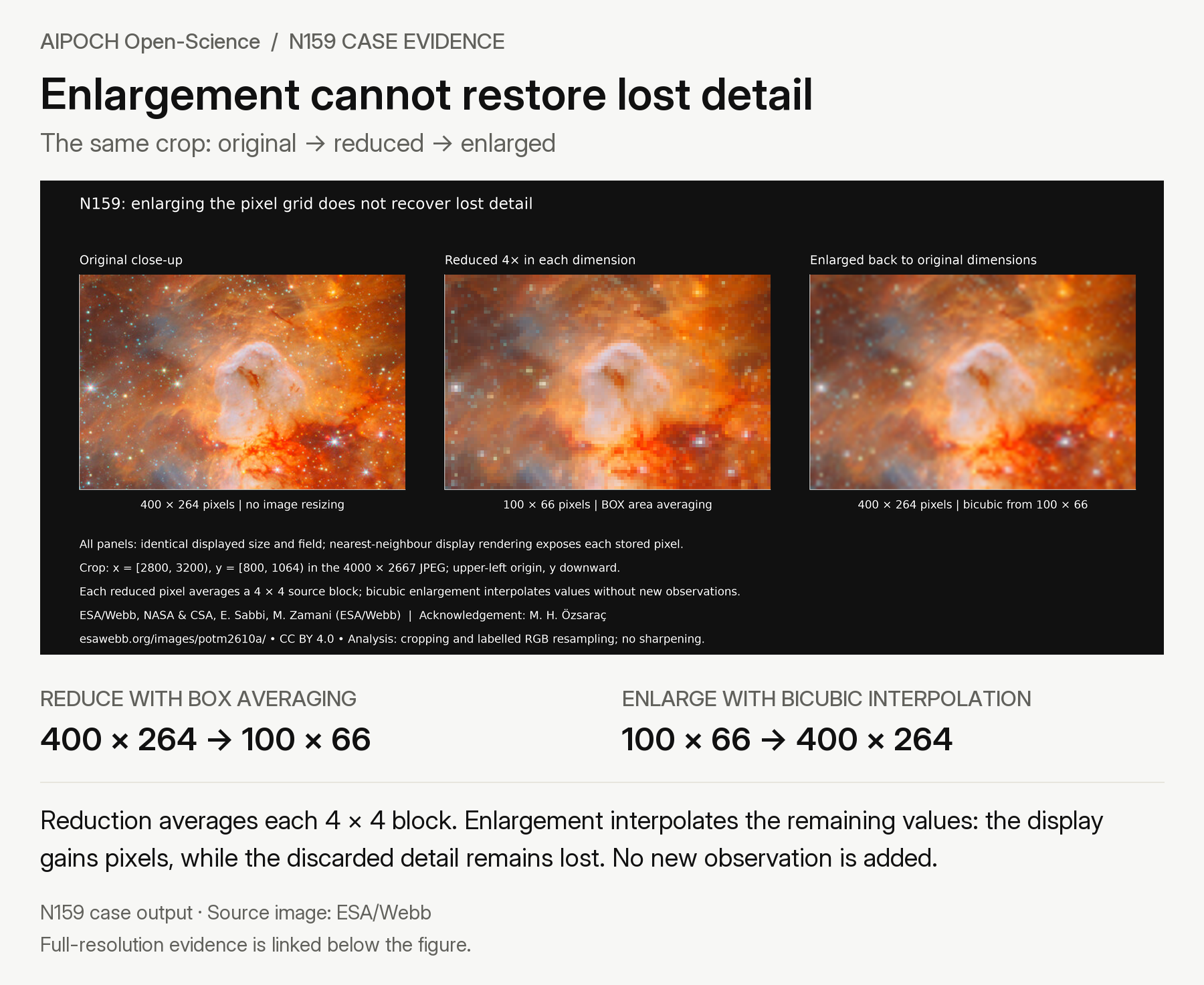
The same crop from the analyzed 4,000-pixel-wide JPEG: 400 × 264 pixels, reduced to 100 × 66, then enlarged back to 400 × 264. These are JPEG pixels, not native detector pixels. The enlargement smooths the reduced image without recovering discarded detail. Source image: ESA/Webb N159. View the original comparison at full resolution.
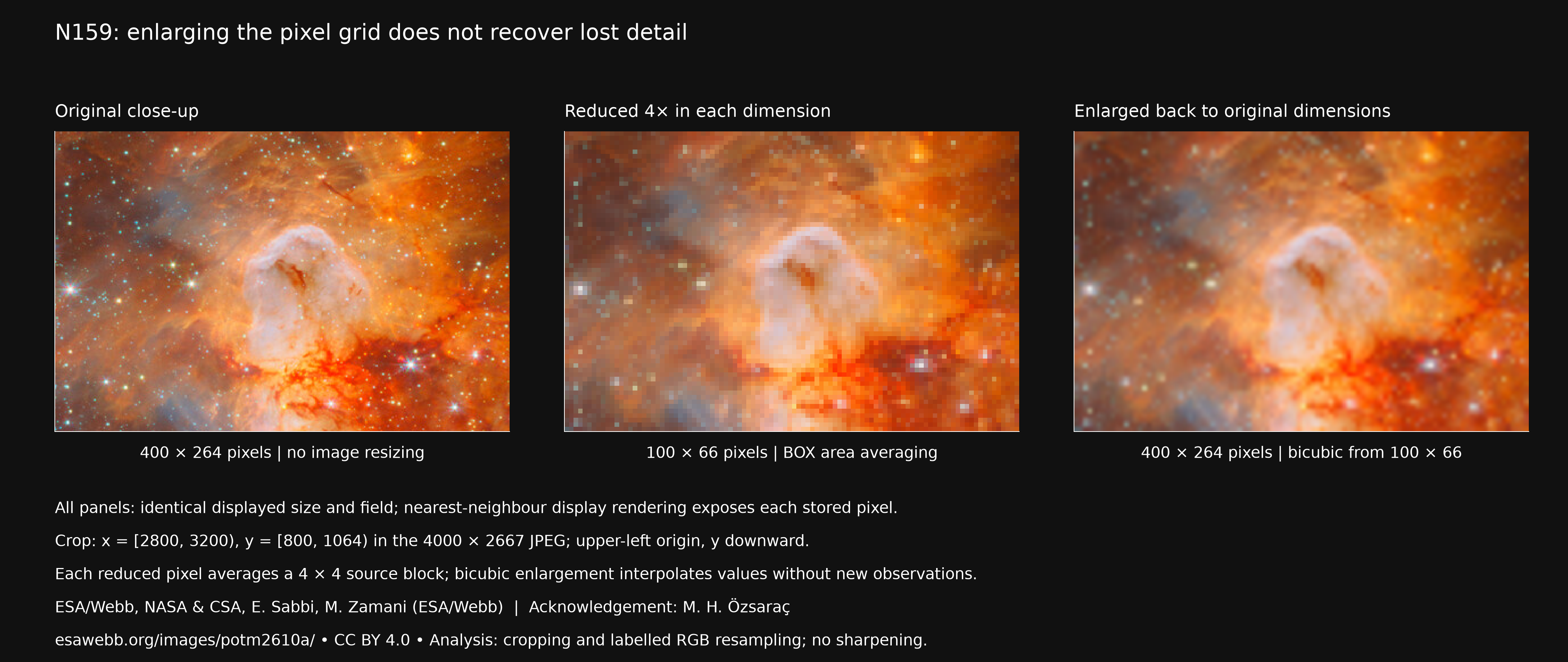
Each reduced pixel averages a 4 × 4 block, leaving one-sixteenth as many pixels. Bicubic enlargement estimates values between the remaining samples. The case's separate full-frame comparison demonstrates the corresponding scale change: a 1,920-pixel-wide copy retains the assumed overall field, so each stored pixel represents more sky.
Explore the .science evidence in AIPOCH Open-Science
AIPOCH Open-Science lets readers inspect the N159 case's inputs, report, figures and recorded checks in a read-only .science research record, then use the desktop app's Fork action to create a writable continuation with inherited files and separately configured execution permissions.
The published N159 case (2026) provides the package download and Open in Open-Science action. The official package guide, updated October 2026, describes desktop Fork continuation and states that Fork is unavailable in Web.
Start with the final report inside n159_verified_package.zip. The session also retains separate Artifacts from the analysis process. The standalone n159_report.md is an earlier version; use the copy inside the ZIP for the final report and file index.
| What to explore | Where to look |
|---|---|
| Final explanation, figures and file index | n159_verified_package.zip → n159_report.md |
| Image dimensions and scale calculation | Inside the ZIP: inputs/n159_image_metadata.json and n159_pixel_scale.csv |
| Final recomputation script and short check record | Inside the ZIP: n159_reproduce.py and n159_check_record.txt |
| Original analysis scripts and longer check record | Separate session Artifacts: n159_scale.py, n159_resize_comparison.py and n159_check_record.md |
Follow one question through the final report: Why does the calculation use 4,000 pixels rather than the 9,694 recorded in the metadata? Compare the input description with the pixel-scale table, then inspect the relevant calculation. The ZIP's reproduction script recalculates scales and resized arrays and assembles an overview from existing figure PNGs; it does not recreate every individual plot layout.
Import does not execute the archived code or restore credentials. A desktop Fork creates a writable continuation, but new calculations still need a configured runtime and appropriate permissions. Included files depend on export selection; Side Chat and private reading bookmarks are excluded. Received check records describe the sender's work, not a rerun on the receiving computer.
Quick questions
Is one N159 pixel really 0.0590 light-years wide? In the recorded calculation, approximately yes for the analyzed JPEG under its full-field and distance assumptions. A pixel is a sampling interval, not a physical square in the nebula.
What would a more precise physical pixel scale require? A verified field of view and pixel-to-sky mapping, together with uncertainty estimates for the source distance. Determining which structures are actually resolved additionally requires appropriate PSF and image-processing analysis.
Can I continue the analysis in Web? The official package guide directs readers to open the workspace in the desktop app and use Fork. Fork is unavailable in Web; viewing or importing a record does not make it writable.
Open the N159 case in AIPOCH Open-Science, import its .science package, and begin with the final report inside n159_verified_package.zip.
Evidence scope: This walkthrough examines the published N159 case and its archived outputs; the calculations were not independently rerun. Image credit: ESA/Webb, NASA & CSA, E. Sabbi, M. Zamani (ESA/Webb). Acknowledgement: M. H. Özsaraç. Analysis figures are case outputs; no ESA/Webb endorsement is implied.