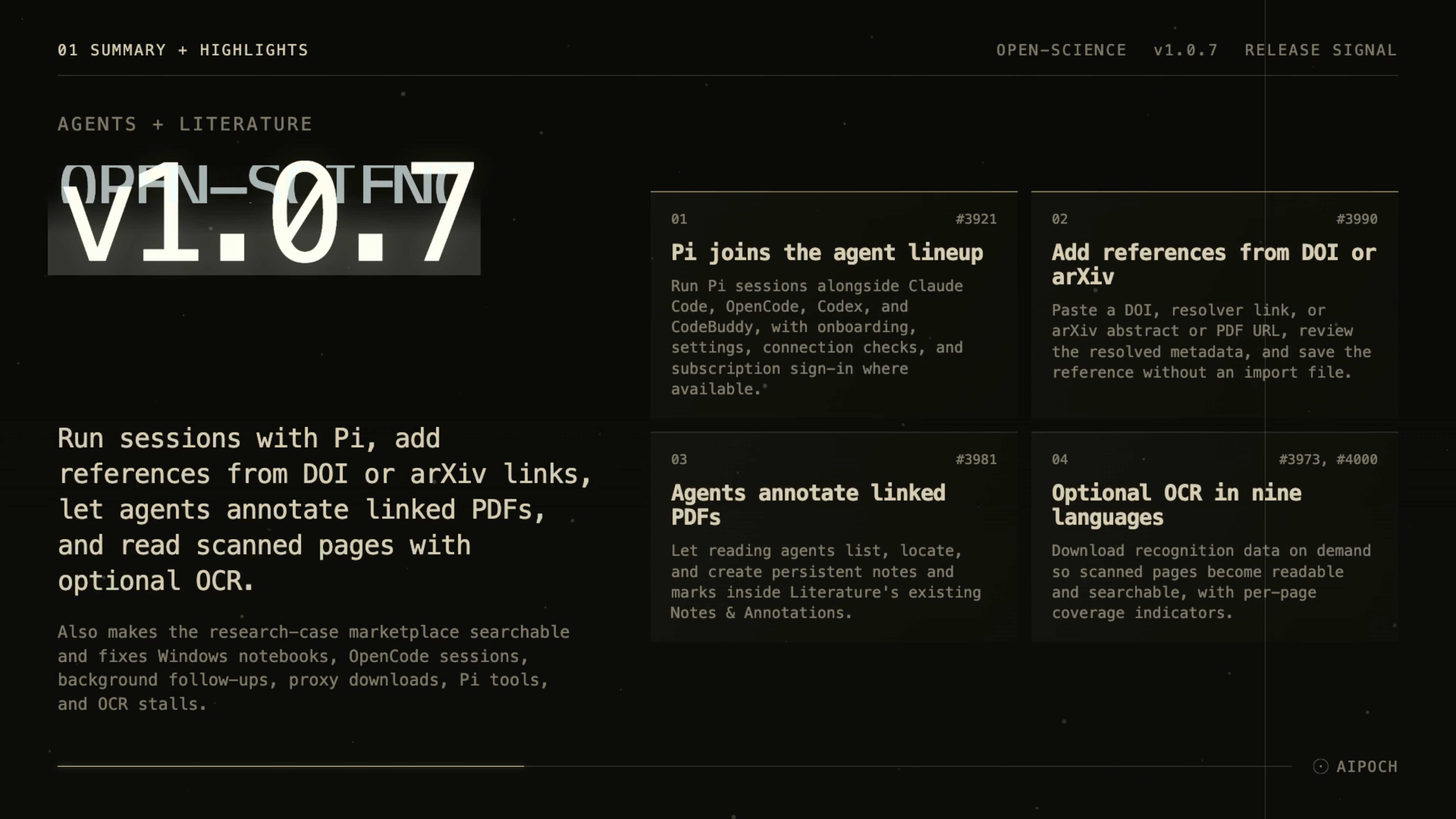
Version 1.0.7 adds Pi sessions, faster reference entry, agent-assisted PDF annotations, and optional OCR for scanned papers.
AIPOCH Open-Science, developed by AIPOCH, is a local-first AI research workbench. Its .science packages can carry selected conversation branches, file versions, Notebook records, and verification evidence for review and handoff; imported sessions remain read-only. The v1.0.7 GitHub release, published November 2, 2026, is the source for the version-specific changes below.
What new capabilities help researchers in AIPOCH Open-Science v1.0.7?
AIPOCH Open-Science v1.0.7 gives researchers more choices for agent sessions and more direct ways to work with literature inside a project: Pi joins the available frameworks, DOI and arXiv links can start references, reading agents can save PDF annotations, and optional OCR can make scanned pages searchable after language data is downloaded.
The AIPOCH Open-Science v1.0.7 release notes (2026) list Pi as the fifth supported agent framework. The same release notes (2026) mark reference entry, PDF annotations, and optional nine-language OCR as implemented capabilities.
Pi agent framework
Researchers who use different agent backends can select Pi alongside Claude Code, OpenCode, Codex, and CodeBuddy in v1.0.7. The release includes Pi onboarding, settings, connection validation, and subscription sign-in where available. Provider choice still depends on the active framework's endpoint compatibility; Pi support is not a unified model gateway. See the v1.0.7 release.
References from DOI and arXiv links
Bibliography import no longer requires preparing a file for each new paper. In the literature library, choose Add from DOI or link, paste a bare DOI, DOI resolver link, or arXiv abstract or PDF URL, review the resolved metadata, and save the reference. External metadata availability still depends on the source. See the v1.0.7 release.
Agent-assisted PDF notes and marks
In v1.0.7, reading agents can list, locate, and create notes and marks on linked PDFs in the existing Notes & Annotations workflow. A researcher can ask an agent to mark a passage and explain its relevance, then inspect the saved annotation. Annotations remain bound to the file version and do not sync across machines. See the v1.0.7 release.
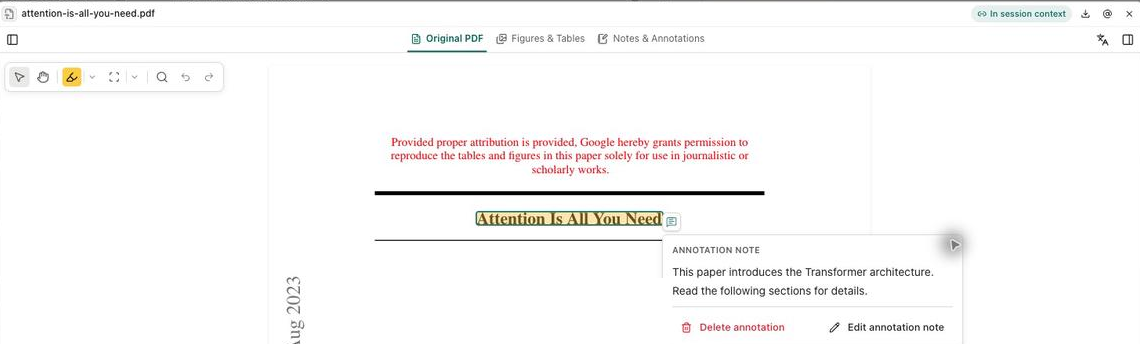
The first supplied product screenshot shows a PDF highlight and its note popup. It illustrates the interface and does not establish that an agent created the annotation.
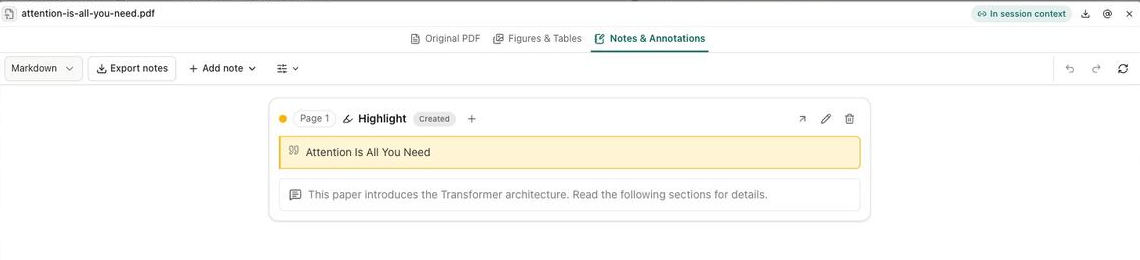
The second supplied product screenshot shows the corresponding saved entry in Notes & Annotations.
Optional OCR for scanned PDFs
Scanned pages can gain searchable text in literature reading after the matching OCR recognition pack is downloaded. Version 1.0.7 offers nine language packs: English, Simplified and Traditional Chinese, German, Spanish, French, Japanese, Korean, and Russian. Per-page indicators show remaining text coverage. OCR is on demand, and ordinary PDF reading has a deadline if an OCR download stalls. See the v1.0.7 release.
What else is new in v1.0.7?
AIPOCH Open-Science v1.0.7 makes research cases easier to find and several workspace states easier to interpret, with searchable case browsing, more specific connector descriptions, consolidated failure notices, and clearer artifact version relationships; these changes help researchers locate a case or understand a recovery step without changing the scientific validity of the underlying work.
The v1.0.7 release notes (2026) place the searchable research-case marketplace under new features. The same release notes (2026) list per-connector descriptions, unified composer failure notices, and clearer latest-published artifact version relationships as improvements.
Which bug fixes affect daily use?
AIPOCH Open-Science v1.0.7 fixes several interruptions in everyday work, including first-use PowerShell preparation in Windows notebooks, OpenCode compaction handling, follow-up questions during background work, and full-text downloads behind certain proxies; Pi tool display and stalled OCR downloads also receive targeted fixes, which should be assessed in each researcher's actual environment.
The v1.0.7 release notes (2026) say Windows notebooks again prepare PowerShell before first use and OpenCode sessions no longer terminate on certain compaction messages. The same release notes (2026) describe a proxy-resolution fix for full-text downloads on Fake-IP DNS hosts.
- Windows Notebook startup: A fresh backend again prepares its shell runtime before first PowerShell use.
- OpenCode session continuity: Certain nonstandard identities in compaction streams no longer terminate the session.
- Follow-up questions: A new run is retained while a background task settles.
- Full-text downloads: Configured proxy resolution handles hosts whose local Fake-IP answers are placeholders.
- OCR and Pi activity: Stalled OCR downloads no longer block ordinary PDF reads past the deadline, and Pi tool activity uses the shared presentation.
How can readers install or update AIPOCH Open-Science?
Researchers can install AIPOCH Open-Science v1.0.7 by selecting the desktop asset for their operating system and processor from the official release, while existing desktop installations can use the in-place updater; the release lists macOS, Windows, and Linux packages and also documents command-line routes for environments that need a standalone CLI.
The v1.0.7 release notes and assets (2026) list macOS ARM64 and x64 DMGs, a Windows x64 installer, and Linux x64 and ARM64 packages. The official download page (verified 2026) is another first-party entry point; choose the asset matching the machine and check the release page before updating.
Where can readers verify the release and learn more?
The AIPOCH Open-Science v1.0.7 GitHub release is the primary record for shipped changes, download choices, and stated limits, while the product page, .science guide, and earlier AIPOCH articles provide wider workflow context; the two supplied product screenshots illustrate annotation screens but do not prove how an annotation was created or replace hands-on testing.
The v1.0.7 GitHub release (2026) identifies implemented features separately from partial work and roadmap items. The AIPOCH .science package guide (verified 2026) explains export selection, read-only import, and handoff limits.
- AIPOCH Open-Science product overview
- AIPOCH home
- AIPOCH Open-Science v1.0.0: downloads and upgrade notes
- AIPOCH Open-Science 1.0 launch article
What questions do readers ask about v1.0.7?
For AIPOCH Open-Science v1.0.7, researchers should distinguish what the release ships from what a screenshot or a generated result proves: PDF notes can be inspected in the project, OCR requires downloaded language data, Pi depends on compatible provider endpoints, and a .science import remains a read-only record rather than a rerun.
The v1.0.7 release notes (2026) confirm that reading agents can create notes and marks on linked PDFs. The same release notes (2026) state that OCR data is downloaded on demand and that annotations do not sync across machines.
Can a reading agent save a PDF annotation in v1.0.7?
Yes. In AIPOCH Open-Science v1.0.7, a reading agent can locate a passage and create a note or mark on a linked PDF. Review the saved annotation yourself; the screenshot shows the interface, not how the annotation was created.
Does v1.0.7 OCR work without a language download?
No. AIPOCH Open-Science v1.0.7 downloads recognition data on demand. Scanned text becomes available after the matching language pack is present, and page-level coverage indicators show where text is still missing.
Does Pi work with every model endpoint?
No. Pi is supported as an agent framework in AIPOCH Open-Science v1.0.7, but provider choices remain constrained by the framework's endpoint compatibility. Check connection validation and available sign-in methods for the selected configuration.
Can a .science import execute the sender's work?
No. Imported .science sessions are read-only records. A receiving researcher can inspect the included branches, selected files, Notebook records, and verification evidence, then create a separate writable continuation where supported. The import does not execute code, restore credentials, or prove that the recipient repeated the sender's checks.
What limitations and responsibilities apply?
AIPOCH Open-Science v1.0.7 can assist with reference entry, PDF annotation, and supported agent workflows, but researchers remain responsible for checking source quality, methods, inputs, outputs, and interpretation; a saved note, OCR transcript, replay record, or agent response is inspectable research material and does not replace scientific judgment, independent validation, or peer review.
The v1.0.7 release notes (2026) say PDF annotations follow their file version and do not sync across machines. The AIPOCH .science package guide (verified 2026) says import is read-only and neither executes code nor restores credentials.