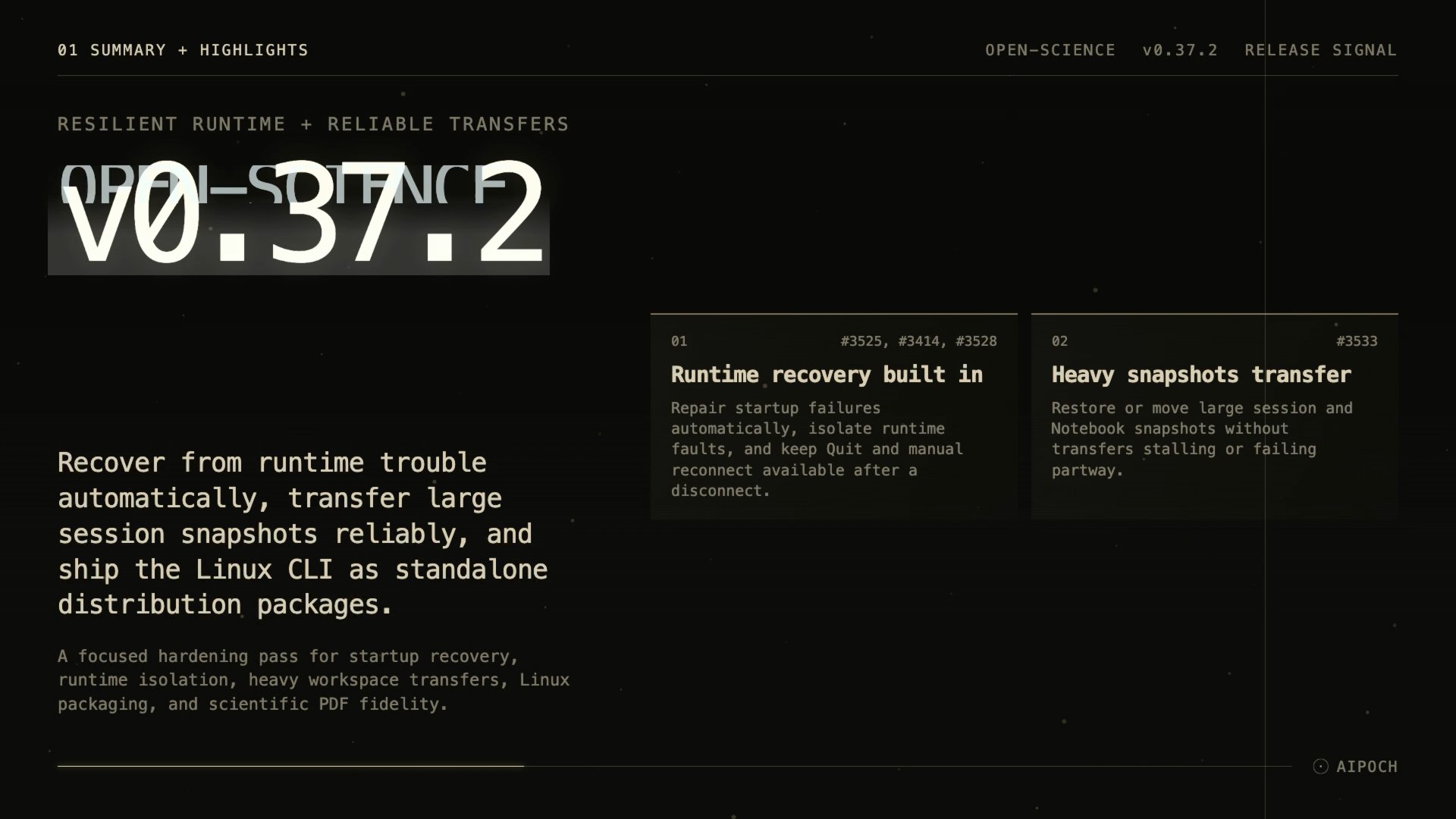
AIPOCH Open-Science v0.37.2 improves startup recovery, runtime reconnection, and large snapshot transfers, adds Linux CLI packages, and fixes scientific PDF extraction.
AIPOCH Open-Science is an open-source, local-first, model-agnostic, self-hosted AI research workbench for reproducible scientific discovery, developed by AIPOCH. Its existing .science research packages carry selected conversation branches, file versions, Notebook records, and verification evidence for review, handoff, and archiving in another project or computer.
Published on October 13, 2026, this patch follows v0.37.1. The changes below are based on the official v0.37.2 release notes, with operating boundaries checked against the version-specific documentation. The Open-Science repository provides the source code.
What new capabilities help researchers recover and continue in v0.37.2?
AIPOCH Open-Science v0.37.2 adds recovery paths for startup and connection failures, more reliable large-snapshot transfers, and standalone Linux CLI installers. These changes address interruptions in an existing research workflow.
Startup Recovery and Runtime Reconnection
An interrupted connection can leave a researcher unsure whether a task stopped or only its interface disconnected. In v0.37.2, startup recovery handles backend, settings, and network initialization failures, while runtime failure isolation helps keep the app responsive. When the desktop loses its runtime connection, the workbench stays open and offers Reconnect and Quit app.
Reconnect restores access to the original backend when it is still running. It does not restart a stopped backend or automatically repeat submitted operations. If a response was lost, inspect the original task's state before submitting the same work again. The v0.37.2 recovery guidance explains this distinction.
More Reliable Large Snapshot Transfers
Large session and Notebook snapshots could previously stall or fail during transfer. AIPOCH Open-Science v0.37.2 fixes this transfer path, helping researchers restore or move substantial workspace records without the failures described in the release notes.
This is a transport reliability improvement. Receiving a record does not mean its calculations have run again. For research handoff, .science packages remain inspectable, read-only imports: importing does not execute code or restore credentials. Included files depend on export selection; Side Chat conversations and private reading bookmarks are excluded. Received verification records describe the sender's checks, not checks rerun on the receiving computer.
Standalone Linux CLI Packages
Researchers who prefer a terminal and local browser interface can now install the v0.37.2 CLI using standalone .deb or .rpm packages for x64 and ARM64. The packages include Node, the backend, and the local Web UI, so a separate Node.js installation is not required. They join the existing standalone archives and package-manager distribution options.
Choose the CLI package for a terminal/browser installation, or the desktop package for the desktop application. The Linux CLI packages use the explicit command open-science-cli and do not start a system service automatically. Model access and the scientific runtimes needed for a task still require setup; see the official installation guide.
What else is new in v0.37.2?
AIPOCH Open-Science v0.37.2 also improves the browser interface under heavy agent activity, localizes help access, and reduces diagnostic-log growth. The release notes identify three changes:
- A more responsive web interface: a shared send queue bounds event bursts, and runtime event batches are limited by encoded size. This addresses interface load during busy agent activity; it is not a claim of faster scientific computation.
- Localized help: Help Center links and Settings search follow the interface language, making the relevant documentation easier to reach.
- Smaller diagnostic folders: redirected backend logs are compacted to reduce accumulated log volume.
Bug fixes that affect daily use
AIPOCH Open-Science v0.37.2 repairs PDF extraction, evidence handling, literature state, provider settings, and several interface problems. The following fixes are listed in the official release:
- Scientific PDF structure: figure and table ownership stays with the correct element in more layouts. Compare extracted objects with the source PDF before using them in analysis or citations.
- Notebook evidence: dependency and file-lineage analysis is hardened against misleading evidence. First-run preparation also shows the code being received; visible code is not evidence that execution has completed.
- Provider settings: compression and retry behavior configured in Settings is published correctly again.
- Literature records: metadata commits with conflicting identities are rejected, and literature state is preserved across asynchronous operations.
- Remote compute: job recovery evidence survives cancellation and cleanup on compute hosts. Retained evidence does not itself resume a cancelled job.
- Species metadata: the Bgee species metadata fix corrects information used by the connector.
- Attachment errors: agent prompt errors identify empty image attachments more clearly.
- Startup and Windows interface: web startup loading is unified, recovery dialogs wait for startup to settle, and background Windows subprocesses no longer flash console windows.
Install or update
AIPOCH Open-Science v0.37.2 supports macOS 12 or later on Apple Silicon or Intel, Linux x64 or ARM64, and Windows 10/11 x64. Get the matching installer from the official v0.37.2 release assets.
| Installation | v0.37.2 package choice |
|---|---|
| macOS desktop | ARM64 or x64 DMG |
| Linux desktop | x64 or ARM64 AppImage or Debian package |
| Windows desktop | x64 installer |
| Linux standalone CLI | x64 or ARM64 .deb or .rpm package |
| Standalone CLI archives | macOS/Linux ARM64 or x64 archive; Windows x64 ZIP |
Existing desktop installations can update in place. For a new installation, the onboarding wizard checks the environment and can configure an app-managed agent runtime. For Linux CLI upgrades, stop all profiles using that package before updating, and retain the research data and credential store as described in the installation and upgrade guide.
Start with the AIPOCH Open-Science product overview, then download the package that matches how you intend to work.
Resources
Use these official sources for the release details, installation choices, and related research workflows:
- AIPOCH Open-Science v0.37.2 release notes and downloads
- AIPOCH Open-Science product overview
- AIPOCH
- AIPOCH Open-Science v0.37.1: Faithful PDFs, Stronger Windows
- AIPOCH Open-Science .science research handoff guide
- Extract PDF figures and tables with AIPOCH Open-Science
FAQ
What changes in AIPOCH Open-Science v0.37.2?
AIPOCH Open-Science v0.37.2 improves startup recovery, runtime reconnection, and large session and Notebook snapshot transfers. It adds standalone Linux .deb and .rpm CLI packages and fixes PDF extraction, literature state, Notebook evidence handling, and other daily-use issues.
Does Reconnect restart a stopped backend or rerun a task?
No. In v0.37.2, Reconnect restores the connection to the original backend if it is still running; it does not restart a stopped backend or automatically repeat operations. Check the original task's state before retrying work whose response was lost, as described in the recovery documentation.
Does the Linux CLI need a separate Node.js installation?
The v0.37.2 standalone Linux CLI packages bundle Node, the backend, and the local Web UI, so they do not require a separate Node.js installation. Both x64 and ARM64 .deb and .rpm packages are available; model access and required scientific runtimes still need configuration. Follow the Linux CLI installation instructions.
Does v0.37.2 guarantee correct PDF extraction?
No. The v0.37.2 fix preserves figure and table ownership in more layouts, but extracted content remains a starting point for researcher review. Compare it with the original PDF using the figure and table extraction workflow.
Does importing a .science package rerun its verification checks?
No. A .science package carries selected research records and available verification evidence; its imported sessions are read-only and do not execute code or restore credentials. The received evidence describes the sender's checks and does not establish that the receiving computer repeated them.
Disclaimer
AIPOCH Open-Science assists researchers with research workflows and inspectable records but does not replace scientific judgment or peer review. Recovery controls, extracted figures and tables, Notebook outputs, and verification evidence require appropriate review of their source data, execution state, methods, and limitations. This release article does not report an independent performance test or validated scientific findings.