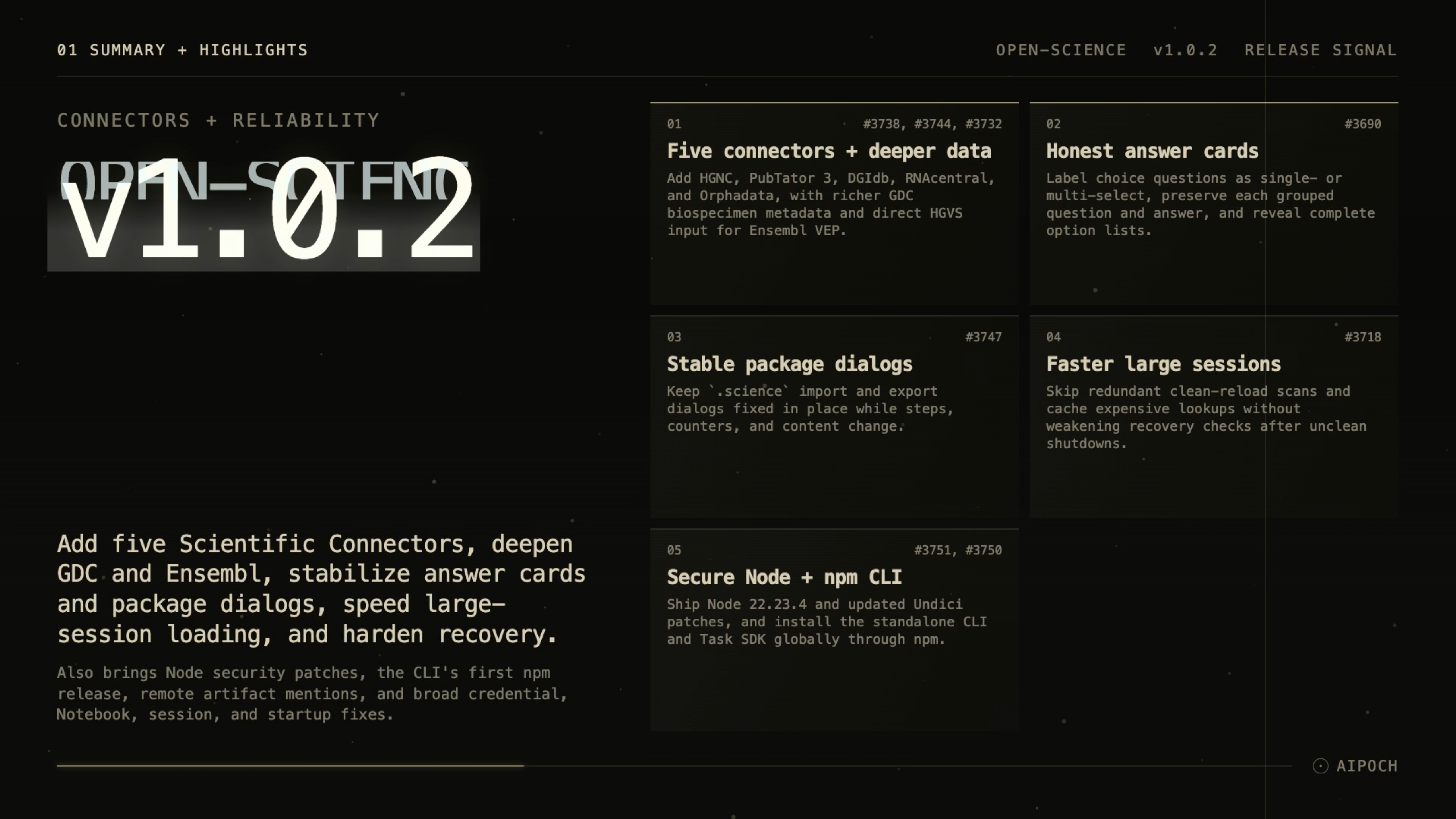
Version 1.0.2 adds five scientific data sources, steadier .science package handling, faster large-session loading, npm CLI access, and focused reliability fixes.
AIPOCH Open-Science is an open-source, local-first, model-agnostic, self-hosted AI research workbench for reproducible scientific discovery, developed by AIPOCH.
Released on October 22, 2026, v1.0.2 concentrates on two practical goals: giving researchers more direct paths into scientific data and reducing interruptions around sessions, credentials, documents, and startup recovery. The GitHub Release is the authoritative record for shipped changes and downloadable assets.
What new capabilities help researchers work with more scientific data and fewer interruptions?
AIPOCH Open-Science v1.0.2 adds five Scientific Connectors, improves two existing genomics paths, makes answer and package workflows clearer, and reduces work required to open large sessions or install the command-line tools.
Five new scientific data sources and deeper genomics queries
Researchers can now connect agents to HGNC gene nomenclature, PubTator 3 literature annotations, DGIdb drug-gene interactions, RNAcentral non-coding RNA records, and Orphadata rare-disease associations. Orphadata is disabled by default and can be enabled for Main or an individual Specialist when a workflow requires it.
The release also deepens two existing paths. GDC file and case searches can filter by case, sample type, and analysis workflow, while summaries retain linked sample, aliquot, and workflow metadata. Ensembl VEP now accepts HGVS notation directly, alongside variant IDs and genomic coordinates. Together, these changes reduce manual conversion and help prevent biospecimens from being collapsed under a single case-level summary.
Clearer answer cards
Choice questions now identify whether they expect a single selection or multiple selections. Grouped results preserve each question's full wording and answer, and an expanded historical answer shows its complete option list. That makes the interface easier to review before a researcher accepts or revisits a decision.
Steadier .science package workflows
The .science package dialog now keeps a stable position and size while import and export steps, counters, and status text change. Reliability fixes also prevent a retry after a partially committed import from creating a duplicate session, allow imported-session titles to be edited, deduplicate repeated evidence on disk, and preserve specific export diagnoses.
A .science package can carry selected conversation branches, file versions, Notebook records, and verification evidence for review, handoff, and archiving in another project or computer. Imported sessions remain read-only: they do not execute code or restore credentials. Side Chat conversations and private reading bookmarks are excluded, included files depend on the export selection, and received verification records describe the sender's checks rather than proving that the receiving computer reran them. A recipient can inspect the imported record and fork it into a new writable session when continuation is needed.
Faster loading for large sessions
On a clean reload, large projects can skip redundant consistency scans and reuse cached expensive lookups. Recovery checks still run after an unclean shutdown, so the speedup does not remove the checks intended for interrupted state.
CLI and Task SDK installation through npm
The standalone CLI and Task SDK are now available through the @aipoch/open-science npm package for environments running Node.js 22.13 or later. Desktop and standalone builds bundle Node.js 22.23.4 plus an updated Undici network library. This gives terminal users an npm path alongside Homebrew and downloadable standalone archives.
npm install --global @aipoch/open-science
open-science --help
What else is new in v1.0.2?
The release improves remote artifact references, context accounting, high-volume Skill imports, diagnostic feedback, and the safety of drafts and queued messages.
Remote web chat clients can now use @ mentions for artifacts, not only the local desktop app. Codex subscription sessions also apply the model's actual context-window capacity, so the displayed usage reflects the active model rather than a larger default.
Screenshot: actual product interface from an inspected build; values reflect one captured run.
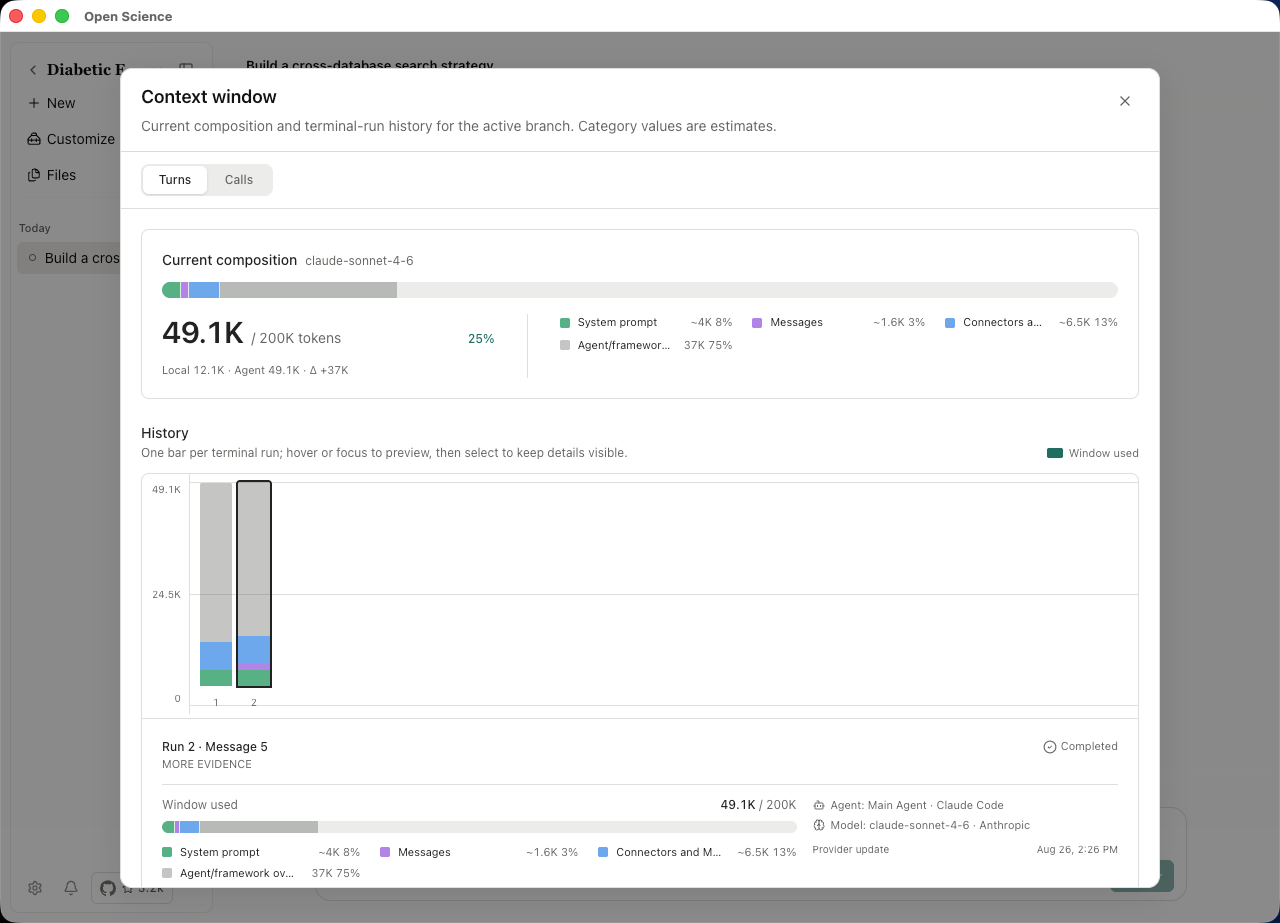
Local version, help, and paths commands report the installed version, command guidance, and configuration locations without requiring a running service. Skill imports with 257 or more selections are submitted in batches, and imported Skills with reserved name prefixes receive safe local names instead of disappearing from the catalog.
Draft and queue behavior is more protective. Connector and Compute settings no longer lose unsaved entries to stale completions; queued-message failures stay visible with an undo action; and the app warns before quitting or reloading with unsent messages. Switching conversations while another message is still sending no longer pulls the view back to the sending conversation.
Screenshot: actual product interface from an inspected build; values reflect one captured run.
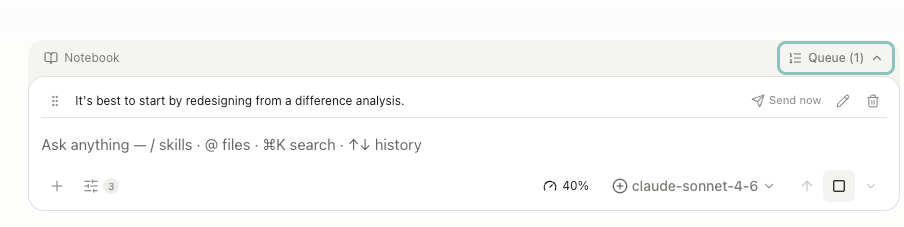
Folder-drop and folder-access feedback is also clearer. Dropping a folder into the composer prompts the user to select files inside it, while translated folder-access errors retain their specific message and keep actions visible. Diagnostic export results remain in a fixed area, and partial exports are labeled as warnings.
Bug fixes that affect daily use
The most visible fixes restore clearer recovery paths, more faithful document reading, and steadier session and Notebook state.
- Credential recovery: Expired or invalid model and connector credentials now show a specific recovery path instead of a raw authentication error. The composer is disabled only while recovery is required, which protects drafts and in-flight replies.
Screenshot: actual product interface from an inspected build; values reflect one captured run.
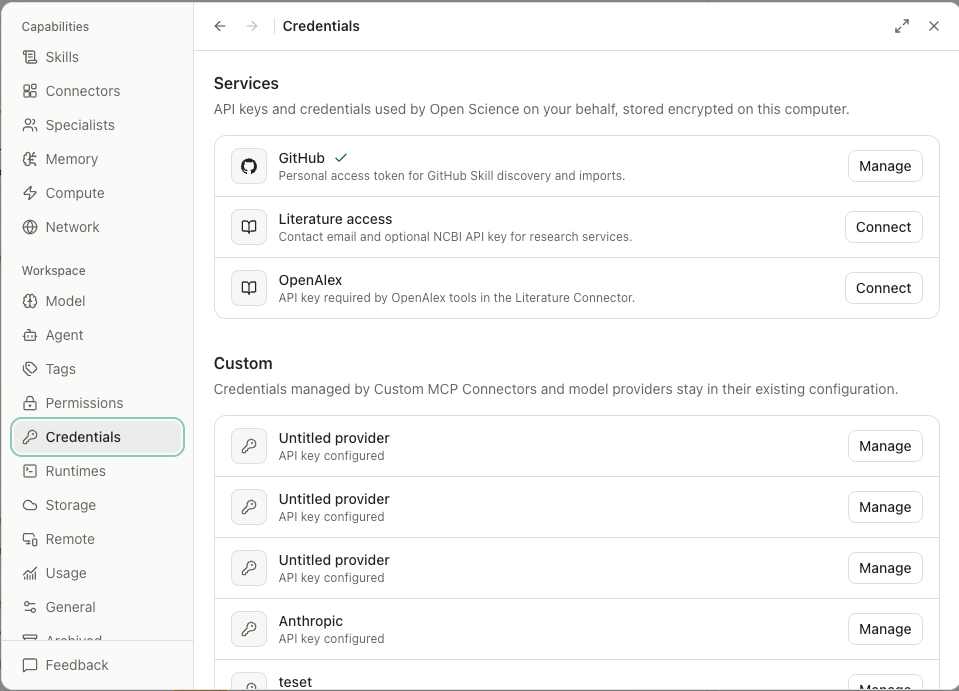
- Questions and the composer: Failed durable questions and stale pending questions from completed turns no longer leave the composer hidden behind an obsolete card.
- Literature collections: Deleting a collection is no longer blocked when a child collection shares its name.
- DOCX reading: Numbered lists keep their counters across a document, and table borders render more consistently with desktop editors.
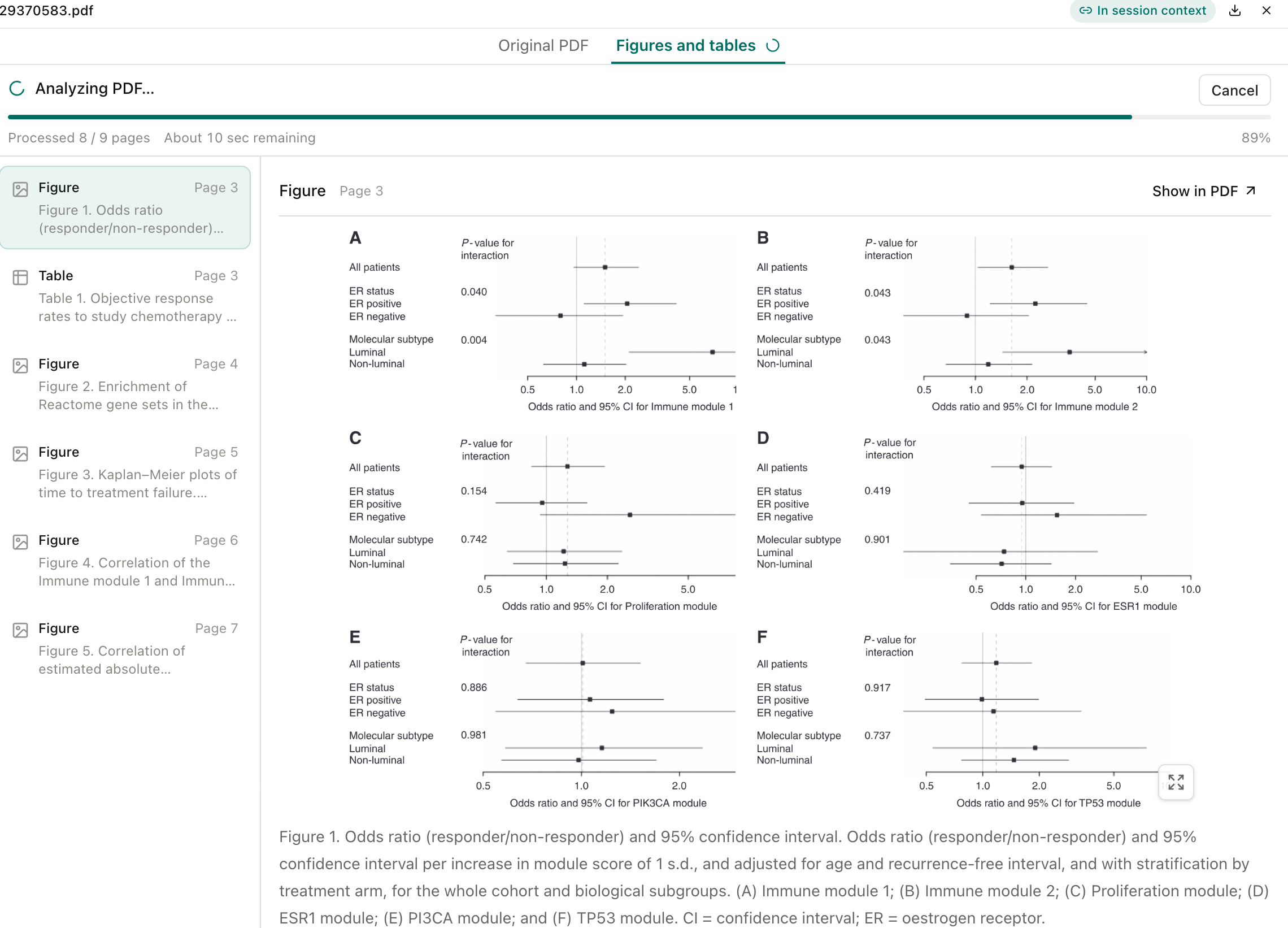
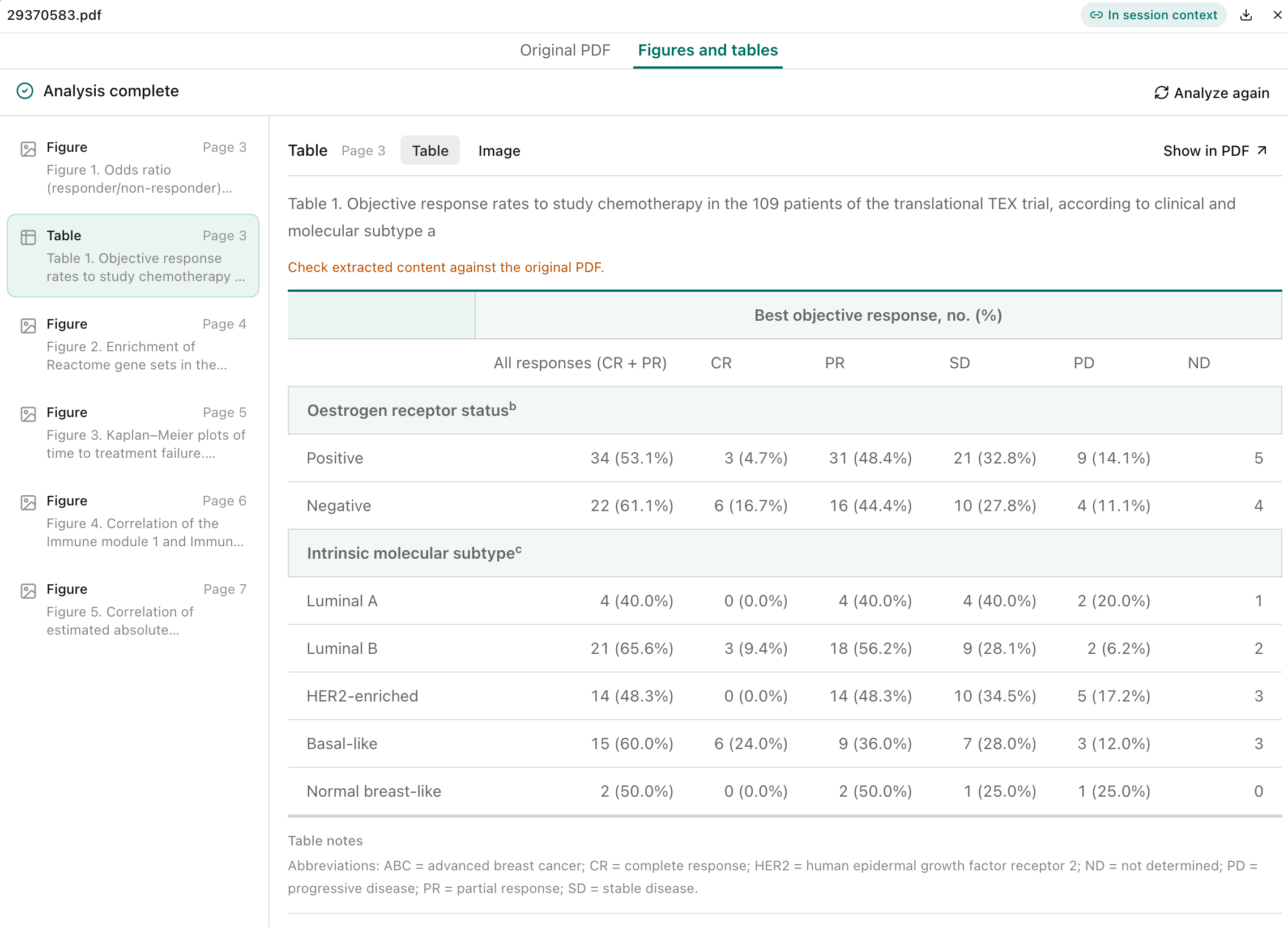
- PDF reading: Figure crops, captions, and table structure are preserved more faithfully, while Reader-mode classification and layout are more accurate for complex scientific PDFs.
Screenshots: actual product outputs from inspected runs; the source PDFs and extraction results vary by document.
- Notebook lineage: Dependency and file-lineage records are more accurate across chained CSV reads, transformations, and exports in Python and R analysis cells.
- Artifacts and models: A committed large artifact is no longer reported as failed after a finalization timeout, and the built-in MiniMax M3.1 connector works through Codex.
- Startup and shutdown: Diagnostics retain the original Codex initialization error; connection loss during quit no longer stalls shutdown; recovered sessions can resume after storage migration; harmless partial SQLite journal files no longer block launch; and Windows network-sandbox permission cleanup preserves recoverable state.
Install or update
Most users should install or update from the v1.0.2 GitHub Release and verify that the selected asset matches the operating system and CPU architecture.
| Platform | v1.0.2 desktop package |
|---|---|
| macOS 12+ | DMG for Apple Silicon or Intel; Homebrew cask is also available |
| Windows 10/11 | Code-signed x64 installer |
| Linux | AppImage or Debian package for x64 or ARM64 |
For macOS desktop installation through Homebrew:
brew install --cask open-science
For the standalone CLI through the official tap:
brew install aipoch/tap/open-science
open-science start --no-open
open-science url
For npm, install with Node.js 22.13 or later:
npm install --global @aipoch/open-science
open-science --help
Standalone CLI archives are also available for macOS, Linux, and Windows. See the installation and update guide for package names, checksum guidance, CLI setup, and platform-specific steps.
Resources
- AIPOCH Open-Science v1.0.2 release and assets
- AIPOCH Open-Science product page
- AIPOCH home page
.sciencepackage guide- AIPOCH Open-Science v1.0.0 release overview
- AIPOCH launches Open-Science v1.0
- Per-agent resource access controls in AIPOCH Open-Science
FAQ
What is the main change in AIPOCH Open-Science v1.0.2?
The release adds five Scientific Connectors and focuses on reliability. It also deepens GDC and Ensembl VEP queries, clarifies answer cards, stabilizes .science package flows, speeds large-session loading, and adds npm installation for the CLI and Task SDK.
Which scientific data sources were added?
The five additions are HGNC, PubTator 3, DGIdb, RNAcentral, and Orphadata. Orphadata is disabled by default and can be enabled only where it is needed.
Does importing a .science package run code or transfer credentials?
No. An imported .science session is read-only, does not execute code, and does not restore credentials or permission grants. It can be inspected and then forked into a writable continuation, where any new execution requires the receiving environment's own setup and approvals.
Can I install AIPOCH Open-Science v1.0.2 from npm?
Yes, for command-line use. With Node.js 22.13 or later, run npm install --global @aipoch/open-science. Desktop installers, Homebrew options, Linux packages, and standalone CLI archives remain available.
Does faster session loading skip recovery checks?
No. Clean reloads avoid redundant scans and reuse cached lookups, while sessions opened after an unclean shutdown still run recovery checks.
Disclaimer
AIPOCH Open-Science supports research workflows but does not replace scientific judgment, domain review, citation checking, statistical validation, or regulatory requirements. Connector results, extracted document content, model outputs, and transferred verification records should be checked against primary sources and the receiving environment before they inform research or clinical decisions.