AIPOCH Open-Science v0.29.0: Carry Research Sessions Between Machines
AIPOCH Open-Science v0.29.0 adds portable research sessions, a verified Skills marketplace, local PDF extraction, external R installs, and faster startup.
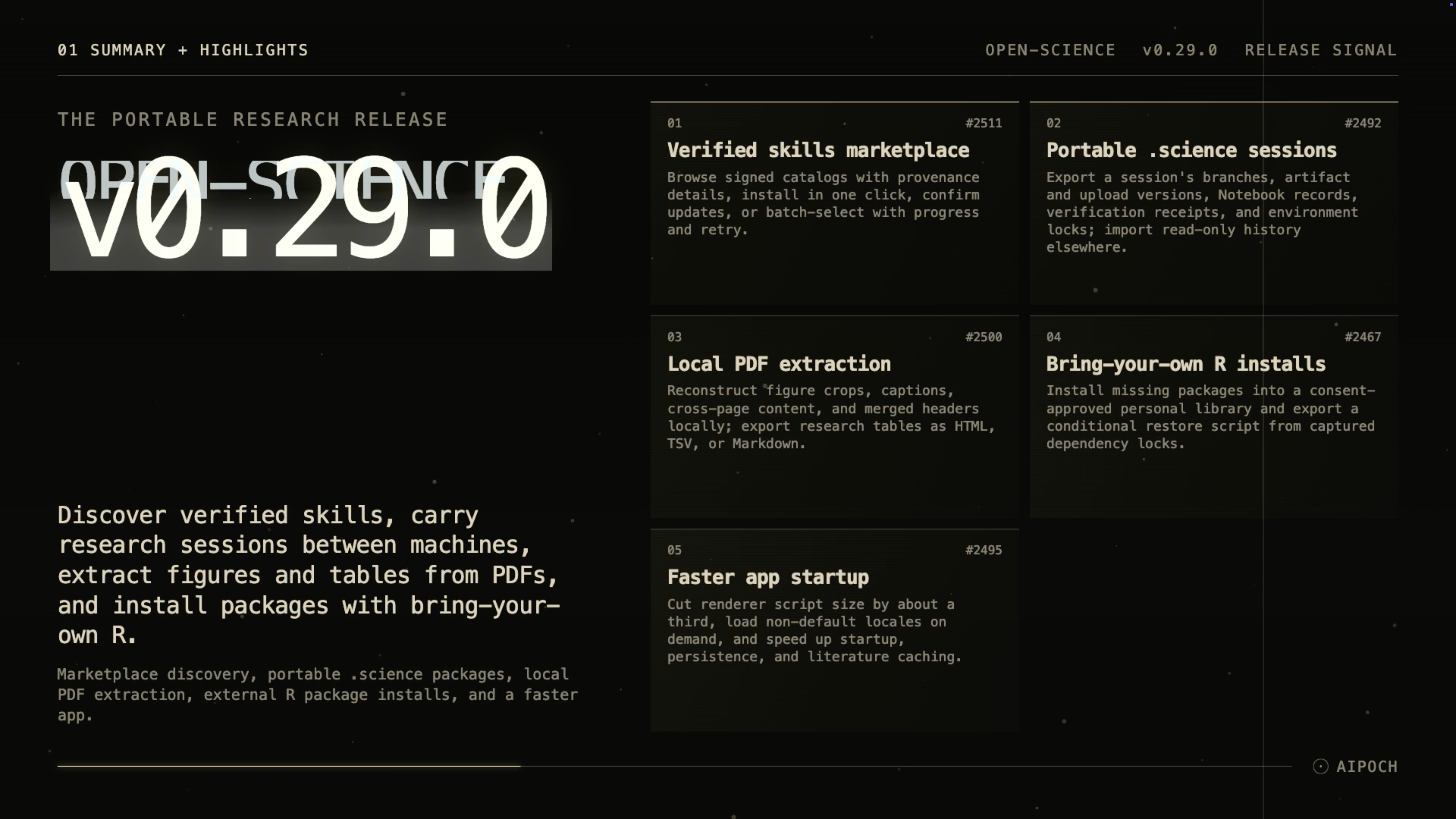
AIPOCH Open-Science v0.29.0 adds portable research sessions, a verified Skills marketplace, local PDF extraction, external R package installs, and faster startup.
AIPOCH Open-Science is an open-source, local-first, model-agnostic, self-hosted AI research workbench for reproducible scientific discovery, developed by AIPOCH.
What new capabilities help researchers move and extend their work?
The v0.29.0 release makes research sessions portable, Skills easier to discover and install, PDF figures and tables available through a local extraction workflow, and external R environments more practical to maintain. Each capability keeps review, consent, and provenance boundaries explicit.
Carry a research session between projects or machines
Research context is difficult to transfer when conversation branches, uploaded inputs, generated artifacts, Notebook records, environment evidence, and verification results are stored separately. AIPOCH Open-Science v0.29.0 can export a session as a self-contained .science research package that keeps those materials together.
The essential export is the default, while a full export and deeper content controls are optional. Packages can include conversation branches, artifact and upload versions, Notebook records, verification receipts, and environment locks. Import can begin from a Project menu, by dropping a package into the application, or by opening the file directly.
Before importing, the researcher receives a preview and confirmation step. Progress can be cancelled, and cleanup failures are retryable. Imported sessions remain inspectable and referenceable, but their history is read-only: execution and continuation are disabled, imported activity is excluded from local usage totals, and source verification records remain identified as assertions from the source package.
The result is a portable research record rather than a promise that every external dependency or service will behave identically on another machine. Researchers still need to inspect the transferred evidence, confirm the destination environment, and independently review any outputs they reuse.
Discover and install Skills from verified marketplace catalogs
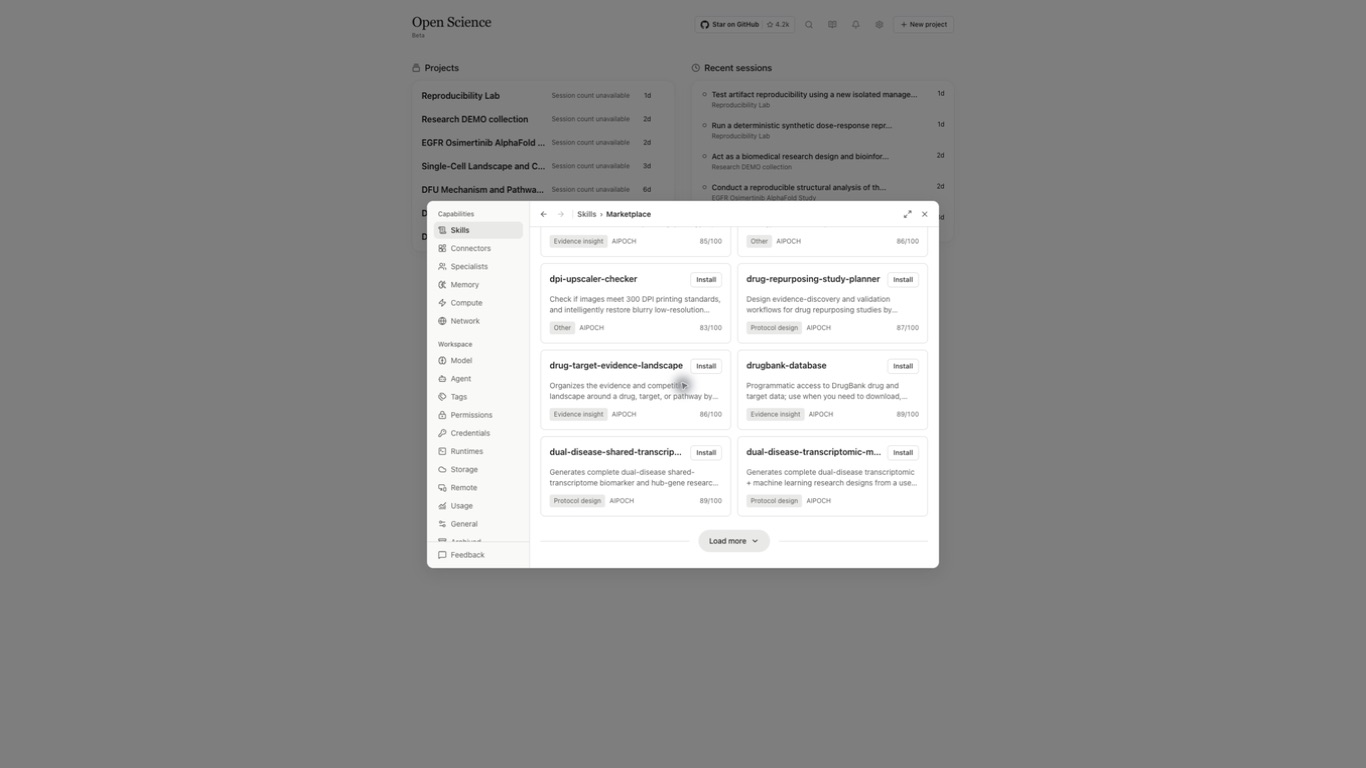
Finding a reusable method is more useful when its source and package evidence remain visible. The v0.29.0 Skills marketplace reads verified signed catalogs and immutable snapshots, preferring the official CDN so successful browsing and downloads do not require GitHub credentials.
Compact marketplace cards can show category, author, optional score, publisher, upstream provenance, and license evidence. Researchers can inspect a Skill, install it from the card, explicitly confirm version updates, and manage enablement or uninstallation from a consistent detail area.
Screenshot: actual AIPOCH Open-Science v0.29.0 product interface.
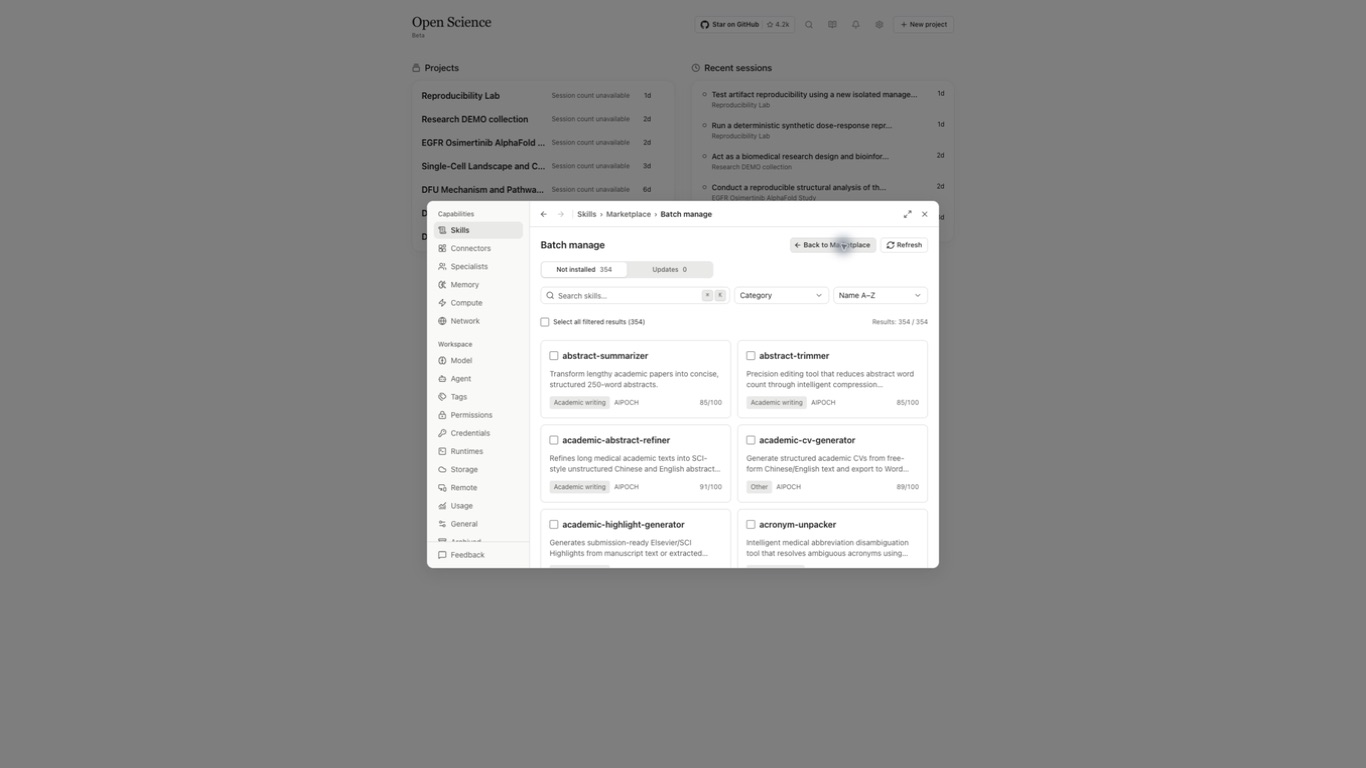
A separate batch route selects Skills that match a filter, presents them for review, and installs them sequentially. Researchers can stop after the current installation and retry failures. Catalog verification establishes package and source evidence; it does not establish that a Skill is scientifically appropriate for a particular dataset, method, or research question.
Screenshot: actual AIPOCH Open-Science v0.29.0 product interface.
Extract figures and research tables from PDFs locally
Scientific PDFs often store useful figures, captions, and tables as page geometry rather than reusable structured data. AIPOCH Open-Science v0.29.0 adds an optional local figures-and-tables workflow that runs analysis in an isolated process.
The workflow can reconstruct figure crops, captions, cross-page content, table groups, merged headers, source text, and footnotes using shared geometry and evidence rules. Research tables can be exported as HTML, TSV, or Markdown, while unresolved text and review warnings remain visible instead of being silently removed from the export.
Required model resources are installed with integrity checks and cancellation controls. Cached results can reopen without repeating the analysis. Extracted structures remain material for researcher review, especially when a PDF contains unusual layouts, scanned content, merged cells, or ambiguous labels.
Install missing packages into a bring-your-own R library
External R runtimes become more useful when researchers can add missing packages without giving the application unrestricted control over the installation. In v0.29.0, package installation requires explicit, revocable consent for an existing personal R library.
Open-Science checks the interpreter and library, then scopes sandbox writes to the selected library. Captured external R renv locks and hash-pinned Python requirements can be retained as conditional evidence. A user-invoked restore script checks exact prerequisites and checksums before restoring packages into a destination the researcher owns.
This is a consent-controlled package workflow, not an assurance that a restored environment will reproduce a scientific result. Researchers remain responsible for repository trust, package versions, system dependencies, licenses, statistical methods, and output review.
Start and navigate the application faster
Version 0.29.0 reduces the renderer script graph by roughly one-third and loads non-default locales only when needed. It also tightens session lookups, persistence cleanup, literature cache expiry, and related startup paths.
These changes shorten the path into an existing project without changing the underlying research record. The release describes measurable improvements to startup, persistence, and literature caching, while actual timing will still depend on the machine, stored projects, enabled capabilities, and local environment.
What else is new in v0.29.0?
The release also expands connector administration, public literature lookups, headless operation, model choice, update recovery, and workspace consistency.
- Bulk connector management: Settings can enable or disable multiple connectors in one operation.
- Connector validation and literature lookups: bundled tool examples are checked against registered methods, Rfam sequence search uses the official batch endpoint, and public methods add Crossref work and update lookups plus DataCite searches for reusable datasets and software.
- More headless controls: the CLI can list runtimes, bootstrap a Codex first run, initialize terminal profiles, and report readiness as JSON. On Debian, the command-line tool installs with the application.
- Additional model and runtime choices: Kimi K2.8 joins the coding-model options, and the managed R runtime baseline expands.
- Provider and terminal reliability: Codex terminal provider errors reach task runs, Codex subscriptions work in workspace side chats, and the required OpenCode Go session header is sent.
- Update and workspace recovery: a previously refused update can still be applied later, unavailable provider sessions can be deleted, and confirmation and recovery surfaces follow more consistent contracts.
- Windows interaction fixes: cancelled mutation retries are restored, and alternate zoom-in shortcut aliases are supported.
Install or update
AIPOCH Open-Science v0.29.0 supports macOS 12 or later on Apple Silicon or Intel, Linux x64, and Windows 10/11 x64. Download the appropriate DMG, AppImage, Debian package, or Windows installer from the official v0.29.0 release page. Existing installations can update in place where the platform supports it.
Official macOS builds are Developer ID signed and notarized. Windows builds remain unsigned, so SmartScreen may display an “unrecognized app” warning on first launch; confirm that the installer came from the official release page before continuing.
Resources
- AIPOCH Open-Science v0.29.0 release notes and downloads
- AIPOCH Open-Science product page
- AIPOCH Open-Science source repository
- AIPOCH
- How AIPOCH Open-Science Extends a Research Agent
- How AIPOCH Open-Science Tracks Results with Artifact Provenance
- How AIPOCH Open-Science Reads Multiple PDFs and Links Evidence Back to the Source
- How AIPOCH Open-Science Runs Python, R, REPL, and Shell Code
FAQ
What is an AIPOCH Open-Science .science file?
A .science file is a portable session package introduced in v0.29.0. It can carry conversation branches, artifact and upload versions, Notebook records, verification receipts, and environment locks into another project or machine.
Can an imported .science session continue running?
No. Imported session history is inspectable and referenceable but read-only, with execution and continuation disabled. Source verification records remain marked as source assertions rather than being presented as locally repeated checks.
Does local PDF extraction replace checking the original paper?
No. The workflow can reconstruct figures, captions, table groups, merged headers, and related source text, then export tables as HTML, TSV, or Markdown. Unresolved text and warnings remain for researcher review, and the original PDF should still be checked before using an extracted result.
Can AIPOCH Open-Science install packages into an external R runtime?
Yes. Version 0.29.0 can install missing packages into a consent-approved personal R library after validating the interpreter and library. Consent is revocable, and the conditional restore script checks prerequisites and checksums before writing to a researcher-owned destination.
Which operating systems support AIPOCH Open-Science v0.29.0?
The release provides packages for macOS 12 or later on Apple Silicon and Intel, Linux x64, and Windows 10 or 11 x64. Official macOS builds are signed and notarized, while Windows installers remain unsigned.
Disclaimer
This article is intended for informational purposes only and does not constitute medical advice, clinical guidance, diagnostic recommendations, treatment decisions, or validated scientific conclusions.
AIPOCH Open-Science is a research workflow tool. It does not replace scientific judgment or peer review, and researchers remain fully responsible for evaluating the accuracy, completeness, and appropriateness of generated or extracted outputs. All outputs require independent verification and expert interpretation before use in any research context.
References and external links in this article are provided for informational purposes. AIPOCH does not endorse and is not responsible for the content of third-party sources.